
1949 Founding of Communist China Explained Clearly
The founding of Communist China marked a monumental shift in global history. It was the culmination of decades of civil war and revolution that reshaped Asia’s largest nation. This event established the People’s Republic of China under the leadership of Mao Zedong and the Chinese Communist Party.
Understanding this pivotal moment requires examining the complex factors that led to the Communist victory. You will learn about the key events, figures, and ideologies that defined this transformation. The consequences of 1949 continue to influence international relations and politics today.
Simply put, the founding of Communist China occurred on October 1, 1949, when Mao Zedong proclaimed the establishment of the People’s Republic of China. This followed the Communist Party’s decisive victory over the Nationalist government in the Chinese Civil War.
Key Takeaways
- The founding of Communist China in 1949 concluded a bloody civil war between the Chinese Communist Party (CCP) and the Nationalist Party (Kuomintang or KMT).
- Mao Zedong emerged as the paramount leader, declaring a new era of “the people” from Beijing’s Tiananmen Square.
- The victory was secured through effective rural mobilization, superior strategy, and widespread public disillusionment with the Nationalist government.
- The establishment of the PRC led to the relocation of the Nationalist government to Taiwan, creating a political division that persists to this day.
- This event fundamentally altered the Cold War dynamic, adding a major new communist power to the global stage.
What Were the Main Causes of the Chinese Civil War?
The Chinese Civil War was not a sudden event but the result of long-simmering tensions. Its roots trace back to the early 20th century and the collapse of the Qing dynasty. The initial alliance between the KMT and CCP against warlords and foreign influence quickly fell apart.
Several core issues fueled the conflict between the two parties. Their visions for China’s future were fundamentally incompatible. The failure of the First United Front in 1927 set the stage for open warfare.
Key Factors That Escalated Tensions
- Ideological Conflict: The KMT promoted a nationalist, capitalist state, while the CCP sought a Marxist-Leninist revolution centered on the peasantry.
- Control of Territory: Both parties competed to govern key provinces and cities, especially in southern and central China.
- Japanese Invasion: The Second Sino-Japanese War (1937-1945) forced a temporary truce but ultimately weakened the KMT, which bore the brunt of conventional warfare.
- Economic Mismanagement: Hyperinflation and corruption under the Nationalist government eroded public trust, especially in urban centers.
- Land Reform Debates: The CCP’s promise to redistribute land from landlords to peasants won them immense support in rural areas.
| Cause | KMT Perspective | CCP Perspective |
|---|---|---|
| Ideology | Three Principles of the People (Nationalism, Democracy, Livelihood) | Mao Zedong Thought, adapted Marxism-Leninism |
| Base of Support | Urban bourgeoisie, landlords, military elites | Peasantry, rural poor, intellectuals |
| Key Weakness | Corruption, inflation, overextension | Limited resources, hunted by KMT & Japanese |
These factors created a perfect storm. The KMT, though initially stronger and internationally recognized, could not maintain popular legitimacy. The CCP, through discipline and a clear rural-focused strategy, gradually built an unstoppable force.
How Did the Communists Win the Civil War?
The Communist victory was not inevitable. It resulted from a brilliant military and political campaign that exploited Nationalist weaknesses. Mao Zedong’s strategies, particularly after the Long March, proved decisive.
The war is typically divided into two main phases. A brief truce occurred during the Japanese invasion, but fighting resumed with greater intensity in 1946. The final phase saw a rapid collapse of Nationalist forces.
The Three Main Campaigns
- Liaoshen Campaign (Northeast): Capturing Manchuria gave the Communists critical industrial resources and a strong base.
- Huaihai Campaign (Central Plains): Often called the “Campaign of a Lifetime,” this massive battle destroyed the KMT’s best troops and opened the path to Nanjing and Shanghai.
- Pingjin Campaign (North): Secured Beijing and Tianjin, forcing the surrender of the northern Nationalist armies.
Tip: Remember the CCP’s “fish in water” analogy. They saw peasants as the water and themselves as the fish. This philosophy drove their successful integration into rural communities.
The Communists also excelled at winning over enemy soldiers. Many Nationalist troops, demoralized and poorly led, switched sides during battles. This provided the CCP with both manpower and equipment.
Who Were the Key Figures in the Founding of Communist China?
The founding of the PRC was shaped by several influential individuals. While Mao Zedong was the paramount leader, others played crucial roles in the revolution and in building the new state.
Understanding these figures helps explain the different strands of thought within the early PRC government. Their cooperation and later conflicts shaped the nation’s early policies.
Core Leadership of the New China
- Mao Zedong: The undisputed leader, chief theorist (“Mao Zedong Thought”), and first Chairman of the PRC. He envisioned a classless, revolutionary society.
- Zhou Enlai: The skilled diplomat and administrator who became the first Premier. He managed day-to-day government and later foreign policy.
- Zhu De: The commander-in-chief of the People’s Liberation Army (PLA). His military experience was vital to the war effort.
- Liu Shaoqi: A prominent party theorist and later head of state. He focused on economic reconstruction and party organization.
- Deng Xiaoping: A veteran revolutionary and pragmatic administrator who would later lead China’s economic reforms after Mao’s death.
Important: Many of these leaders had survived the perilous Long March (1934-1935). This shared experience forged their resilience and deep bonds of loyalty.
On the opposing side, Chiang Kai-shek led the Nationalists. His government, while holding international recognition, was plagued by corruption and failed to address deep-seated social issues. The contrast in leadership quality and popular appeal was a major factor in the outcome.
What Happened on October 1, 1949?
This date is celebrated as National Day in the People’s Republic of China. It marks the formal, public proclamation of the new government. The ceremony was a powerful symbol of the transfer of power.
Mao Zedong stood atop the Gate of Heavenly Peace (Tiananmen) in Beijing. He declared the “central people’s government” of the new republic. This moment was broadcast to the nation and has become an iconic image in Chinese history.
The Founding Ceremony: Key Moments
- Proclamation: Mao read the proclamation establishing the People’s Republic of China. He announced that “the Chinese people have stood up.”
- National Flag: The new five-star red flag was raised for the first time.
- 21-Gun Salute: A military salute honored the new nation.
- First Government Formation: The Central People’s Government Council was announced, with Mao as Chairman.
- Mass Parade: A celebratory procession of troops and citizens followed through Beijing.
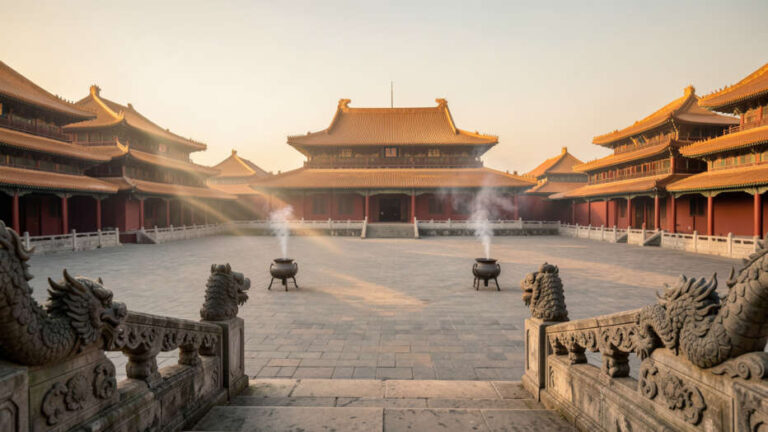
The event was meticulously planned to project strength and unity. It served to consolidate the CCP’s authority and announce its presence to the world. The chosen location, Tiananmen, held deep historical significance as the entrance to the Forbidden City.
How Did the Founding Affect Ordinary Chinese People?
The transition to Communist rule brought immediate and profound changes to daily life. For millions, especially the rural poor, the revolution promised a break from the past. However, the new era also brought uncertainty and new forms of control.
The social hierarchy of old China was systematically dismantled. Landlords and the “bourgeois class” saw their power and property taken away. Peasants and workers were elevated as the new ruling class in theory.
Key Social Changes Implemented
- Land Reform: Land was seized from landlords and redistributed to peasant families. This was the CCP’s most popular early policy, though often violent.
- Marriage Law (1950): Abolished arranged marriages, concubinage, and child betrothal. It promoted free choice in marriage.
- Women’s Status: The new government officially promoted gender equality, encouraging women to work and participate in public life.
- Education and Literacy: Campaigns were launched to improve basic education and reduce illiteracy, especially in rural areas.
- Collectivization Begins: Agricultural production started to be organized into cooperatives, laying groundwork for later collectivization.
| Aspect of Life | Pre-1949 (Nationalist Era) | Post-1949 (Early PRC) |
|---|---|---|
| Social Structure | Hierarchical: Landlords, gentry, merchants, peasants | Classless ideal: “Workers and peasants lead” |
| Land Ownership | Concentrated in the hands of a few | Redistributed to individual peasant households |
| Economic System | Mixed, with growing hyperinflation | Transition toward state control of key industries |
These changes were welcomed by many who had suffered under the old system. Yet the implementation was often brutal, with public struggle sessions and executions of former elites. This period set the tone for later, more radical political campaigns.
What Was the International Reaction to the New Communist State?
The founding of Communist China sent shockwaves through the international community. It dramatically altered the Cold War balance of power in Asia. Reactions were sharply divided along ideological lines.
The Western world, led by the United States, viewed the new government with alarm and hostility. The Soviet Union, however, quickly recognized and supported its new communist ally.
Global Response and Diplomatic Shifts
- United States: The Truman administration refused to recognize the PRC, maintaining diplomatic ties with the Nationalist government in Taiwan. This policy of non-recognition lasted for decades.
- Soviet Union: Recognized the PRC on October 2, 1949, the day after its founding. The Sino-Soviet Treaty of 1950 formalized their alliance, providing crucial economic and military aid.
- United Nations: The Republic of China (Taiwan) retained China’s seat in the UN Security Council until 1971.
- Newly Independent Nations:
- European Allies:
Many Asian and African countries were cautiously optimistic, seeing China’s revolution as part of a broader anti-colonial movement.
Britain, facing economic pressures from its Hong Kong colony, took a pragmatic approach and recognized the PRC in 1950, ahead of most Western nations.
Warning: The US policy of containment aimed to prevent the spread of communism. The “loss” of China intensified anti-communist fervor domestically, contributing to McCarthyism.
The Korean War (1950-1953) cemented this division. China’s entry into the war to support North Korea against UN forces led by the US made reconciliation impossible for a generation. The PRC became isolated from the Western world.
Why Is 1949 Considered Such a Pivotal Year in Chinese History?
The year 1949 represents a complete historical rupture for China. It ended over a century of instability, civil wars, and foreign domination that began with the Opium Wars. It launched an entirely new political and social order.
The significance lies in the comprehensiveness of the change. It wasn’t just a change of government but an attempt to reinvent Chinese society from the ground up. The scale and ambition were unprecedented.
The Lasting Significance of 1949
- End of the “Century of Humiliation”: The CCP narrative framed 1949 as the moment China reclaimed its sovereignty and national dignity after decades of foreign interference.
- Social Revolution: It fundamentally reordered social classes, dismantling traditional hierarchies that had existed for centuries.
- Political Consolidation: For the first time since the Qing dynasty fell, a single, effective central government controlled the vast majority of China’s territory.
- Geopolitical Shift: It created a new center of power in Asia, aligning with the Soviet bloc and challenging Western influence in the region.
- Foundation of Modern Institutions: The key state and party structures established in 1949-1950 remain the foundation of China’s governance system today.
For historians and political scientists, 1949 is the definitive starting point for modern China. Every subsequent development, from the Great Leap Forward to the Economic Reforms, is a direct consequence of the revolution’s victory.
Frequently Asked Questions
What was the name of the new country founded in 1949?
The new country was named the People’s Republic of China (PRC). Mao Zedong announced its formation on October 1, 1949. This name emphasized the government’s claim to represent the common people.
Where did the losing side of the Chinese Civil War go?
The defeated Nationalist government, led by Chiang Kai-shek, retreated to the island of Taiwan. They continued to call themselves the “Republic of China” and claimed to be the legitimate government of all China.
What was the most popular early policy of the Communist government?
Land reform was overwhelmingly the most popular initial policy. By redistributing land from landlords to peasants, the CCP secured the vital support of China’s massive rural population, which made up over 80% of the country.
How many people died in the Chinese Civil War?
Casualty figures are difficult to verify, but estimates suggest millions died. The fighting, especially in the final campaigns of 1948-1949, was incredibly intense and involved massive armies on both sides.
Why doesn’t Taiwan consider itself part of the People’s Republic of China?
Taiwan’s government was the Republic of China (ROC), the internationally recognized government of China before 1949. After retreating to Taiwan, it continued to claim legitimacy over all of China, while the PRC in Beijing claims sovereignty over Taiwan. This unresolved conflict is a core issue in cross-strait relations.
Final Thoughts
The founding of Communist China in 1949 was a watershed moment that redrew the map of global power. It was the product of a brutal civil war, brilliant strategy, and profound social discontent with the old order. The new government’s arrival promised radical change and a break from a troubled past.
This event’s legacy is complex, encompassing both national rejuvenation and immense human tragedy in subsequent decades. The political entity established that day in Tiananmen Square remains the government of the world’s most populous nation. Its impact continues to shape our interconnected world.