How the Maritime Silk Road Differed From the Land Route
The Maritime Silk Road and its land-based counterpart were two distinct arteries of ancient global exchange. While both connected East and West, they functioned in fundamentally different ways. Understanding these differences reveals how geography shaped trade, culture, and history.
This post explores the key distinctions between the sea and land routes of the Silk Road. You will learn about their origins, the goods they carried, the challenges travelers faced, and their lasting impact on world civilizations.
Simply put, the Land Silk Road was a network of overland caravan trails crossing deserts and mountains, primarily carrying high-value, low-volume goods. The Maritime Silk Road was a network of sea lanes connecting coastal ports, capable of transporting bulkier commodities over vaster distances with different environmental challenges.
Key Takeaways
- The Maritime Silk Road was slower but could carry larger quantities of bulk goods like spices, ceramics, and timber compared to the limited capacity of overland caravans.
- The land route faced constant threats from bandits, harsh climates, and shifting political territories, while sea travel contended with monsoons, pirates, and shipwrecks.
- Both routes facilitated profound cultural and technological exchange, but the maritime routes more directly connected diverse coastal communities from China to the Persian Gulf and East Africa.
- The Land Silk Road is often romanticized as a single path, but it was actually a web of shifting routes around obstacles like the Taklamakan Desert.
- Decline in the Maritime Silk Road came later, primarily due to European maritime expansion, while the overland routes waned earlier as political stability fractured.
What Are the Origins and Historical Development of Each Route?
The Land Silk Road finds its formal origins in the Han Dynasty, around the 2nd century BCE. The explorer Zhang Qian’s missions to Central Asia helped map the overland paths that became the primary conduits for goods flowing west from China. For centuries, it remained the sole connection.
The Maritime Silk Road developed more gradually. While coastal trade existed earlier, it blossomed during the Tang Dynasty (7th-10th centuries). Advancements in shipbuilding and navigation, coupled with a stable Chinese maritime policy, allowed sea trade to flourish and eventually challenge the land routes’ dominance.
- Land Route Catalyst: Diplomatic missions, later joined by private merchants and caravans.
- Maritime Route Catalyst: Technological innovation (sternpost rudders, magnetic compasses) and demand for bulk goods.
- Peak Period (Land): Tang and Song Dynasties (7th-13th centuries).
- Peak Period (Maritime): Song, Yuan, and early Ming Dynasties (10th-15th centuries).
- Key Historical Figure (Land): Zhang Qian, the “Pioneer of the Silk Road.”
- Key Historical Figure (Maritime): Admiral Zheng He, who led massive treasure fleets.
Their development wasn’t competitive at first. The maritime routes grew as a parallel system, offering alternatives and eventually surpassing the land routes in trade volume and geographical reach.
| Development Aspect | Land Silk Road | Maritime Silk Road |
|---|---|---|
| Formal Start | Han Dynasty (~2nd Century BCE) | Tang Dynasty (~7th Century CE) |
| Primary Promoter | Chinese Imperial Court (diplomacy) | Merchants & later State Expeditions |
| Key Technological Boost | Camel caravans, saddle design | Maritime navigation (compass, ship design) |
How Did the Physical Routes and Geography Differ?
The most immediate difference lies in the terrain. The Land Silk Road was a grueling overland trek across some of Earth’s most extreme landscapes. Caravans navigated the scorching Taklamakan and Gobi deserts, scaled the Pamir and Karakoram mountain passes, and crossed vast steppes.
The route was never a single road but a shifting web of paths dictated by oases, political boundaries, and seasonal conditions.
The Maritime Silk Road followed coastal sea lanes, using the predictable patterns of the monsoon winds. Ships sailed from Chinese ports like Quanzhou or Guangzhou, hugging the Vietnamese coast, passing through the Strait of Malacca, across the Indian Ocean to India and Sri Lanka, and onward to the Persian Gulf and East Africa. The primary geographical challenge was the ocean itself, not landlocked deserts.
Warning: The overland Taklamakan Desert earned the nickname “the place of no return.” Travelers without adequate water supplies perished. The maritime route had its own deadly moniker: the “Graveyard of Ships” for the many vessels lost in storms.
Comparative Geographical Challenges
Both routes presented severe challenges, but of different kinds. Land travelers dealt with altitude sickness, dehydration, extreme temperature swings, and isolation. Seafarers battled storms, scurvy from long voyages, coral reefs, and the risk of being stranded on unknown coasts.
- Land: Carrying capacity limited by animal strength and survival needs.
- Land: High risk of banditry in lawless frontier regions.
- Maritime: Vulnerability to typhoons and the unpredictable doldrums.
- Maritime: Dependence on specific seasonal winds for safe travel.
- Maritime: Risk of grounding on reefs or shoals in poorly charted waters.
The geography dictated the pace. A land caravan might cover 25-30 miles per day. A ship could cover 100-150 nautical miles in the same period under favorable winds, making sea travel ultimately faster for long hauls once the monsoon seasons were mastered.
What Kinds of Goods Were Traded on Each Route?
The nature of the goods transported is a primary distinction. The Land Silk Road was famous for high-value, low-weight, and durable luxury items. Silk was the iconic commodity, but it was joined by precious stones, metals, fine textiles, glassware, and eventually paper.
These goods could justify the high cost and risk of camel caravans.
The Maritime Silk Road specialized in bulkier, heavier, and sometimes perishable goods. Its cargo holds could carry massive quantities of spices (pepper, cloves, cinnamon), ceramics, timber, resins, aromatics, and precious stones. It also moved bulk commodities like rice, sugar, and cotton cloth that would be impractical over land.
| Trade Good Category | Land Silk Road (Primary) | Maritime Silk Road (Primary) |
|---|---|---|
| High-Value Luxuries | Silk, jade, gold, silver, furs | Precious gems, ivory, luxury ceramics |
| Spices & Aromatics | Saffron, dried herbs (limited) | Pepper, cloves, cinnamon, camphor |
| Bulk Commodities | Horses, livestock (limited) | Ceramics, timber, metals, rice |
| Cultural & Religious Items | Buddhist texts, mantras | Religious icons, architectural knowledge |
This difference in cargo shaped the economics. Land trade involved many middlemen, with prices inflating at each transfer. Maritime trade, especially with larger ships, allowed for economies of scale, making some goods more affordable in distant markets over time.
How Did the Primary Modes of Transportation Compare?
The fundamental unit of transport on the Land Silk Road was the caravan. This consisted of trains of Bactrian camels, sometimes numbering in the hundreds, led by merchants and guards. Camels were essential for their ability to carry heavy loads (up to 300 lbs) and go days without water.
Smaller pack animals like horses and donkeys were used in less arid regions.
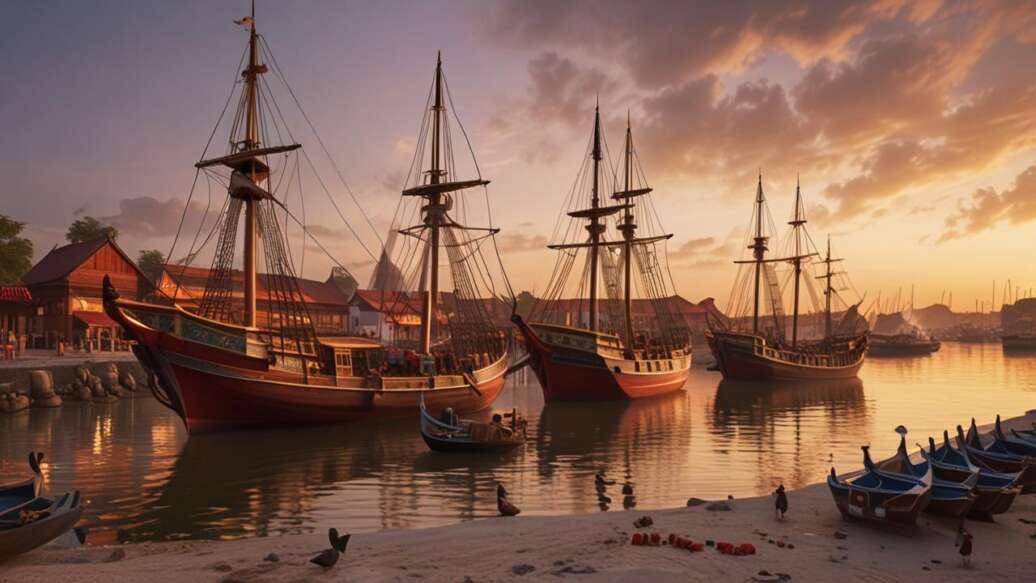
On the Maritime Silk Road, the vessel was everything. Early ships were smaller junks, but during the Song and Ming Dynasties, China produced massive “treasure ships” (baochuan) for state expeditions and highly seaworthy merchant junks for private trade. These vessels could carry hundreds of passengers and tons of cargo, representing a significant technological investment.
Transportation Technology Breakdown
The technological investment differed greatly. Land transportation relied on millennia-old animal domestication and breeding knowledge. Maritime technology was dynamic and evolving, incorporating the compass (invented in China), advanced astrolabes from the Arab world, and sophisticated joinery techniques for watertight hulls.
- Land Capacity: One camel = ~300 lbs. A large caravan = 10-20 tons of goods.
- Maritime Capacity: A large Ming treasure ship = ~500 tons. A standard merchant junk = 100-200 tons.
- Land Speed: 15-25 miles per day consistently.
- Maritime Speed: 100-150 nautical miles per day with good monsoon winds.
- Key Land Vehicle: The camel saddle and packs.
- Key Maritime Vehicle: The sternpost rudder for maneuverability.
Tip: When studying Silk Road transport, remember the mantra: “Land moves luxury; Sea moves bulk.” This simple rule explains much about the economic and cultural impact of each route.
What Were the Main Risks and Challenges for Travelers?
Travel on the Land Silk Road was defined by constant, multifaceted risk. The environmental hazards were severe, but human dangers were equally potent. Political instability along the route could lead to closed borders or heavy taxation.
Banditry was a persistent threat in remote stretches. The sheer isolation and need for reliable guides made journeys treacherous.
The Maritime Silk Road posed a different set of risks. The primary danger was the natural environment: violent storms, monsoons that could sink ships, and navigational errors leading to shipwrecks. Pirates were a significant threat, especially in strategic chokepoints like the Strait of Malacca.
Long voyages also brought health risks like scurvy and limited fresh water.
Risk Comparison at a Glance
It is useful to compare the risk profiles systematically. A caravan faced more frequent, low-intensity threats (robbery, disease, animal loss), while a ship faced less frequent but potentially catastrophic threats (total loss of cargo and life).
- Land – Political Risk: Crossing multiple kingdoms with changing policies and tariffs.
- Land – Human Risk: Bandits, disputes with local tribes, kidnapping.
- Land – Environmental Risk: Dehydration, sandstorms, altitude sickness.
- Maritime – Navigational Risk: Running aground, getting lost, storms.
- Maritime – Human Risk: Piracy, crew mutiny, disease outbreaks confined to ship.
- Maritime – Environmental Risk: Hurricanes/typhoons, coral reefs, monsoon reversals.
Despite these challenges, the Maritime Silk Road ultimately proved more resilient. A single ship lost was a major blow, but the network as a whole could absorb the shock. The loss of a major caravan was often a personal or family ruin, and the overland routes were more susceptible to being completely severed by regional conflicts.
How Did Each Route Influence Cultural and Technological Exchange?
Both routes were powerful engines of cultural diffusion, but they spread different types of influence. The Land Silk Road was a primary conduit for the transmission of religions, philosophical ideas, and artistic styles. Buddhism spread from India to China along these paths.
Zoroastrianism, Manichaeism, and Nestorian Christianity also traveled eastward. Art styles like Gandharan art, a fusion of Greek and Buddhist aesthetics, were products of this exchange.
The Maritime Silk Road excelled at spreading technologies, scientific knowledge, and practical crops. The Chinese compass reached the Arab world and Europe by sea. Islamic astronomical tables, Indian numeral systems, and Persian astronomical instruments traveled to China via these lanes.
It also facilitated the transfer of crops like sugarcane and new varieties of rice, impacting agriculture across continents.
| Type of Exchange | Land Silk Road (Primary Spread) | Maritime Silk Road (Primary Spread) |
|---|---|---|
| Religions | Buddhism, Christianity (Nestorian), Islam | Islam (spread along coasts), Hinduism |
| Technologies | Papermaking, gunpowder (later) | Compass, shipbuilding, irrigation techniques |
| Art & Music | Gandharan art, Central Asian music | Ceramic glazing techniques, maritime motifs |
| Language & Script | Spread of Sogdian as a lingua franca | Spread of Arabic numerals and scripts in ports |
The Maritime Silk Road created cosmopolitan port cities like Calicut, Hormuz, and Malacca. These were melting pots where merchants, sailors, and craftsmen lived in multicultural quarters. The cultural exchange was often more practical and daily in nature compared to the often monastic or courtly channels of the land routes.
Important: Archaeological evidence from shipwrecks, like the Belitung shipwreck (c. 830 CE), provides direct, tangible proof of the sheer volume and variety of goods moved by sea, confirming historical texts.
Why Did the Land Route Decline and the Maritime Route Prosper?
The decline of the Land Silk Road was gradual and caused by a confluence of factors. The rise of the Mongol Empire initially unified the route under the Pax Mongolica, but its fragmentation led to renewed instability and higher risks for caravans. Furthermore, the Black Death likely traveled these overland paths, causing demographic collapse.
By the 15th century, the overland routes were significantly diminished.
The Maritime Silk Road entered its golden age as the land routes faltered. The Song Dynasty’s economic revolution invested heavily in naval technology. The Yuan and early Ming Dynasties sponsored massive state-backed voyages.
When the Ming court later restricted these, private trade networks with Southeast Asia, India, and the Middle East had already become too robust to suppress.
Factors in the Decline of Overland Routes
- Political Fragmentation: The fall of the Mongol Empire created hostile, competitive khanates and kingdoms.
- Economic Shift: Maritime trade became more efficient and profitable for bulk goods.
- Disease: Plague pandemics disrupted populations and trade networks.
- Technological Stagnation: Overland transport saw little innovation compared to rapid naval advances.
- Rise of Ottoman Empire: Controlled key western terminuses, imposing heavy tariffs and creating instability.
Ultimately, the maritime routes were simply more adaptable. They connected more regions, could scale up capacity with larger ships, and were less vulnerable to the land-based political shocks that repeatedly crippled the overland caravans. The Portuguese arrival in the Indian Ocean in 1498 was the final catalyst that integrated these Asian maritime networks into a truly global one, largely under European direction.
Frequently Asked Questions
Which Silk Road route was used first?
The overland Land Silk Road was formalized and used first, during the Han Dynasty around the 2nd century BCE. While coastal trade existed earlier, the organized maritime network developed significantly later, during the Tang Dynasty in the 7th century CE.
What was the most valuable good traded on the Maritime Silk Road?
Spices, particularly pepper from India and cloves from the Moluccas, were extraordinarily valuable. However, in terms of sheer volume and cultural impact, Chinese ceramics—porcelain—were the defining commodity of the maritime trade in its later centuries.
How long did a typical journey take on each route?
A journey along the entire Land Silk Road from China to the Mediterranean could take several years due to stops, weather, and terrain. The Maritime Silk Road, following monsoon winds, typically took 1-2 years for a similar round trip from China to the Persian Gulf or East Africa.
Did the two routes ever intersect?
Yes, they intersected at key terminal cities. Ports like Alexandria, Constantinople (modern Istanbul), and Basra served as crucial nodes where goods transferred from sea to land or vice versa. Central Asian cities like Samarkand were major land hubs that also received goods brought overland from maritime-connected ports.
Why is the term “Silk Road” used if other goods were traded?
The term “Silk Road” (Seidenstraße) was coined by German geographer Ferdinand von Richthofen in 1877. He used it because silk was the most iconic, distinctive, and high-value product that initially motivated the overland exchange. The name stuck, even though it oversimplifies the diverse trade that occurred.
Final Thoughts
The Maritime Silk Road and the Land Silk Road were not interchangeable but complementary networks. They shaped different chapters of globalization, with the sea routes ultimately providing the template for the interconnected modern world. Their combined legacy is a testament to human ingenuity and the relentless drive to connect across vast distances.
Understanding their differences highlights how geography, technology, and economics dictate the paths of history. From the camels of the Taklamakan to the junks of the South China Sea, these ancient routes laid the foundations for our globalized society.