The History of Macau Before Its Return to China
This post explores the key eras, pivotal events, and lasting influences that shaped Macau. We will trace its path from Portuguese arrival to the complex negotiations that led to its 1999 handover.
Simply put, Macau’s pre-handover history is defined by over 400 years of Portuguese administration, which created a unique East-West hybrid society. Its strategic location made it a crucial trading port, especially for Portuguese commerce in China and Japan, before its economy pivoted to tourism and gaming in the 20th century.
Key Takeaways
- Macau’s history began with a permanent Portuguese settlement in 1557, making it the oldest European colony in East Asia.
- It functioned as a vital intermediary for the China-Japan trade, controlled exclusively by Portugal until the 1640s.
- The Macau handover to China on December 20, 1999, ended Portuguese rule and established it as a Chinese Special Administrative Region.
- Throughout its history, Macau developed a unique Macanese culture, blending Portuguese and Cantonese elements in language, food, and architecture.
- Its modern economy was fundamentally reshaped by the granting of a gaming monopoly to Stanley Ho in 1962 and the subsequent liberalization of casino licenses.
Paul’s” alt=”Historic Ruins of St. Paul’s” title=”Historic Ruins of St. Paul’s”>

What Is the Core History of Macau Before the 1999 Handover?
The core history of Macau centers on its role as a Portuguese maritime and trading outpost. While Chinese authorities had allowed temporary anchorage for foreign ships earlier, a permanent settlement was established in 1557. Portugal administered the territory under a lease arrangement with the Chinese Ming and later Qing dynasties, paying an annual rent until 1849.
This arrangement was formalized in the 1887 Sino-Portuguese Treaty of Peking, where China recognized the “perpetual occupation and government of Macau by Portugal.” From that point until 1999, Macau was an overseas province of Portugal, enjoying a unique status with high autonomy.
- 1557: Portuguese establish a permanent settlement, trading and paying rent to Chinese authorities.
- 1849: Portuguese governor Ferreira do Amaral stops paying rent and takes over the administration of all of Macau’s territory.
- 1887: The Sino-Portuguese Treaty of Peking makes Macau a formal Portuguese colony.
- 1966: The “12-3 Incident” sparks major pro-Communist riots, shifting political power towards pro-Beijing groups.
- 1974: Portugal’s Carnation Revolution leads to a new policy of decolonization, proposing to return Macau to China.
- 1976: Portugal grants Macau the status of a “Chinese territory under Portuguese administration.”
- 1987: The Sino-Portuguese Joint Declaration is signed, setting the handover date for December 20, 1999.
This timeline shows a gradual evolution from a de facto commercial settlement to a legally recognized colony, and finally to a territory slated for return to Chinese sovereignty.
How Did Portuguese Arrival Shape Macau’s Early Development?
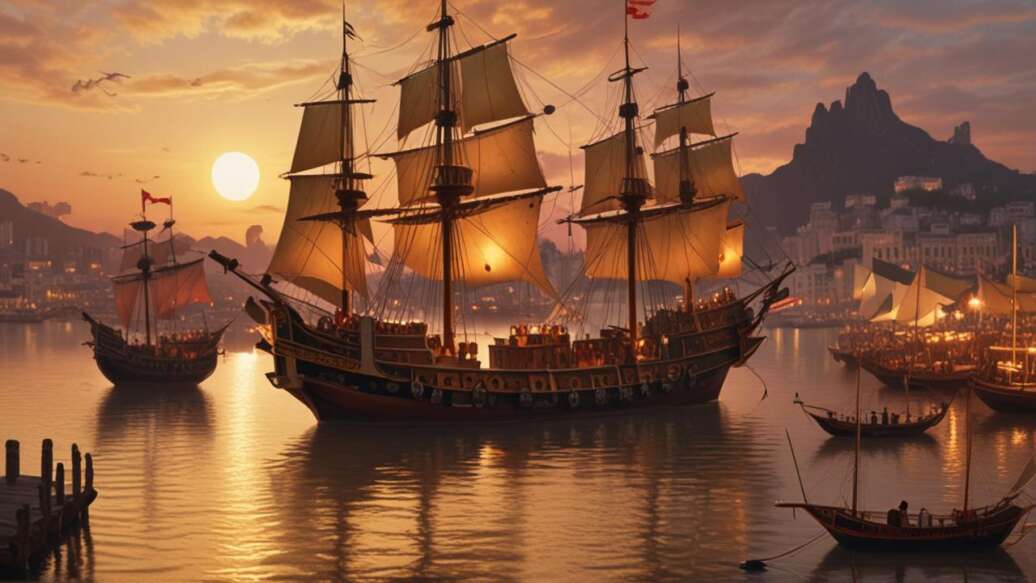
Portuguese arrival transformed Macau from a fishing community into a global trading node. Following Vasco da Gama’s sea route to India, Portuguese traders and adventurers pushed further east. They reached southern China in the early 16th century, initially engaging in trade and sometimes piracy around the Pearl River Delta.
Their request to dry cargo on the Macau Peninsula led to a permanent foothold. This was not a conquest but a negotiated settlement. In return for annual rent, the Chinese permitted the Portuguese to settle and govern their own community, while Chinese residents remained under Chinese jurisdiction.
This early arrangement created a dual administrative system.
| Impact Area | Portuguese Influence | Chinese Continuity |
|---|---|---|
| Governance | Created a Captain-Major and later a Governor system for the foreign enclave. | Maintained official oversight of Chinese residents and land ownership. |
| Trade | Made Macau the hub for the lucrative China-Japan silk-for-silver trade. | Supervised the flow of Chinese goods, particularly silk and porcelain, through the port. |
| Society | Introduced Catholicism, Latin alphabet, and European architectural styles. | Preserved traditional clan associations, temples, and festivals like the Bun Festival. |
| Economy | Established shipbuilding yards and international banking connections. | Dominating fishing, agriculture, and the provisioning of the foreign community. |
This symbiotic relationship, though often tense, allowed Macau to thrive as a meeting point between East and West for centuries.
What Were the Key Eras of Macau’s Pre-Handover Economy?
Macau’s economy underwent dramatic transformations, shifting from trade monopoly to gaming dominance. Three distinct economic eras defined its development before 1999.
- The Trading Port Era (1557 – mid-1600s): Macau’s initial wealth came from its exclusive role as an intermediary between China and Japan. Portuguese merchants carried Chinese silk to Nagasaki and returned with Japanese silver, earning enormous profits. However, the Dutch and English competition, along with Japan’s sakoku (closed country) policy, weakened this trade by the mid-17th century.
- The Coexistence & Decline Era (mid-1600s – 1960s): After the trade collapse, Macau’s economy relied on smuggling, opium, and acting as a refuge during regional conflicts. The rise of British Hong Kong as a major port further diminished Macau’s importance. It became a relatively poor territory known for its ceramics and fishing.
- The Gaming & Tourism Era (1962 – 1999): The pivotal moment was in 1961 when the Portuguese government designated Macau as a “permanent gaming region.” Stanley Ho’s STDM company won a monopoly on all games of chance, launching the Casino Lisboa in 1970. This single industry redefined the economy, drawing massive investment and visitors, especially after China’s economic reforms in the late 1970s.
Statistical Insight: According to historical economic reports from the Macau Statistics and Census Service, gaming revenue accounted for less than 5% of GDP in the 1960s. By 1998, just before the handover, it had surged to represent over 40% of GDP.
This economic pivot was crucial. It provided the fiscal resources and modern identity that Macau carried into its transition to a Chinese SAR.

How Did Political Unrest Influence Macau’s Path to Handover?
Political unrest, particularly in the 20th century, directly accelerated the handover process. The most significant event was the “12-3 Incident” of 1966. A dispute over a building permit for a ferry terminal escalated into violent protests.
The Portuguese police fired on demonstrators, killing several people and igniting widespread outrage.
This incident effectively broke Portuguese colonial authority in Macau. The pro-Communist opposition, backed by mainland China, forced the governor to concede to all their demands. From that moment, real power shifted to pro-Beijing local organizations and business leaders.
Portugal retained nominal administration but operated under a “one country, two systems” framework long before the official 1999 handover.
Warning: The “12-3 Incident” is a sensitive topic in Macau’s history. While it demonstrated Chinese influence, the protests also reflected local grievances against perceived colonial neglect and corruption.
Following Portugal’s 1974 revolution, the new government sought to decolonize. It proposed returning Macau immediately, but Beijing declined, preferring to resolve the Hong Kong question first. A pragmatic arrangement followed, leading to the 1987 Joint Declaration.
The political unrest of the 1960s made it clear that Portuguese rule was unsustainable, paving the way for a negotiated transfer.
What Was the Macau Handover Agreement and Why Was It Significant?
The Macau Handover Agreement is officially the Joint Declaration of the Government of the Republic of Portugal and the Government of the People’s Republic of China on the Question of Macau. Signed on April 13, 1987, it was the legal foundation for the transfer of sovereignty. Its significance lies in its “one country, two systems” formula, which guaranteed Macau’s high degree of autonomy for 50 years.
The agreement stipulated that Macau would become a Chinese Special Administrative Region (SAR) with its own legal, economic, and social systems intact. Portugal would administer until 1999, after which China would assume responsibility. This was a diplomatic model, prioritizing stability and continuity over revolutionary change.
- Key Provisions:
- Establishment of the Macau SAR on December 20, 1999.
- Preservation of the capitalist system and individual freedoms for 50 years.
- Maintaining the Macau dollar as the official currency.
- Portuguese as an official language alongside Chinese.
- Independent judiciary and customs territory.
- Significance:
- It provided a peaceful blueprint for resolving colonial legacies in Asia.
- It assured investors and residents of continuity, preventing a capital flight before the handover.
- It formally ended 442 years of European presence in China.

How Did Culture and Society Evolve in Colonial Macau?
Colonial Macau developed one of the world’s most unique blended cultures. It was not a typical colony where one culture dominated; instead, a distinct Macanese creole society emerged. This fusion was visible in language, cuisine, religion, and architecture.
The most distinctive social group was the Macanese, or “Macaense.” They are a Eurasian community descended from Portuguese, Indian, Malay, and Chinese intermarriages over centuries. They created Patuá, a unique creole language blending Portuguese with Cantonese, Malay, and Sinhalese. This language is now critically endangered but is celebrated in local theatre and song.
| Cultural Aspect | Blended Elements in Macau |
|---|---|
| Cuisine | Portuguese egg tarts (adapted from pastel de nata), African chicken (a spicy coconut dish), minchi (minced meat with soy sauce and potatoes). |
| Festivals | Chinese Lunar New Year and Mid-Autumn Festival coexist with Catholic Holy Week processions. The “Festas do Senhor do Bonfim” combines a Portuguese religious march with local traditions. |
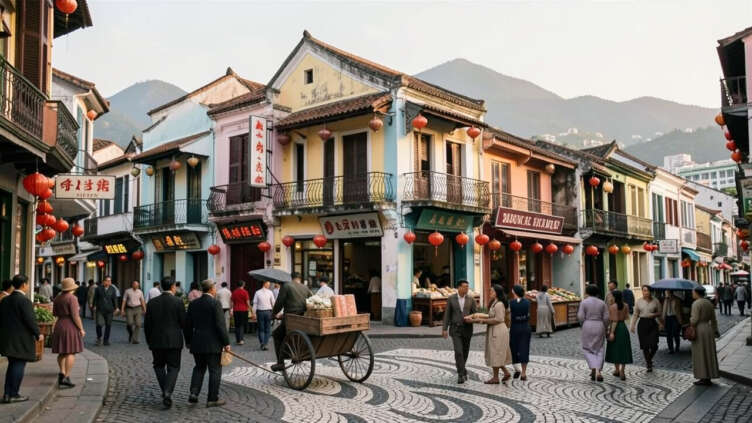
| Architecture | Southern European pastel-colored buildings with Chinese motifs, long verandas for tropical climate, and “shophouse” layouts blending commercial and residential space. |
This cultural mosaic was protected by the Portuguese administration, which generally practiced a policy of religious tolerance and cultural autonomy. It created a social fabric that was distinct from both mainland China and Hong Kong.
Who Were the Key Figures in Macau’s Pre-Handover Story?
Several pivotal figures guided Macau through its most critical transitions. Their decisions directly shaped the territory’s destiny.
- Fernão Mendes Pinto (1509-1583): While his exact role is debated, this Portuguese explorer was among the first Europeans to visit Macau. His writings helped popularize the location as a gateway to China and Japan.
- Leonel de Lima, 1st Viscount of Macau (18th Century): As governor, he formalized the municipal government, laying the administrative groundwork that would last for centuries.
- João Maria Ferreira do Amaral (1803-1849): A controversial and forceful governor who ended the rent payments to China in 1849, effectively making Macau a full colony. His assassination by Chinese resisters underscored the tensions of colonial expansion.
- Stanley Ho (1921-2020): Although his prime influence was later, his winning of the gaming monopoly in 1962 through his STDM company was the single most important economic decision in modern Macau. It created the wealth that would define the territory through the handover and beyond.
- Rui Fontes (First CNPJ Head): As the last Portuguese Governor’s representative in the Joint Liaison Group, he played a key technical role in managing the complex day-to-day negotiations leading up to December 20, 1999.
Tip: When researching figures like Stanley Ho or Ferreira do Amaral, look for balanced perspectives. Historical accounts often reflect the biases of their era, especially regarding colonial policies.

What Is the Legacy of Portuguese Rule in Macau Today?
The legacy of Portuguese rule is physically and culturally embedded in modern Macau. The “Historic Centre of Macau,” a UNESCO World Heritage Site, is the most visible testament. It consists of over 20 historic buildings, including the Ruins of St.
Paul’s, the A-Ma Temple, and Senado Square, showcasing over 400 years of architectural fusion.
Legal and institutional frameworks also bear this legacy. Macau’s legal system is based on continental Portuguese law. The Portuguese language remains an official language, used in government and courts, though daily use has declined.
The Catholic Church continues to play a significant social role, running schools and hospitals.
The most complex legacy is social. The Macanese community, while smaller now, maintains a strong identity. The annual “Macanese Day” celebrates this heritage.
The fusion cuisine is now a major tourist attraction and a point of local pride. Portuguese place names like “Rua do Cunha” and “Avenida da Praia” still define the city’s geography. This legacy is not a relic; it is a living part of Macau’s unique branding as a cultural and tourism destination.
Frequently Asked Questions
When did Portugal first arrive in Macau?
Portuguese traders and adventurers arrived in the Macau region in the early 1550s. The commonly accepted date for the establishment of a permanent settlement is 1557, when Chinese authorities permitted them to dock and live on the peninsula.
What was Macau’s main source of income before gambling?
Before the rise of the gaming industry in the 1960s, Macau’s economy was based on trade, shipbuilding, fishing, and the manufacture of fireworks and incense. Its role as a trading port between China and Japan was the most lucrative in its early centuries.
Why was the Macau handover delayed until 1999, after Hong Kong?
China prioritized resolving the status of Hong Kong first due to its larger size and greater global economic importance. The successful implementation of the “one country, two systems” model in Hong Kong in 1997 then provided a proven template and reassurance for the smooth transition of Macau two years later.
What does “Special Administrative Region” mean for Macau?
As a SAR, Macau enjoys a high degree of autonomy except in defense and foreign affairs. It maintains its own legal, economic, and monetary systems, and its capitalist system and way of life are guaranteed for 50 years after the 1999 handover.
Is Portuguese still widely spoken in Macau?
Portuguese is an official language and is used in government, law, and higher education. However, daily use among the general population is limited, with Cantonese being the dominant spoken language. It is more commonly heard among the older generation and the Macanese community.
Final Thoughts
The pre-handover history of Macau is far more than a footnote to its modern casino glitz. It is a story of cultural creation through trade, negotiation, and survival. From its negotiated beginning in 1557 to the pragmatic “one country, two systems” framework of 1999, Macau’s journey reflects complex interactions between Eastern and Western powers.
This history endowed Macau with a unique identity that continues to define its place in the world today.