Qin Dynasty: China’s First Unified Empire Explained
The Qin Dynasty marks a pivotal moment in Chinese history, representing the first empire to unify the warring states under a single, centralized rule. This short-lived dynasty, lasting only from 221 to 206 BCE, fundamentally reshaped China’s political, cultural, and social landscape. Its legacy of standardization and monumental infrastructure created the blueprint for imperial China for the next two millennia.
This post explores the rise and fall of the Qin Dynasty, its transformative policies, key figures like Qin Shi Huang, and the lasting structures it built, from the Great Wall to the Terracotta Army. Understanding the Qin Dynasty is essential for grasping the origins of the Chinese imperial system and the legalist philosophy that powered its rapid changes.
Simply put, the Qin Dynasty was China’s first unified empire, established by Qin Shi Huang. It replaced feudal states with a centralized bureaucracy, standardized writing, currency, and measurements, and began construction of the Great Wall, leaving an indelible mark on Chinese civilization.
Key Takeaways
- The Qin Dynasty unified China in 221 BCE after centuries of warfare, ending the Warring States Period.
- Qin Shi Huang implemented radical reforms based on Legalism, creating a centralized imperial government.
- Standardization of writing, weights, measures, and currency was crucial for unifying a diverse empire.
- Monumental projects like the Great Wall and the Terracotta Army were started during this period.
- The dynasty’s harsh rule and rapid collapse led to the rise of the more pragmatic Han Dynasty.
What Is the Historical Context of the Qin Dynasty?
To understand the Qin Dynasty, one must look at the chaos that preceded it. The Spring and Autumn and Warring States Periods (roughly 771 to 221 BCE) were centuries of constant warfare and political fragmentation. Numerous states fought for dominance, leading to immense suffering but also significant technological and philosophical advancements.
The state of Qin, located in the west, gradually rose to prominence. Its rulers adopted a strict philosophy of Legalism, which emphasized absolute power, harsh laws, and the subordination of all personal interests to the state. This system made Qin’s military and bureaucracy incredibly efficient and ruthless, setting the stage for conquest.
- Philosophical Shift: Legalism replaced the ethical teachings of Confucianism as state policy, focusing on reward and punishment to control society.
- Military Innovation: The Qin army adopted iron weapons, crossbows, and sophisticated tactics, creating a formidable war machine.
- Systematic Conquest: The ambitious King Zheng of Qin systematically defeated the six other major states between 230 and 221 BCE.
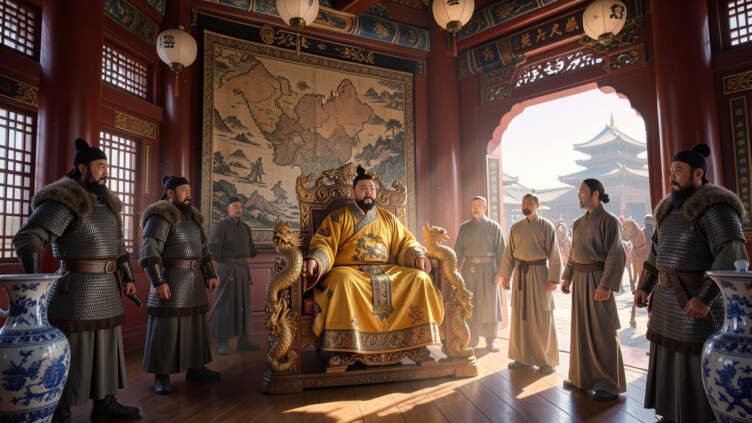
- Birth of an Emperor: After unification, Zheng declared himself “Qin Shi Huang” – the First Emperor of Qin.
According to historical records like the Records of the Grand Historian, the population of the Qin state mobilized for war on an unprecedented scale. This context of total war is critical to understanding the dynasty’s later policies, which were designed to maintain control and prevent a return to chaos.
How Did Qin Shi Huang Unify China?
Qin Shi Huang’s unification was not just a military victory; it was a systematic dismantling of the old feudal order. He and his chief advisor, the Legalist scholar Li Si, implemented a series of sweeping reforms aimed at creating a single, centralized empire from a collection of independent kingdoms.
The process began immediately after conquest. The former kings of the conquered states were executed or exiled. The old feudal aristocracy, which had ruled through hereditary privilege, was stripped of power.
Their lands were confiscated and reorganized into commanderies (jun) and counties (xian) governed by centrally appointed officials.
| Policy | Old System | Qin System | Purpose |
|---|---|---|---|
| Administration | Feudal hereditary lords | Appointed commandery governors | Central control, loyalty to emperor |
| Land | Owned by aristocrats | State-owned, leased to farmers | Break aristocratic power, generate tax revenue |
| Military | Private feudal armies | National standing army | Prevent rebellion, defend frontiers |
The emperor also ordered the disassembly of the defensive walls between the former states and connected them into a single barrier against northern nomads – the first version of the Great Wall. All weapons were melted down to cast statues and bells, preventing armed insurrection.
Warning: Qin Shi Huang’s unification policies were brutally effective but also deeply oppressive. The burning of books and burial of scholars, intended to suppress dissent, became a symbol of his tyranny.
What Were the Key Standardization Reforms?
The most enduring achievement of the Qin Dynasty was its sweeping standardization. Before unification, the seven states had different written scripts, currencies, axle widths, and systems of measurement. This made trade, administration, and communication across the new empire incredibly difficult.
Li Si spearheaded a radical project to unify everything.
The standardization was comprehensive and transformative. It didn’t just simplify logistics; it created a shared cultural and economic framework that helped knit the diverse populations into a single Chinese identity. This policy was arguably more significant for the long-term unity of China than the military conquest itself.
- Writing System: The complex and varied scripts of the former states were abolished. A single, simplified script called Small Seal Script (Xiao Zhuan) was mandated for all official documents and inscriptions.
- Currency: The diverse knife, spade, and cowrie shell currencies were replaced with two standardized copper coins: the round Ban Liang coin with a square hole, which became the model for Chinese coinage for over 2,000 years.
- Weights and Measures: A unified system of measurement for length, volume, and weight was established. Government-issued bronze standards were distributed across the empire.
- Axle Widths: The width of cart axles was standardized so that all vehicles could fit into the same wheel ruts on the newly built imperial highways, improving transportation.
- Laws and Taxes: A uniform code of law and a standardized tax system based on land and labor were applied throughout the empire.
These reforms were enforced with extreme rigor. Officials who used old measurements or script could be severely punished. This top-down approach, while effective, left little room for local adaptation and contributed to widespread resentment.
What Major Projects Did the Qin Dynasty Undertake?
Leveraging the centralized power and conscript labor of the entire empire, Qin Shi Huang initiated some of the most ambitious construction projects in ancient history. These projects were designed to protect the empire, facilitate movement, and glorify the emperor, but they came at a tremendous human cost.
The most famous of these projects is the Great Wall. The Qin connected and extended earlier walls built by the northern states into a single defensive line stretching thousands of miles. This monumental effort required hundreds of thousands of soldiers, conscripted laborers, and convicts, many of whom perished during construction.
Another incredible feat was the empire-wide road system. Known as “Chidao” or “Straight Roads,” these paved highways radiated from the capital, Xianyang. The most famous, the 800-km “Straight Line” to the northern frontier, allowed for the rapid deployment of troops and information across the vast territory.
| Project | Purpose | Legacy |
|---|---|---|
| The Great Wall | Defense against northern nomads | Enduring symbol of China, expanded by later dynasties |
| Imperial Highways | Military movement, administration, trade | Facilitated cultural and economic integration |
| Lingqu Canal | Transport grain and troops south | Advanced hydraulic engineering, enabled southern expansion |
| Mausoleum of Qin Shi Huang | Eternal afterlife for the emperor | Home to the Terracotta Army, a world wonder |
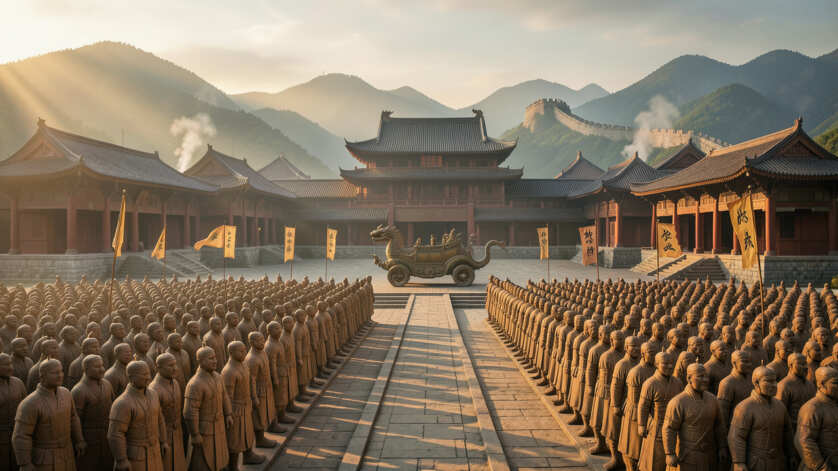
The emperor’s final resting place was his most personal project. The mausoleum complex near modern Xi’an is a vast necropolis, its most famous feature being the Terracotta Army – thousands of life-sized clay soldiers buried to guard him in the afterlife. Its discovery in 1974 revealed the incredible craftsmanship and resources of the Qin era.
Important: The labor conscripted for these projects fueled popular resentment. An estimated 300,000 people worked on the Great Wall alone, with countless deaths recorded in historical texts.
What Led to the Rapid Collapse of the Qin Dynasty?
Despite its immense power and transformative achievements, the Qin Dynasty lasted only 15 years. The very factors that enabled its swift rise – centralized control, harsh Legalist laws, and massive conscription – also sowed the seeds of its rapid disintegration. The dynasty’s collapse was a classic case of overextension and oppression.
The burden of taxation and forced labor fell overwhelmingly on the peasant population. Farmers were taken from their fields for years at a time to build walls, roads, and mausoleums. The legal code was unforgiving; minor infractions could lead to brutal punishment or execution.
This created a powder keg of discontent across the empire.
The catalyst came in 209 BCE. Two army officers, Chen Sheng and Wu Guang, were delayed by rain while escorting convicts to a frontier post. Knowing they would be executed for tardiness under Qin law, they chose to rebel.
Their uprising, though eventually crushed, ignited a firestorm. Disaffected nobles, merchants, and peasants across the empire rose up.
- Initial Spark: Chen Sheng and Wu Guang’s rebellion mobilized thousands, proving the Qin army was not invincible.
- Coalition of Rebels: Former aristocrats from conquered states, like Xiang Yu of Chu and Liu Bang of Han, organized larger, more effective rebel armies.
- Internal Collapse: The Qin court fell into infighting. The emperor had died in 210 BCE, and a succession crisis was manipulated by the eunuch Zhao Gao.
- Final Defeat: By 206 BCE, rebel forces had captured the Qin capital, Xianyang, and the last Qin emperor surrendered.
The dynasty’s harshness left no loyal supporters to defend it. The centralizing reforms, while effective for control, had eliminated any buffer of local elites who might have helped stabilize the system. Once the emperor’s will faltered, the entire structure crumbled with astonishing speed.
What Is the Lasting Legacy of the Qin Dynasty?
Though the Qin Dynasty itself was short-lived, its impact on Chinese history is immeasurable. It created the template for the imperial system that would endure until 1912. The Han Dynasty, which succeeded it, adopted the Qin’s centralized bureaucracy and standardized systems while softening its harsh Legalist edge with Confucian principles.
The concept of a unified “China” was firmly established by the Qin. The standardized writing system ensured that educated people across the vast territory could communicate, fostering a shared cultural identity. The imperial road network and canals laid the groundwork for economic integration.
Militarily, the concept of a unified northern frontier defense, symbolized by the Great Wall, became a recurring theme in Chinese statecraft. The Qin demonstrated both the potential and the peril of mobilizing an entire society for state-driven projects.
- Administrative Blueprint: The commandery-county system became the standard for provincial administration in later dynasties.
- Cultural Unification: The Qin script evolved into the modern Chinese characters used today, enabling cultural continuity.
- Symbol of Power: The title “Huangdi” (Emperor) and the imperial insignia became the standard for Chinese sovereignty for millennia.
- Cautionary Tale: The Qin serves as a historical lesson in the dangers of authoritarian overreach and the importance of popular consent.
Historians today view the Qin Dynasty as a necessary, if brutal, revolution. It broke the old feudal order and, through standardization and centralization, built the foundations of a Chinese state that could sustain unity over an enormous territory for centuries to come.
Frequently Asked Questions
Who was Qin Shi Huang and why is he important?
Qin Shi Huang was the king who unified China’s warring states and became its First Emperor in 221 BCE. He is important for establishing the imperial system, standardizing Chinese culture and administration, and initiating massive projects like the Great Wall. His ruthless methods and legacy make him one of history’s most significant and controversial figures.
What was the main philosophy behind Qin Dynasty rule?
The Qin Dynasty was governed by Legalism, a philosophy that emphasized strict laws, harsh punishments, and absolute state power. Unlike Confucianism, which focused on moral leadership and relationships, Legalism sought to control society through a powerful, centralized bureaucracy and the suppression of all dissent, including rival philosophical schools.
How long did the Qin Dynasty last?
The Qin Dynasty lasted only 15 years, from 221 BCE to 206 BCE. Despite its brief existence, its reforms and unification of China had a permanent impact. Its rapid collapse was due to widespread rebellion fueled by oppressive policies, forced labor, and a rigid legal system that left no room for leniency.
What was the significance of the Terracotta Army?
The Terracotta Army is a collection of thousands of life-sized clay soldiers, horses, and chariots buried with Emperor Qin Shi Huang to guard him in the afterlife. Discovered in 1974, it is a UNESCO World Heritage Site and showcases the incredible artistry, resources, and organizational power of the Qin Dynasty. It provides invaluable insight into ancient Chinese military practices and beliefs.
Did the Qin Dynasty really burn books and bury scholars?
Yes, historical records indicate that in 213 BCE, Emperor Qin Shi Huang ordered the burning of many historical and philosophical books, particularly Confucian texts, to suppress intellectual dissent. The following year, a group of scholars who criticized him were reportedly buried alive. This event is known as the “burning of books and burying of scholars” and symbolizes the dynasty’s authoritarian approach to controlling thought.
Final Thoughts
The Qin Dynasty’s story is one of revolutionary change and brutal consequence. It created a unified Chinese empire and set enduring administrative and cultural standards. Yet its reliance on fear and coercion proved unsustainable, offering a timeless lesson about governance.
The foundations it laid, however, proved far more lasting than the dynasty itself.