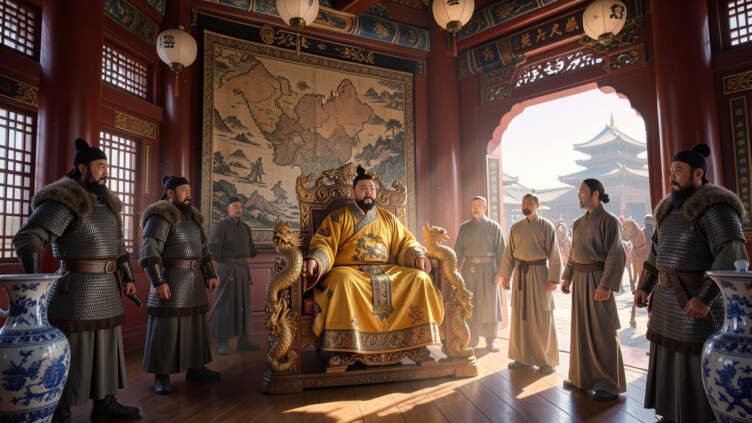

The Qing Dynasty: China’s Last Imperial Dynasty Explained
The Qing Dynasty was the final and one of the most significant imperial dynasties in Chinese history. It ruled for nearly three centuries, shaping the modern borders and cultural landscape of China. Understanding this era is key to grasping the foundations of contemporary Chinese society.
This post provides a comprehensive overview of the Qing Dynasty, from its rise to power to its eventual collapse. We will explore its key emperors, territorial expansions, cultural achievements, and the internal pressures that led to its fall. You will gain a clear picture of this complex and transformative period.
Simply put, the Qing Dynasty was a Manchu-led empire that ruled China from 1644 to 1912. It oversaw a vast expansion of territory, a flourishing of arts, but ultimately faced decline due to internal decay and foreign pressures, ending China’s imperial system.
Key Takeaways
- The Qing Dynasty was established by the Manchu people and ruled China for 268 years, the second-longest dynasty in Chinese history.
- Under emperors like Kangxi and Qianlong, the dynasty achieved vast territorial expansion and a population boom, creating a powerful, multi-ethnic empire.
- The dynasty’s later years were marked by the Opium Wars, internal rebellions, and failed reforms, leading to its collapse in the 20th century.
- The legacy of the Qing Dynasty is profound, as it established the territorial basis for modern China and its multi-ethnic national identity.
What Was the Qing Dynasty and When Did It Rule?
The Qing Dynasty was China’s last imperial dynasty, reigning from 1644 until the abdication of its final emperor in 1912. The name “Qing” translates to “Clear” or “Pure,” a reference chosen by its founders to signify a new era. It succeeded the Ming Dynasty, which had ruled for nearly 300 years prior.
The dynasty was founded not by the Han Chinese majority, but by the Manchu people from the northeastern region of Manchuria. After overthrowing the Ming, the Qing rulers skillfully adopted Chinese administrative traditions while maintaining their distinct cultural identity. This dual approach was central to their long rule.
- Founding: Established in 1636, with the conquest of Beijing in 1644.
- Capital: Based in Beijing, with the Forbidden City as the imperial palace.
- Founders: The Aisin Gioro clan, beginning with the Hong Taiji and later the Shunzhi Emperor.
- Succeeded by: The Republic of China, following the Xinhai Revolution.
How Did the Manchu Conquer China and Establish Power?
The Manchu rise to power was a calculated and gradual process. Originally a tribal federation in the northeast, they unified under Nurhaci in the early 17th century. Nurhaci created the “Eight Banners” system, a combined military-social-administrative structure that became the backbone of Manchu power.
After years of consolidation and skirmishing with the Ming, the Manchu seized their chance. A massive peasant rebellion led by Li Zicheng toppled the Ming emperor in 1644. The Ming general Wu Sangui, seeking to suppress the rebels, opened the gates at Shanhai Pass to the Manchu armies, who quickly defeated Li Zicheng and claimed Beijing for themselves.
| Key Factor | Description |
|---|---|
| Eight Banners System | A multi-ethnic military organization that integrated Manchu, Mongol, and Han Chinese soldiers into a single command structure. |
| Adoption of Chinese Bureaucracy | The Qing kept the civil service examination system and Confucian governance models, ensuring stability and winning over the Han elite. |
| Strategic Alliances | Formed crucial alliances with Mongol tribes and Tibetan Buddhist leaders, securing the northern and western frontiers. |
Warning: Early Qing rule faced significant resistance. The “Queue Order,” forcing Han Chinese men to adopt the Manchu hairstyle, sparked widespread rebellion and was a source of deep cultural tension for decades.
Who Were the Most Influential Qing Emperors?
The dynasty’s fortunes were often tied to the character and competence of its emperors. Several rulers are considered the greatest, presiding over eras of expansion, stability, and cultural brilliance. These “High Qing” emperors set a standard for effective governance in a multi-ethnic empire.
The Kangxi, Yongzheng, and Qianlong emperors are particularly notable. Together, their reigns spanned over 130 years, a period of unprecedented prosperity and territorial growth. Their policies balanced Manchu identity with effective use of Chinese statecraft.
- Kangxi Emperor (r. 1661–1722): Ascended the throne as a child but became one of China’s longest-reigning and most capable rulers. He suppressed revolts, drove out Russian influence in the north, and commissioned major scholarly works.
- Qianlong Emperor (r. 1735–1796): Presided over the dynasty’s peak. He expanded the empire to its greatest extent, patronized the arts and literature, and maintained immense wealth. His later years, however, saw growing corruption.
What Defined the Culture and Society of the Qing Era?
Qing society was a complex tapestry of Manchu traditions, Han Chinese Confucian values, and influences from Mongolian and Tibetan cultures. This multi-ethnic synthesis was a hallmark of the empire. Social hierarchy remained strict, with the emperor and Manchu nobility at the top, followed by the scholar-officials, farmers, artisans, and merchants.
Culturally, this was a period of significant achievement. The Qing saw a flourishing of literature, painting, and ceramics. The imperial court commissioned massive projects, including the compilation of the Complete Library of the Four Treasuries, a monumental encyclopedia of Chinese knowledge.
- Religion: The court promoted Tibetan Buddhism among Mongols and Manchus, while Confucianism governed state ideology and public life. Popular Daoist and folk practices continued widely.
- Arts & Crafts: Famously elegant porcelain, intricate jade carving, and refined court painting. The imperial workshops produced some of China’s finest decorative arts.
- Gender Roles: Society was patriarchal. The practice of foot binding, while not mandated by the court, remained prevalent among Han Chinese elites as a status symbol.
Why Did the Qing Dynasty Decline and Fall?
The decline of the Qing was not a single event but a long process of internal decay and external shocks. By the early 19th century, the empire was grappling with severe problems. Corruption was rampant in the bureaucracy, the treasury was depleted, and a rapidly growing population strained resources.
The greatest external shocks came from the West. Britain, seeking to reverse its trade deficit in tea and silk, began exporting opium to China, creating a widespread addiction crisis. When Chinese authorities tried to suppress the trade, it led to the catastrophic Opium Wars, which resulted in humiliating defeats and unequal treaties.
Important: The Taiping Rebellion (1850-1864) was a devastating civil war led by a charismatic leader who claimed to be Jesus Christ’s brother. It resulted in an estimated 20-30 million deaths and shattered the Qing’s remaining military and fiscal strength.
The dynasty attempted reforms during the late 19th-century Self-Strengthening Movement, but these half-hearted efforts were too little, too late. The final blow came with the Xinhai Revolution in 1911, which overthrew the last emperor, the child Puyi, and established the Republic of China.
| Cause of Decline | Impact on the Dynasty |
|---|---|
| Population Explosion | Doubled from ~150 million to ~300 million in the 18th century, causing food shortages, unemployment, and social unrest. |
| Opium Trade & Wars | Drained silver reserves, caused social degradation, and led to military defeats that exposed China’s weakness to foreign powers. |
| Internal Rebellions | Massive uprisings like the Taiping and Nian Rebellions consumed the state’s resources and destroyed vast regions of the empire. |
How Did the Qing Dynasty Shape Modern China?
The legacy of the Qing Dynasty is immense and paradoxical. On one hand, it created the multi-ethnic, continental empire that forms the basis of today’s People’s Republic of China. Its territorial acquisitions in Tibet, Xinjiang, Mongolia, and Taiwan are now integral parts of the Chinese state.
The concept of a “Chinese nation” (Zhonghua minzu) as a union of multiple ethnic groups was solidified during this period.
On the other hand, the dynasty’s collapse marked the end of a millennia-old political system. Its failure to modernize effectively in the face of Western imperialism left a legacy of national humiliation that continues to influence Chinese politics and identity. The search for a new, modern Chinese state directly led to the revolutions of the 20th century.
- Territorial Integrity: The Qing established the vast borders of modern China, incorporating diverse regions into a single state.
- Ethnic Policy: Its “five races under one union” concept evolved into the modern recognition of 56 official ethnic groups.
- Historical Consciousness: The “Century of Humiliation” narrative, beginning with the Opium Wars, is a powerful tool in modern Chinese nationalism.
- Cultural Export: Qing-era art, porcelain, and architecture (like the restored Summer Palace) are globally recognized symbols of Chinese heritage.
What Are the Most Surprising Facts About the Qing Dynasty?
Beyond the grand narrative, the Qing era is full of fascinating details that reveal its complexity. These facts highlight the dynasty’s unique character, blending Manchu traditions with vast imperial ambitions. From economic superpower status to complex ethnic policies, the Qing was far more than just another Chinese dynasty.
For instance, at its peak, the Qing economy may have accounted for over a third of global GDP. Its military was one of the largest in the world, and its administrative reach extended deeper into remote regions than any previous Chinese state. These achievements make its later decline all the more dramatic.
- Economic Giant: In 1820, just before the Opium Wars, the Qing economy generated roughly 33% of the world’s GDP, according to economic historian Angus Maddison.
- Multi-Ethnic Army: The elite Eight Banners forces included separate Manchu, Mongol, and Han Chinese units, all under a unified command.
- The Forbidden City’s Scale: The imperial palace in Beijing contains 980 surviving buildings and was home to 24 emperors from two dynasties (Ming and Qing).
- Population Milestone: China’s population first exceeded 400 million during the Qing Dynasty, a figure not reached by any other country until much later.
Frequently Asked Questions
What was the difference between the Qing and Ming Dynasties?
The key difference was ethnic and cultural. The Ming Dynasty (1368-1644) was ruled by Han Chinese, while the Qing (1644-1912) was founded and ruled by the Manchu people. The Qing maintained distinct Manchu customs and language alongside Chinese traditions, creating a more multi-ethnic empire.
Why is the Qing Dynasty considered the “last” dynasty?
It is the last because its fall in 1912 marked the end of imperial, dynastic rule in China entirely. The Xinhai Revolution overthrew the monarchy and established a republic, meaning no subsequent dynasty followed. This event concluded thousands of years of imperial Chinese history.
Did the Qing Dynasty have any positive effects on China?
Yes. It achieved massive territorial expansion, bringing regions like Tibet, Xinjiang, and Mongolia firmly under central control. It also presided over a long period of relative peace and economic growth, and made significant contributions to art, literature, and infrastructure development.
How did the Qing Dynasty affect non-Han Chinese groups?
Policies were complex. The court often patronized Tibetan Buddhism and employed Mongol elites to manage the northern frontier, giving them a privileged status. However, relations with Han Chinese were marked by periods of tension, exemplified by the forced hairstyle order and occasional massacres during the conquest.
Is the modern Chinese government connected to the Qing Dynasty?
The modern People’s Republic of China claims a direct connection as the successor state that restored unity after the Qing’s collapse and the subsequent “Century of Humiliation.” It actively manages the multi-ethnic national identity and territorial boundaries that were fundamentally shaped by the Qing Dynasty.
Final Thoughts
The Qing Dynasty represents a crucial bridge between imperial and modern China. Its reign saw the zenith of Chinese imperial power, vast cultural production, and the forging of a multi-ethnic state. Understanding its rise and fall provides essential context for the challenges and identity of China today.
Its legacy remains a living part of China’s historical consciousness and political landscape.