
Qin Shi Huang: The Brutal Genius Behind Ancient China
Qin Shi Huang was a figure of immense contradiction, a ruler who unified a warring land and left behind a legacy both magnificent and macabre. He is remembered as the architect of a unified China, yet his methods were often ruthless and his obsession with immortality bizarre. This post explores the life, achievements, and enduring impact of China’s first emperor.
You will uncover how a king from the small state of Qin rose to conquer all rivals. We will examine his sweeping reforms that shaped Chinese civilization for millennia and the colossal projects he initiated, from the Great Wall to the Terracotta Army. Understanding Qin Shi Huang is key to understanding the foundations of imperial China.
Simply put, Qin Shi Huang was the ambitious and ruthless king who ended the Warring States period, declared himself the First Emperor, and implemented radical centralized reforms. His reign was marked by incredible construction projects, severe Legalist laws, and a fierce suppression of intellectual dissent, leaving a legacy that is both foundational and feared.
Key Takeaways
- Qin Shi Huang unified the fractious Warring States into a single empire in 221 BCE, creating the foundation for modern China.
- He implemented sweeping standardizations of currency, weights, measurements, and writing, which greatly facilitated trade and administration.
- His most famous projects include the initial linking of the Great Wall and the creation of the life-sized Terracotta Army to guard his tomb.
- The emperor was a devout follower of Legalism, a philosophy that enforced strict laws and harsh punishments, leading to the burning of books and persecution of scholars.
- Despite his tyranny and quest for immortality, his administrative legacy lasted for over two thousand years.
Who Was Qin Shi Huang Before Becoming Emperor?
Born in 259 BCE as Ying Zheng, the future emperor had a tumultuous childhood. He was a hostage prince in the state of Zhao, a precarious position that likely fueled his later paranoia and ambition. His father, a prince of Qin, managed to return home and eventually seize the throne, making Ying Zheng the crown prince.
At the age of 13, Ying Zheng ascended to the throne of Qin. However, real power was held by the regent Lü Buwei and later the court eunuch Zhao Gao. He had to navigate a treacherous court filled with conspiracies, including an attempt by Lü Buwei to place him under house arrest.
This early struggle for control hardened his resolve and instilled a deep mistrust of others.
The state of Qin during this time was already the most powerful of the seven major states. It had benefited from earlier Legalist reforms under Shang Yang, which transformed it into a militaristic powerhouse. Ying Zheng inherited a state with a formidable army, a efficient bureaucracy, and a clear goal: the conquest of the remaining six rivals.
The Warring States Period
The era preceding Qin’s unification was known as the Warring States Period (c. 475–221 BCE). China was divided into seven major kingdoms constantly fighting for territory and supremacy.
This was a time of intense intellectual ferment, giving rise to the “Hundred Schools of Thought,” including Confucianism, Daoism, and Legalism.
Military technology and strategy advanced rapidly. States used massive infantry armies, iron weapons, and sophisticated crossbows. Diplomacy and betrayal were common tools.
It was from this chaotic landscape that the state of Qin would emerge as the sole victor, largely due to the ruthless efficiency of its systems and the ambition of its young king.
| The Seven Warring States | Key Characteristic | Final Fate Under Qin |
|---|---|---|
| Qin | Legalist reforms, strong military | Conquered all others (221 BCE) |
| Han | First to fall, small and weak | Annexed in 230 BCE |
| Wei | Central location, frequent conflicts | Annexed in 225 BCE |
| Zhao | Strong cavalry, opponent to Qin | Annexed in 228 BCE |
| Chu | Large territory, distinct culture | Annexed in 223 BCE |
| Yan | Northeastern border state | Annexed in 222 BCE |
| Qi | Wealthy, tried diplomacy over war | Surrendered without major battle in 221 BCE |
This table summarizes the political landscape Qin Shi Huang conquered through a series of swift military campaigns between 230 and 221 BCE.
How Did Qin Shi Huang Unify China?
The unification of China was a military campaign of systematic conquest. Ying Zheng, guided by his advisor Li Si, employed a brilliant strategy often summarized as “alliying distant states and attacking near ones.” This meant forming alliances with faraway states like Qi to isolate and conquer neighboring enemies like Han and Zhao first.
The Qin army was a highly disciplined machine. It was organized into 20-rank merit system, where soldiers could rise in rank and gain rewards based on enemy kills. This created a fiercely motivated fighting force.
They utilized advanced weaponry, including repeating crossbows and standardized bronze weapons, which gave them a significant technological edge.
Key battles, like the Battle of Changping where hundreds of thousands of Zhao soldiers were buried alive, showcased Qin’s brutality and determination. The campaigns were swift. Once a state was defeated, its lands were annexed, its ruling family deposed, and its population potentially relocated to break local loyalties.
The Imperial Title and First Acts
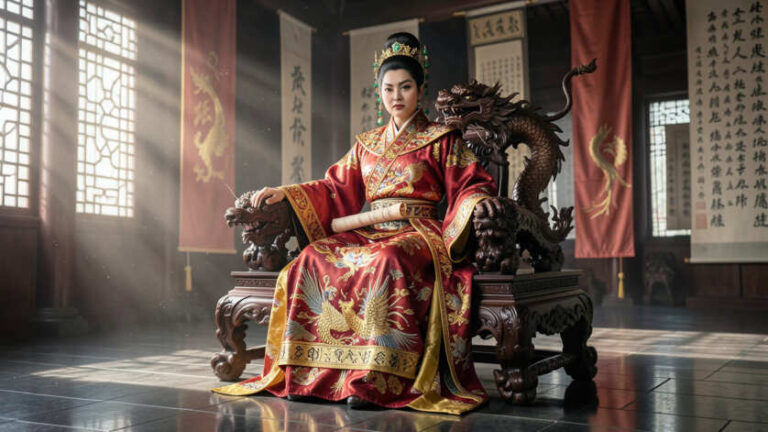
After his final conquest in 221 BCE, Ying Zheng did not simply call himself king. He felt his achievements surpassed the legendary “Three Sovereigns and Five Emperors” of myth. He created a new title: Huangdi, or Emperor, combining the words for sovereign and god-like ancestor.
He became Qin Shi Huangdi, “First Emperor of Qin.”
His first acts were to prevent a return to the chaos of warring states. He abolished feudalism and divided the empire into 36 commanderies, each run by centrally appointed officials (a governor, a military commander, and an imperial inspector). This bureaucratic structure ensured direct imperial control over the entire territory.
Tip: The Qin administrative model of using centrally appointed officials in local regions became the template for Chinese imperial governance for the next two millennia, influencing dynasties like the Han, Tang, and Ming.
What Were Qin Shi Huang’s Major Reforms and Standardizations?
Understanding how to run a unified empire led Qin Shi Huang and his chancellor Li Si to implement radical standardizations. Before this, each state had its own currency, weights, measures, and even written script. This caused chaos in trade, tax collection, and administration.
The reforms brought much-needed consistency.
One of the most critical changes was the standardization of the written language. The diverse scripts of the former states were abolished, and a single, simplified script known as Small Seal Script was mandated across the empire. This created a unified written medium that allowed for clear communication of laws, decrees, and literature, helping to bind the diverse culture together.
Economic standardizations included a round copper coin with a square hole in the center, the Ban Liang coin. Uniform standards for weights (using bronze measures) and lengths were also enforced. These measures facilitated taxation, trade, and construction on a national scale, making the empire’s economy more integrated and efficient.
Legalist Philosophy and Social Control
The ideological backbone of all these reforms was Legalism, a philosophy that prioritized strict, impersonal laws and harsh punishments over moral virtue or tradition. Confucian ideals of benevolent rule and filial piety were seen as threats to absolute state power. Legalism aimed to create a perfectly ordered, productive society through fear and incentive.
To enforce this philosophy, the emperor famously ordered the “burning of the books and burying of the scholars” in 213 BCE. Philosophical and historical texts, especially those from the Confucian and Mohist schools that criticized his rule or advocated for the old feudal system, were ordered destroyed. Scholars who resisted were reportedly buried alive.
This act was meant to suppress dissent and ensure only the state-sanctioned version of history and thought survived.
| Reform Area | Before Unification | Qin Standardization |
|---|---|---|
| Currency | Knife coins, spade coins, cowrie shells, etc. | Round Ban Liang coin (copper, with square hole) |
| Writing | Multiple regional scripts (e.g., Greater Seal, Wu characters) | Small Seal Script (uniform across empire) |
| Weights & Measures | Diverse local systems | Standardized bronze measures and scales |
| Axle Widths | Varied widths, making road travel difficult | Standardized width for chariots across the empire |
These standardizations were not just administrative; they were tools of control, ensuring the emperor’s authority was felt in every marketplace and scroll across the vast empire.
What Are Qin Shi Huang’s Most Famous Construction Projects?
Qin Shi Huang’s ambition extended to monumental engineering projects designed to protect his empire and secure his eternal afterlife. The scale of these projects required the mobilization of hundreds of thousands, often conscripted laborers and convicts, and is a testament to both his vision and the brutal efficiency of his state.
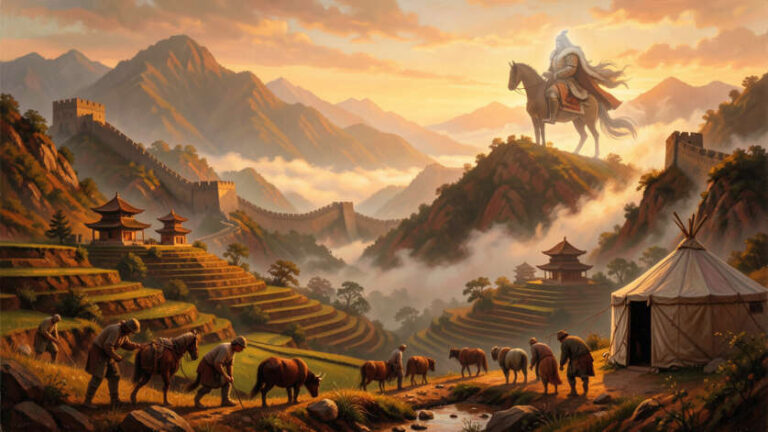
The most famous of these projects is, without doubt, the initial linking and fortification of the Great Wall. To defend against nomadic raids from the north, he ordered General Meng Tian to lead 300,000 soldiers to connect existing defensive walls from the former states. This created a continuous barrier, the earliest version of the Great Wall of China.
Another colossal undertaking was the empire-wide road and canal network. A system of straight, standardized highways, known as the “Straight Roads,” radiated from the capital, Xianyang, to the frontiers. This facilitated rapid troop movement and communication.
The Lingqu Canal was also dug to connect the Yangtze and Pearl River systems, enabling the conquest of the southern regions.
The Mausoleum and Terracotta Army
From the moment he became emperor, Qin Shi Huang began construction on his vast mausoleum near modern-day Xi’an. Historical texts describe a subterranean palace with rivers of mercury, ceilings depicting the heavens, and crossbow traps to deter grave robbers. The site covered a vast area and involved an estimated 700,000 workers.
The mausoleum’s most astonishing discovery, found in 1974, is the Terracotta Army. This collection of over 8,000 life-sized clay soldiers, horses, and chariots was buried with the emperor to guard him in the afterlife. Each figure is unique, with individualized facial features, hairstyles, and armor, showcasing incredible craftsmanship.
It stands as one of the most significant archaeological finds of the 20th century.
Important: The Terracotta Army was only a part of the mausoleum complex. Recent geophysical surveys suggest the main tomb chamber itself remains unopened and could contain treasures even more spectacular than the clay army.
Why Was Qin Shi Huang So Obsessed With Immortality?
The emperor who could conquer all men feared his own mortality. Qin Shi Huang’s later years were consumed by a frantic quest for eternal life. This obsession was likely fueled by a combination of ego, fear of the violent death he had inflicted on so many, and exposure to alchemists who promised elixirs of immortality.
He sent expeditions across the sea to find legendary islands of the immortals, such as Penglai. These missions, led by figures like Xu Fu, never succeeded. Some historians believe these expeditions may have been early voyages that reached Japan, though this is debated.
The emperor also consumed pills and potions made by court alchemists, many of which were likely toxic, containing ingredients like mercury.
This pursuit was deeply ironic. The man who sought to live forever was actively poisoning himself while also ensuring his own legacy through monuments. His paranoia and quest for immortality also led to purges within the court, as he saw conspiracies and betrayal everywhere, further isolating him in his final years.
How Did Qin Shi Huang Die and What Was His Immediate Legacy?
In 210 BCE, during a tour of eastern China, Qin Shi Huang died suddenly at the age of 49, likely due to mercury poisoning from the very pills he believed would prolong his life. His death was kept secret by the powerful eunuch Zhao Gao and Chancellor Li Si to prevent rebellion. They forged a will, forcing the emperor’s capable eldest son, Fusu, to commit suicide, and installed the weak younger son, Huhai, as the Second Emperor (Qin Er Shi).
This manipulation doomed the dynasty. The brutal, wasteful policies of the new emperor, coupled with the harsh legacy of Qin Shi Huang’s rule, sparked massive rebellions within months. The Chen Sheng and Wu Guang uprising, led by conscripted peasants, was the first in a wave that would engulf the empire.
Within four years of his death, the Qin Dynasty collapsed. However, the unified state he created did not. The Han Dynasty that followed, founded by Liu Bang in 206 BCE, inherited and maintained the Qin bureaucratic structure, laws, and concept of a unified empire.
In this way, Qin Shi Huang’s greatest achievement—the idea of a single, indivisible China—outlasted his dynasty.
What Was the Overall Impact of Qin Shi Huang on Chinese History?
The impact of Qin Shi Huang is a tale of two sides: the visionary unifier and the brutal tyrant. Historically, he has been one of the most controversial figures, vilified by Confucian historians who wrote the official histories of the dynasties that followed. They emphasized his cruelty, book burning, and tyranny.
On the other hand, the practical impact of his reign is undeniable. He turned a collection of warring kingdoms into a single political entity with a unified administration, economy, and written culture. The idea of China as a single civilization owes its origin to his conquests and reforms.
He set the template for every subsequent imperial dynasty.
His approach also created a deep-seated tension in Chinese political thought between the harsh, efficient control of Legalism and the more humane, moral governance of Confucianism. Most later dynasties adopted a hybrid model, using Confucian ideals on the surface while often employing Legalist mechanisms of control underneath.
| Controversies & Tyranny | Lasting Positive Legacy |
|---|---|
| The burning of books and burying of scholars, which suppressed intellectual freedom. | The unification of China into a single, enduring political and cultural entity. |
| Use of forced conscript labor for massive projects, leading to immense suffering and death. | Creation of a standardized written language that unified communication across regions. |
| Implementation of harsh Legalist punishments, including collective punishment for families. | Establishment of a centralized, bureaucratic system of government that lasted for millennia. |
| Extreme paranoia, leading to purges of officials, concubines, and even his own sons. | Economic standardization (currency, weights, measures) that facilitated national trade. |
| His mausoleum project drained resources and manpower from the state. | Infrastructure projects like roads and canals that connected the empire. |
This table captures the duality of his reign, where severe methods were used to achieve goals that fundamentally shaped the course of Chinese history.
Frequently Asked Questions
What does “Qin Shi Huang” mean?
“Qin” is the name of the state he ruled. “Shi” means “first,” and “Huang” is a character he created meaning “emperor” or “august sovereign.” So, “Qin Shi Huang” translates to “First Emperor of Qin.” He is also referred to as Qin Shi Huangdi.
Why was Qin Shi Huang considered a tyrant?
He is considered a tyrant for implementing brutally harsh Legalist laws, using mass forced labor for projects like the Great Wall and his mausoleum, and for his persecution of intellectuals, known as the burning of the books and burying of the scholars. His reign prioritized state power and control over human life and intellectual freedom.
What happened to the Terracotta Army?
The Terracotta Army was buried with the emperor around 210 BCE to protect him in the afterlife. The site was lost and covered over by later dynasties. It was accidentally discovered by farmers digging a well in 1974.
Today, it is a UNESCO World Heritage Site and one of the most important archaeological attractions in the world.
Did Qin Shi Huang build the entire Great Wall?
No. Qin Shi Huang is credited with the first major connection and fortification of existing regional walls to form a continuous northern barrier. The Great Wall as we know it today, especially the sections near Beijing, was largely built during the later Ming Dynasty.
The Qin-era wall was made of rammed earth and is mostly gone.
How long did the Qin Dynasty last after his death?
The Qin Dynasty lasted only fifteen years in total (221–206 BCE). Qin Shi Huang’s death in 210 BCE was followed by a brief, chaotic reign of his son, the Second Emperor. After widespread rebellions, the last Qin ruler surrendered in 206 BCE, ending the dynasty he created.
Final Thoughts
Qin Shi Huang was a force of history, a ruler whose actions irrevocably bent the arc of Chinese civilization toward unity. His legacy is etched in the stones of the Great Wall, the terracotta warriors guarding his tomb, and the very concept of a unified Chinese state. While his methods were often horrific, his impact on administration, culture, and political geography is profound.
The story of the First Emperor is ultimately a powerful lesson in how ambition, organization, and ruthlessness can reshape a world, for better and for worse.