
Essential Mandarin Phrases Every Traveler Must Learn
Learning essential Mandarin phrases for travelers can transform your trip from stressful to seamless. A few key words open doors to authentic experiences, helping you connect with locals and navigate with confidence. This guide covers the most important phrases for every situation you’ll encounter on the road in China or Taiwan.
Simply put, mastering a core set of Mandarin phrases empowers you to handle travel logistics, show respect, and build genuine connections. You don’t need fluency; knowing 30-40 key phrases and basic greetings will dramatically improve your journey and confidence.
Key Takeaways
- Essential Mandarin phrases for travel focus on greetings, polite requests, and survival needs, not complex grammar.
- Learning pronunciation basics like tones is more critical than perfect tones for being understood.
- Key phrase categories include navigation, dining, shopping, emergencies, and cultural courtesy.
- Digital translation tools are invaluable backups, but human interaction with Mandarin phrases yields richer experiences.
- Practical repetition and using phrases in real scenarios are the best ways to remember them.

Why Learning Mandarin Phrases Matters for Travelers
Even a small effort to speak the local language shows immense respect. According to a survey by the travel platform Trip.com, 78% of Chinese locals view tourists who attempt basic Mandarin more favorably. This goodwill often translates into warmer service, better recommendations, and occasional kindness.
Relying solely on translation apps can isolate you. The screen becomes a barrier instead of a bridge. When you look up from your phone and say “Nǐ hǎo” (Hello) with a smile, you initiate a human connection that no app can replicate.
This direct interaction is often the highlight of travel.
Knowing essential phrases also grants independence. You can read simple signs, order food confidently, ask for directions, and handle minor emergencies. This self-sufficiency reduces stress and allows you to embrace spontaneity, turning a planned tour into a true adventure.
Core Benefits at a Glance
- Build Rapport: A greeting in Mandarin immediately breaks the ice and shows you are a respectful visitor.
- Enhance Safety: Being able to say “Help” or “I need a doctor” is crucial in an emergency.
- Gain Access: You can navigate beyond tourist traps to local eateries and shops by asking for directions.
- Boost Confidence: Reducing language anxiety lets you focus on enjoying the moment and culture.
- Show Appreciation: A simple “Xièxiè” (Thank you) acknowledges the effort others make for you.

What Are the Most Essential Mandarin Phrases for Greetings and Politeness?
Greetings form the foundation of every interaction. Mandarin has a straightforward set of daily greetings that apply to most situations. Mastering these sets a positive tone for your entire conversation.
Politeness words are equally vital, as they soften requests and show good manners.
The phrase “Nǐ hǎo” is universally known but can sound formal. For casual settings, especially with peers, “Nǐ hǎo ma?” (How are you?) works well. Remember, the question “Nǐ hǎo ma?” expects the response “Hěn hǎo” (Very good), not a detailed update on your life.
Beyond hello and thank you, phrases for apologies and polite requests are crucial. Saying “Duìbùqǐ” (Sorry) or “Qǐng” (Please) demonstrates your awareness of social grace. These small efforts are deeply appreciated by native speakers.
| English Phrase | Mandarin Pinyin | Character | When to Use |
|---|---|---|---|
| Hello | Nǐ hǎo | 你好 | Formal greeting, any time of day. |
| Thank you | Xièxiè | 谢谢 | After receiving help, service, or a gift. |
| You’re welcome | Bù kèqì | 不客气 | In response to “xièxiè”. |
| Sorry / Excuse me | Duìbùqǐ | 对不起 | When bumping into someone or making a mistake. |
| Please | Qǐng | 请 | Before making a request. |
| Yes | Shì | 是 | Confirming a fact. |
| No | Bù shì | 不是 | Denying a fact or negating a statement. |
This table provides the absolute must-know phrases for any social interaction. Pronouncing these correctly will carry you through the vast majority of polite exchanges during your travels.
Getting from point A to point B is a top travel challenge. Mandarin has practical phrases for buses, taxis, subways, and asking for directions. The key is to know where you want to go and how to ask for the closest route.
Hotel staff are excellent allies for this—they can write down your destination in Chinese characters for you.
When in a taxi, showing the driver the written address on your phone is the most reliable method. You can follow up with “Dào le ma?” (Are we there yet?) or “Shuài le” (Stop here). For public transport, asking “Zhè lǐ yǒu gōngjiāo chē ma?” (Is there a bus here?) is useful.
Asking for directions involves a simple structure: “Qǐng wèn, zài nǎr?” (Excuse me, where is ?). Locals are often eager to help, so don’t be surprised if you get a detailed explanation or even an escort to the right place.
| Situation | Key Phrase (Pinyin) | Meaning |
|---|---|---|
| In a taxi | Qù zhè lǐ, qǐng. | Please take me to this place (show address). |
| Asking for a bus | Gōngjiāo chē zhàn zài nǎr? | Where is the bus stop? |
| Buying a subway ticket | Yī zhāng piào. | One ticket, please. |
| Getting lost | Wǒ mílù le. | I’m lost. |
| Asking for distance | Yǒu duō yuǎn? | How far is it? |
Important: Always have your destination written in Chinese characters (simplified for mainland China, traditional for Taiwan). Show this to drivers or when asking directions to avoid misunderstandings due to pronunciation.

Dining Out: Must-Know Mandarin Phrases for Ordering Food
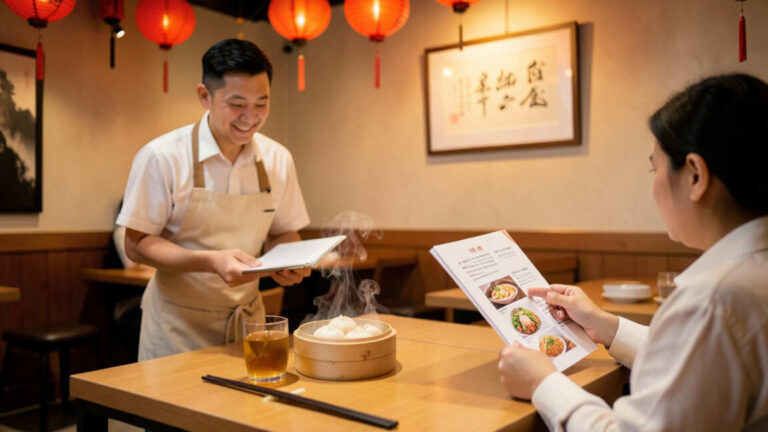
Food is a cornerstone of Chinese travel, and dining out requires a specific set of phrases. The first step is getting a table, often done by simply saying “Liǎng gè rén” (Two people) while holding up fingers. To get the menu, say “Càidān, qǐng” (Menu, please).
Ordering involves pointing at the menu and saying “Wǒ yào zhège” (I want this) or “Zhè ge” (This one). Be aware of the classifier “gè” (个), which is a general-purpose counter for items. To ask for recommendations, try “Nǐmen de tuījiàn shì shénme?” (What is your recommendation?).
Crucial phrases for dietary needs include “Wǒ bù chī ” (I don’t eat ), such as “Wǒ bù chī ròu” (I don’t eat meat). For allergies, “Wǒ duì guòmǐn” (I’m allergic to ) is vital. Tipping is not customary in China; the bill is paid at the front register.
- Hǎo chī! – Delicious! (Great for complimenting the chef)
- Tài guì le – Too expensive! (Use politely or humorously)
- Méi shìr – No problem / It’s okay (Versatile response)
- Bǎozhàng – Receipt (Needed for expense reports)
- Fùjìn yǒu chīfàn de dìfāng ma? – Is there a place to eat nearby?
- Wǒ chī sù – I am vegetarian.
- Jiā fàn – Add rice (to a dish)
Shopping and Bargaining: Mandarin Phrases for Markets and Stores
From bustling night markets to high-end boutiques, shopping is a major activity. Bargaining is expected in markets but not in fixed-price stores. The key is to remain friendly and smile throughout the process.
The opening phrase “Duōshǎo qián?” (How much money?) starts the negotiation.
A common tactic is to ask for the price, then offer a lower amount, saying ” tài guì le, qián xíng ma?” (Too expensive, is money okay?). The seller will counter, and you continue until you agree or walk away. Always count your change carefully.
Useful shopping phrases include “Zhège yǒu dà de xiǎo de ma?” (Does this have big and small sizes?) and “Kěyǐ shì ma?” (Can I try it on?). For souvenirs, “Wǒ xiǎng mǎi yīgè jìniànpǐn” (I want to buy a souvenir) is helpful. Complimenting an item with “Hǎo kàn” (Good-looking) can also create goodwill.
Tip: Start bargaining at about 50-60% of the asking price. The final price is usually somewhere in the middle. Walking away is the most powerful bargaining tool. If the price is fair, they may call you back.

Emergency Mandarin: Phrases for Health, Safety, and Getting Help
Being prepared for emergencies is critical. The most important phrase is “Bāngzhù!” (Help!). If you need to go to a hospital, say “Wǒ xūyào kàn yīshēng” (I need to see a doctor) and point to where it hurts.
“Zhège yào duōshǎo qián?” (How much is this medicine?) is needed at a pharmacy.
For police assistance, find an officer and say “Wǒ xūyào bāngzhù” (I need help) or “Yǒu xiǎotōu” (There’s a thief). If your belongings are stolen, go to the nearest police station and say “Wǒ de dōngxī bèi tōu le” (My things were stolen). They may help fill out a report for your travel insurance.
Communication barriers are biggest in emergencies. Consider having a card with key phrases and your hotel address written in Chinese. The universal gesture of holding your hand to your ear like a phone and saying “Diànhuà” (Telephone) can also summon help.
Critical Emergency Vocabulary
- Jiùmìng a – Help! Save life! (Most urgent)
- Wǒ bìng le – I am sick.
- Diànhuà – Telephone (Use to signal you need to call)
- Zuìjìn de yīyuàn – Nearest hospital
- Jǐngchá – Police
- Hùzhào – Passport (Often needed for reports)
- Shīwù – Lost & Found

Cultural Etiquette: Phrases to Show Respect and Avoid Mistakes
Culture is woven into language. Certain phrases and gestures show deep respect. When meeting someone, a slight nod or bow is appropriate.
Using “Nín” (You, polite form) instead of “Nǐ” with elders or in formal settings is highly respectful.
Topics to avoid in casual conversation include politics, personal income, and age. If asked something sensitive, you can politely deflect with “Tài nán le, wǒ bù zhīdào” (Too difficult, I don’t know). Accepting and giving business cards with two hands is a sign of respect in business contexts.
When sharing a toast, clink glasses and say “Gānbēi” (Cheers, literally “dry cup”). When receiving a gift, it is polite to open it later, not immediately in front of the giver. Saying “Zhège tài guìzhòng le” (This is too valuable) when receiving a gift is a traditional way to show humility.
Warning: Never write someone’s name in red ink, as this symbolizes death in Chinese culture. Sticking chopsticks upright in a bowl of rice resembles funeral incense and should be avoided.
How to Practice and Remember Mandarin Phrases Effectively
Learning phrases is useless if you can’t recall them under pressure. Active practice is key. Use flashcard apps like Anki or Quizlet, creating decks for each category (dining, transport, etc.).
Review them daily for 10-15 minutes, focusing on one category at a time.
Practice speaking aloud, even if alone. Record yourself and compare your pronunciation to native speaker audio. Focus on getting the tones broadly correct for clarity, not perfection.
The first tone (high, flat) and fourth tone (falling) are most critical for basic understanding.
Immerse yourself before the trip. Listen to Mandarin pop music or watch Chinese dramas with English subtitles. Label items in your home with sticky notes in Mandarin.
When you arrive, start with simple phrases. The more you use them, the more they become automatic memory.
- Use Spaced Repetition: Review phrases at increasing intervals (1 day, 3 days, 1 week) to move them into long-term memory.
- Create Mnemonics: Associate the sound with a familiar word. “Xièxiè” sounds like “shy shy.” Link it to the image of someone shyly thanking you.
- Group by Context: Don’t just memorize lists. Learn phrases you need for the taxi ride together: “Hello,” “Where to,” “Stop here,” “Thank you.”
- Role-Play Scenarios: Practice ordering a full meal or buying an item with a friend or family member, even if they don’t speak Mandarin.
- Embrace Mistakes: Locals appreciate effort. A wrongly pronounced phrase with a smile is still a successful interaction.
Digital Tools and Resources for Learning Mandarin Travel Phrases
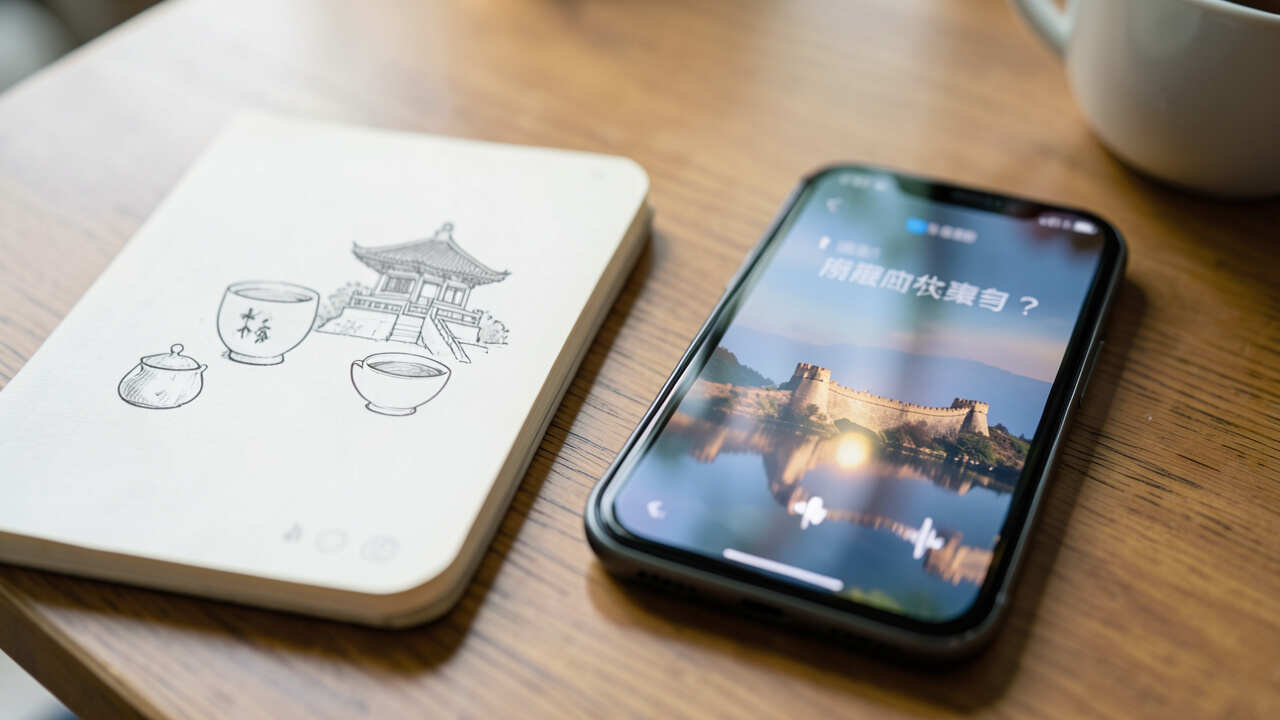
Technology can accelerate your learning. Smartphone apps provide structured lessons, audio pronunciation, and on-the-go practice. Google Translate’s conversation mode and camera translation are indispensable for real-time help, but they should support, not replace, your learned phrases.
Pleco is the gold-standard dictionary app for Chinese, with built-in flashcards and handwriting recognition. Duolingo or HelloChinese offer gamified beginner courses. For audio, the “ChinesePod” podcast has specific travel episodes.
YouTube channels like “Mandarin Corner” provide real-world, contextual dialogues.
A portable, pocket-sized phrasebook from a reputable publisher like Lonely Planet is a battery-free backup. Download offline translation packs for your destination. Consider a simple phrasebook app that works without internet, which is often unreliable on the go.
| Tool Type | Recommended Options | Best For |
|---|---|---|
| Dictionary & Pronunciation | Pleco, Google Translate | Looking up words and hearing native audio. |
| Structured Learning | HelloChinese, Duolingo | Building basic grammar and vocabulary. |
| Flashcard SRS | Anki, Quizlet | Memorizing specific travel phrase lists. |
| Real-World Context | YouTube (Mandarin Corner), Podcasts | Hearing phrases used in natural conversation. |
| Offline Backup | Pocket phrasebook, offline dictionary packs | Accessing information without internet. |
Frequently Asked Questions
Is it really necessary to learn Mandarin if everyone uses translation apps?
While apps are great for complex translations, basic spoken phrases are irreplaceable for building immediate rapport, handling simple interactions quickly, and functioning during phone or internet dead zones. The effort to learn them is a gesture of respect that enhances your overall travel experience.
How difficult is Mandarin pronunciation for English speakers?
The sounds of Mandarin are learnable, but the tones are the biggest challenge for English speakers. Focus on learning the four tones from the beginning, as they change the meaning of words. Starting with the most common phrases helps you get used to the musicality of the language.
What is the single most useful Mandarin phrase for a traveler?
“Xièxiè” (Thank you) is arguably the most useful. It expresses gratitude after virtually any interaction, from buying a ticket to receiving directions. A close second is “Duìbùqǐ” (Sorry/Excuse me), which is essential for navigating crowded spaces politely.
Are there significant differences in Mandarin between mainland China and Taiwan?
The spoken language is mutually intelligible with minor differences in accent and some vocabulary. The main difference is the writing system: mainland China uses Simplified characters, while Taiwan uses Traditional characters. The phrases in this guide are understood in both regions.
How can I politely refuse food or drink if I’m offered something I don’t like?
You can say “Xièxiè, wǒ bù chī/ hē” (Thank you, I don’t eat/drink it) with a smile. If you have a dietary restriction, say “Wǒ bù chī ròu/ jī dàn” (I don’t eat meat/eggs). Always start with “xièxiè” to soften the refusal and show appreciation for the offer.
Final Thoughts
Essential Mandarin phrases are your key to unlocking a richer, more independent, and respectful travel experience. You don’t need to be fluent to make a significant impact. Focus on mastering the core greetings, navigational commands, and dining phrases outlined here.
Your efforts will be met with warmth and often lead to unexpected adventures. Start practicing today, and watch how these simple words transform your journey.