Boxer Rebellion: Causes, Consequences, and Lasting Impact
The Boxer Rebellion was a violent anti-foreign uprising in China that fundamentally altered the course of the Qing Dynasty and its relationship with the world. Understanding its complex causes and far-reaching consequences is essential for grasping a pivotal moment in early 20th-century history. This guide breaks down the key events, the motivations behind the uprising, and its profound impact on China’s future.
In short, the Boxer Rebellion (1899-1901) was a desperate, nativist movement against foreign influence in China, fueled by economic distress, natural disasters, and xenophobia. Its brutal suppression led to crippling indemnities, deepened foreign control, and accelerated the Qing Dynasty’s collapse, ultimately setting the stage for modern China’s revolutionary path.
Key Takeaways
- The Boxer Rebellion was a complex movement driven by economic hardship, natural disasters, and a deep-seated fear of foreign encroachment.
- Empress Dowager Cixi’s covert support for the Boxers turned a regional revolt into a full-scale international crisis.
- The military intervention by the Eight-Nation Alliance resulted in the punitive Boxer Protocol, which severely weakened China’s sovereignty.
- The rebellion’s failure discredited the Qing court, directly contributing to the Xinhai Revolution and the end of imperial rule in China.
What Were the Deep-Rooted Causes of the Boxer Rebellion?
The eruption of the Boxer Rebellion was not a sudden event but the result of decades of simmering tension. The Qing Dynasty was in a state of profound decline, weakened by internal corruption and external military defeats. The First and Second Opium Wars had forced China to accept unequal treaties, ceding territory like Hong Kong and opening “treaty ports” to foreign trade.
This period, known as the “Century of Humiliation,” created widespread resentment. Foreign powers, including Britain, France, Germany, Russia, Japan, and the United States, gained extraterritorial rights, meaning their citizens were not subject to Chinese law. Christian missionaries and their converts were often seen as agents of this foreign penetration, disrupting traditional Confucian values and social structures.
Economic Desperation and Natural Disasters
For the rural peasant population, the late 19th century was a time of acute suffering. A series of devastating floods and droughts, particularly the North China Famine of 1899-1900, destroyed harvests and displaced millions. The Qing government’s inability to provide relief eroded its legitimacy.
Foreign economic activity, such as the expansion of railways and telegraph lines, was viewed not as progress but as a destructive force that displaced traditional livelihoods and desecrated sacred ground (feng shui).
- Unequal Treaties: Ceded territory and imposed massive war indemnities.
- Extraterritoriality: Foreigners operated outside Chinese law, creating resentment.
- Christian Conversion: Missionary activity was perceived as a cultural and spiritual attack.
- Infrastructure Projects: Railroads and mines were seen as threats to tradition and livelihoods.
- Natural Disasters: Famine and floods created a desperate, angry populace.
| Grievance Type | Specific Example | Perceived Impact |
|---|---|---|
| Economic | Foreign-owned railways | Disrupted traditional travel and transport, taking jobs. |
| Religious | Christian missionary schools | Undermined Confucian teachings and family loyalty. |
| Political | Spheres of influence | Marked the slow dismemberment of Chinese sovereignty. |
How Did the Rebellion Gain Momentum and Who Were the Boxers?
The movement known as the “Boxers United in Righteousness” consisted of peasants, mostly from Shandong province. They practiced martial arts and believed they possessed spiritual powers that made them impervious to bullets. Their slogan, “Support the Qing, destroy the foreign,” clearly stated their goals.
Initially, they targeted Chinese Christians and foreign property in rural areas.
The rebellion’s critical turning point was the tacit, then active, support from the Qing court. The conservative Empress Dowager Cixi, who had recently reasserted control from behind the throne, resented the foreign powers’ backing of the reform-minded Emperor Guangxu. Seizing a chance to expel the foreigners, she endorsed the Boxers, allowing them to march on Beijing and attack foreign legations in the summer of 1900.
Warning: The rebellion descended into extreme violence. Boxer gangs killed thousands of Chinese Christians and foreign missionaries before focusing their attack on the besieged International Legation Quarter in Beijing.
The Siege of the Legations
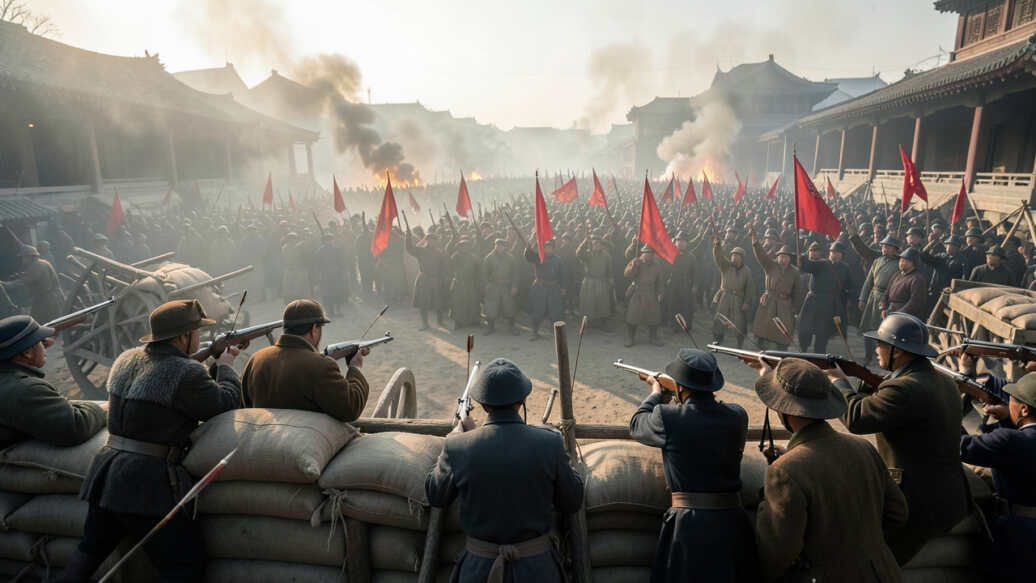
For 55 days, a contingent of approximately 400 foreign soldiers, diplomats, and civilians from 11 nations was besieged in the legation quarter by tens of thousands of Boxer fighters and Qing imperial troops. The besieged held out against overwhelming odds, enduring starvation and constant attack. The event captured global headlines and hardened international resolve for a full-scale military intervention.
The Key Players in the crisis included:
- Empress Dowager Cixi: The de facto ruler who encouraged the anti-foreign sentiment.
- The Boxers: The peasant militia, often led by local leaders with spiritual authority.
- Prince Duan: A radical Qing prince who fueled Cixi’s anti-foreign stance.
- The Eight-Nation Alliance: The military force from Britain, France, Germany, Russia, Japan, the US, Italy, and Austria-Hungary.
What Was the International Response and the Boxer Protocol?
As news of the siege and massacres reached the West and Japan, the Eight-Nation Alliance dispatched a multinational military expedition to relieve the legations and punish the Qing government. The coalition force, which included seasoned troops from the British Indian Army and the Japanese Army, advanced from the coast towards Beijing, fighting key battles along the way.
The allied forces entered Beijing in August 1900, rescuing the besieged survivors. In the aftermath, the Qing court fled, and a period of rampant looting and retribution followed. The primary diplomatic consequence was the negotiation of the Boxer Protocol (also known as the Peking Protocol) in 1901, a punitive treaty imposed on the weakened Qing Dynasty.
| Clause of the Boxer Protocol | Consequence for China |
|---|---|
| War Indemnity of 450 million silver taels | A sum exceeding the entire annual Qing government revenue, to be paid over 39 years with interest. |
| Foreign troops stationed in Beijing | The right for foreign powers to maintain a permanent military presence along the route to the sea. |
| Demolition of Chinese forts | The destruction of key coastal defense works near Beijing. |
| Ban on anti-foreign organizations | The Qing government was forced to outlaw secret societies and enforce anti-foreign laws. |
The indemnity payments consumed a vast portion of China’s state finances for decades, crippling its ability to modernize and fund essential services. This severe financial penalty and the permanent foreign military presence on Chinese soil shattered the Qing government’s remaining authority in the eyes of its people.
How Did the Rebellion Directly Contribute to the Fall of the Qing Dynasty?
The aftermath of the Boxer Rebellion created a fatal crisis of legitimacy for the Qing court. Empress Dowager Cixi survived politically by scapegoating conservative allies, but the disaster proved the dynasty was too incompetent to protect China from humiliation. The crushing indemnity payments starved the government of funds needed for modernization and reform, making further efforts like the “New Policies” appear weak and insincere.
The rebellion accelerated the rise of revolutionary sentiment. Figures like Sun Yat-sen used the Qing’s failure as proof that the monarchy was obsolete and must be replaced with a republic. Secret societies, student groups, and disaffected military officers who had once hoped for reform now saw revolution as the only solution.
The failed uprising drained the last of the dynasty’s political capital.
The Path to Revolution: 1901-1911
In the decade following the rebellion, the Qing court attempted a series of hurried reforms to survive. These included plans for a constitutional monarchy and the abolition of the ancient civil service exam system. However, these efforts came too late and pleased no one.
Reformists found them insufficient, while hardline conservatives saw them as a betrayal of tradition.
- Financial Ruin: Indemnity payments made the government insolvent and unable to fund reforms.
- Military Modernization Backfired: New armies, like the Beiyang Army, became powerful and loyal to local commanders, not the court.
- Provincial Assemblies: Newly formed local political bodies became hotbeds for anti-Qing agitation.
- Loss of Prestige: The court was seen as a puppet of foreign powers, not a sovereign Chinese institution.
Tip: Historians often point to the Boxer Rebellion as the point of no return. The Qing Dynasty lost the moral and financial authority to govern, making the 1911 Xinhai Revolution almost inevitable.
What Were the Long-Term Consequences for China’s Sovereignty and Society?
The consequences of the failed rebellion reshaped China for the 20th century. In the immediate term, foreign dominance deepened. The permanent stationing of troops and the control of railway guards by foreign powers meant that China’s capital and key infrastructure were under international supervision.
This further eroded national sovereignty and became a central grievance for later nationalist movements.
Socially, the rebellion intensified anti-foreign and anti-Christian sentiment, which persisted for decades. It also had a devastating demographic impact. Accurate figures are difficult to obtain, but historical sources indicate that tens of thousands of Chinese Christians, both Catholic and Protestant, were killed during the uprising.
Hundreds of foreign missionaries and their children also lost their lives.
Why Is the Boxer Rebellion Significant in Modern History?
The significance of the Boxer Rebellion extends far beyond its immediate timeline. It is a powerful case study in the dynamics of cultural clash, imperial overreach, and the perils of reactionary politics. For China, it marked the violent end of any hope for the Qing Dynasty to manage Western engagement on its own terms.
In international relations, the episode established a precedent for collective military action by Western powers and Japan to protect “interests” in Asia. It solidified the image of China as a “sick man” in need of foreign supervision, a perception that Chinese nationalists spent the next century working to dismantle.
For historians, the rebellion offers lessons on how economic despair and cultural anxiety can be manipulated into violent conflict. It also demonstrates how a conservative regime, in its attempt to harness popular anger for political gain, can unleash forces that ultimately destroy itself. The echoes of this pattern can be seen in various nationalist movements throughout modern history.
Frequently Asked Questions
What does “Boxer” refer to in the rebellion?
The term “Boxer” is an English translation for the practitioners of the martial arts disciplines the rebels practiced, which included various forms of Chinese boxing and gymnastics. The Chinese name for the movement was “Yihetuan,” which translates to “Militia United in Righteousness.”
How did other nations react to the siege of the legations?
The siege of the foreign legations in Beijing was reported extensively in the international press. It sparked outrage in Western countries and Japan, leading to public demands for government action. This unified sentiment enabled the rapid formation of the Eight-Nation Alliance, a rare example of a large-scale, coordinated military intervention by multiple powers.
Did the rebellion have any positive effects for China?
In the immediate sense, the rebellion was a catastrophic failure for China, bringing military defeat and financial ruin. However, the long-term consequence was the acceleration of the Qing Dynasty’s collapse. This cleared the path for the 1911 Revolution and the eventual establishment of the Republic of China, which sought to rebuild the nation on modern, sovereign principles.
What was Empress Dowager Cixi’s role in the rebellion?
Initially, Cixi adopted an ambiguous stance, but she ultimately sided with the Boxers against the advice of her more moderate advisors. She hoped to use the Boxers as a tool to expel the foreign powers and reassert Qing authority. Her decision to declare war on the foreign powers and support the siege of the legations turned a regional revolt into a national disaster.
How long did the Boxer Rebellion last?
The active phase of the rebellion lasted from the autumn of 1899 through the summer of 1901. The most intense fighting occurred during the Siege of the Legations, which lasted 55 days from June to August 1900. The formal end of the conflict was marked by the signing of the Boxer Protocol on September 7, 1901.
Final Thoughts
The Boxer Rebellion stands as a dramatic climax to the Qing Dynasty’s long struggle with Western imperialism. Driven by genuine desperation but ultimately futile, it resulted in a punitive peace that deepened China’s semi-colonial status. Most importantly, the rebellion’s failure fatally weakened the imperial state, directly paving the way for the revolutionary movements that would soon overthrow two millennia of imperial rule and reshape China’s destiny in the modern world.