Taiping Rebellion Explained: Causes, Key Events, Impact
The Taiping Rebellion was a massive civil war in China that lasted from 1850 to 1864. It was led by Hong Xiuquan and his Taiping Heavenly Kingdom against the ruling Qing Dynasty. This conflict is often called the bloodiest civil war in history.
Understanding its causes, key figures, and devastating impact is crucial for grasping modern Chinese history.
This rebellion reshaped China’s political and social landscape. It resulted in an estimated 20 to 30 million deaths. The sheer scale of the Taiping Rebellion makes it one of the most significant events of the 19th century.
We will explore what sparked this massive uprising and how it eventually fell.
Simply put, the Taiping Rebellion was a catastrophic civil war in Qing Dynasty China. Sparked by a failed scholar’s divine revelation, it created a rival state that nearly toppled the empire. The war led to an immense loss of life and fundamentally weakened imperial authority.
Key Takeaways
- The Taiping Rebellion was the deadliest civil war in history, causing up to 30 million fatalities.
- Led by Hong Xiuquan, the rebellion was driven by a unique mix of Christian-inspired ideology and anti-Manchu sentiment.
- The Taiping Heavenly Kingdom established its own capital, government, and social reforms, including gender equality.
- Internal strife and the eventual Qing victory ended the rebellion but left the dynasty fatally weakened.
- The conflict’s legacy includes the rise of regional armies and foreign intervention that altered China’s trajectory.
What Was the Taiping Rebellion and Why Did It Start?
The Taiping Rebellion began as an uprising by the God Worshipping Society. This group was founded by Hong Xiuquan, a man who had repeatedly failed the imperial civil service exams. After a mental breakdown, Hong interpreted Christian pamphlets he had received.
He believed he was the younger brother of Jesus Christ, sent to rid China of demons.
This religious vision quickly turned political. Hong identified the ruling Manchu-led Qing Dynasty as the demonic force oppressing the Chinese people. His message resonated with millions of peasants, miners, and marginalized groups in southern China.
The region was suffering from economic turmoil, crop failures, and heavy taxes.
The Qing government’s inability to manage natural disasters, like floods and famines, eroded its legitimacy. Hong Xiuquan offered both spiritual salvation and a tangible promise of a new, equal society. This powerful combination transformed a local religious movement into a full-scale revolution.
Core Grievances Fueling the Revolt
- Economic Hardship: Widespread poverty, debt, and a dysfunctional tax system created desperation.
- Foreign Encroachment: The Opium Wars had humiliated the Qing and disrupted traditional economies.
- Social Unrest: A growing population combined with limited resources led to constant tension.
- Manchu Rule: Resentment against ethnic Manchu rulers over the Han Chinese majority was strong.
- Corruption: The Qing bureaucracy was seen as corrupt and ineffective.
Warning: The rebellion’s death toll is staggering. Estimates range from 20 to 30 million people, making it deadlier than World War I. Famine and disease killed as many as direct combat.
Who Were the Key Figures in the Taiping Rebellion?
The conflict was defined by its charismatic leaders and brutal generals. Understanding these individuals is key to understanding the rebellion’s dynamics. The two most important figures were the rebel leader Hong Xiuquan and the Qing general Zeng Guofan.
Hong Xiuquan was the ideological heart of the movement. He remained in the Taiping capital, Nanjing, issuing decrees and managing his theocratic state. In contrast, Zeng Guofan was the military architect of the Qing’s response.
He organized local armies, known as the Xiang Army, which became the dynasty’s salvation.
The Taiping Leadership
| Leader | Role & Significance |
|---|---|
| Hong Xiuquan | The “Heavenly King” and spiritual leader. His vision unified the rebels but his later isolation weakened command. |
| Yang Xiuqing | The “Eastern King.” A brilliant military commander who controlled Nanjing until Hong ordered his execution, causing internal purges. |
| Shi Dakai | The “Wing King.” A capable leader who later led a splinter group. His capture and execution marked a major blow to Taiping hopes. |
The Taiping Heavenly Kingdom also featured notable female leaders. Hong Xiuquan’s wife, Lai Zhen’en, was influential. Taiping armies included “Female Generals” who led troops, a radical departure from Confucian norms.
This reflected the movement’s initial promise of gender equality.
The Qing Response and Zeng Guofan
The Qing court initially struggled to respond. Its traditional “Eight Banner” armies were ineffective. The breakthrough came with scholar-officials like Zeng Guofan.
He built the Xiang Army on traditional Confucian loyalty to local communities.
Zeng’s strategy was methodical. He focused on recapturing key cities and切断 Taiping supply lines. His forces were known for their discipline and use of modern weaponry purchased from foreigners.
Zeng Guofan’s victory solidified a new era of regional military power in China.
Tip: Zeng Guofan’s Xiang Army was funded by local gentry and used innovative logistics. This model was copied to create other regional armies, which later fractured China’s political unity.
How Did the Taiping Heavenly Kingdom Operate?
Once the Taiping captured Nanjing in 1853, they established it as their capital, “Tianjing.” They created a complex government structure that blended monarchy with their unique religious beliefs. The kingdom issued its own currency, calendar, and a series of land and social reforms.
Hong Xiuquan divided the kingdom among several “Kings,” each with administrative duties. A strict code of laws was enforced, based on Hong’s interpretation of Christianity. Opium, alcohol, gambling, and prostitution were banned.
The population was organized into communal groups, and private property was largely abolished in favor of state-controlled distribution.
Social and Gender Reforms
- Land Redistribution: Land was to be distributed equally based on family size, though this was never fully implemented.
- Gender Equality: Women were allowed to take civil service exams, hold military posts, and were forbidden from foot-binding.
- Communal Living: Men and women were separated in barracks, and marriages were arranged by the state.
- Education System: The Taiping created their own exams to promote loyal officials.
- Religious Edicts: Statues of traditional gods were destroyed, and the population was forced to adopt Taiping rituals.
However, the kingdom’s administration was plagued by problems. The early reforms deteriorated as the leadership became corrupt. Constant warfare left little time for governance.
The brutal purges, most notably the “Tianjing Incident,” decimated the rebel leadership in 1856.
A Comparison of Taiping and Qing Ideologies
The two sides fought not just for territory, but for a vision of China’s future. Their fundamental differences are clear.
| Aspect | Taiping Heavenly Kingdom | Qing Dynasty |
|---|---|---|
| Governing Ideology | A syncretic Christian-based theocracy. | Confucian bureaucracy under a Manchu emperor. |
| Social Structure | Egalitarian ideals (in theory), communal living. | Strict Confucian hierarchy and filial piety. |
| View of Tradition | Radical break; destroyed temples and statues. | Custodian of Chinese tradition and culture. |
| Economic Policy | Abolished private land ownership; state stores. | Traditional agrarian tax system with gentry intermediaries. |
This ideological clash made compromise impossible. The conflict was a total war between two fundamentally different worlds.
What Were the Major Battles and Turning Points of the Rebellion?
The war saw dozens of major battles over 14 years. The early phase saw the Taiping achieve stunning victories. They captured major cities like Nanjing and Wuhan, establishing a vast territory.
However, the rebellion’s momentum eventually stalled due to internal strife and a reorganized Qing response.
The “Tianjing Incident” of 1856 was the primary turning point. A power struggle led to Hong Xiuquan ordering the execution of Yang Xiuqing and thousands of his followers. This brutal purge crippled the Taiping’s most effective military command and shattered its early unity.
The Siege of Nanjing: The Final Act
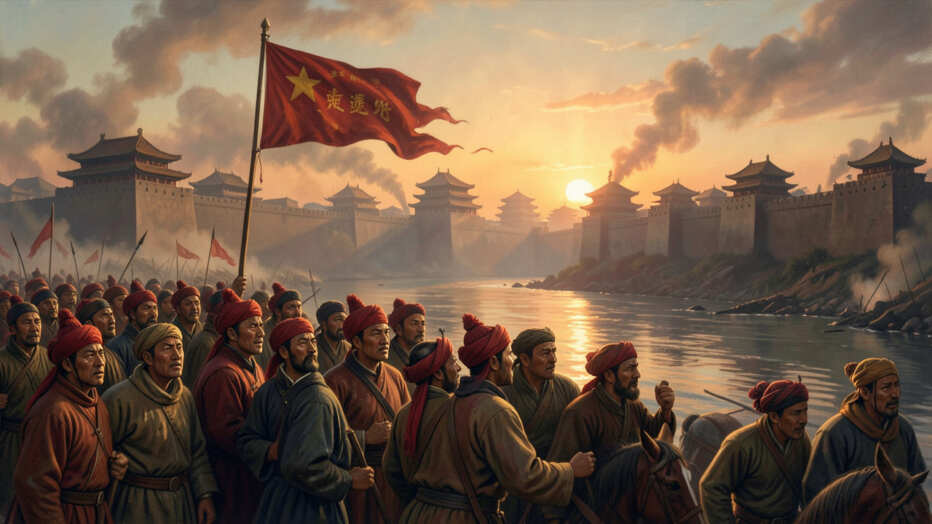
The last chapter of the rebellion was the prolonged Siege of Nanjing (1862-1864). Zeng Guofan’s Xiang Army completely surrounded the Taiping capital. They cut off all food supplies, leading to mass starvation.
The city’s population endured horrific conditions.
Important: The fall of Nanjing in July 1864 marked the effective end of the Taiping Heavenly Kingdom. Hong Xiuquan had died of illness just weeks before the city fell to Zeng’s forces.
Zeng Guofan’s victory was decisive but came at a cost. His regional army’s success demonstrated that the Qing central government relied on local military power. This set a dangerous precedent for the warlordism that would dominate China in the 20th century.
How Did Foreign Powers Influence the Taiping Rebellion?
Foreign nations, primarily Britain and France, played a crucial, if ambiguous, role. Initially, they were neutral, observing the chaos to see which side might offer better trade terms. The Taiping’s anti-foreign stance and economic disruption made them a poor prospect.
The Qing court, conversely, promised to honor existing treaties if they received support. The turning point was the “Ever-Victorious Army,” a Chinese force trained and led by Western officers. The most famous commander was American adventurer Frederick Townsend Ward, later succeeded by British officer Charles George “Chinese” Gordon.
Foreign intervention was not uniform. Some Western mercenaries fought for the Taiping. The Taiping also attempted to build diplomatic ties with the West.
Hong Xiuquan sent letters to Queen Victoria and other leaders, appealing to a shared Christian heritage. These overtures were ignored.
Why the West Ultimately Sided with the Qing
- Stability and Trade: The Qing government was a known entity that guaranteed treaty ports. Taiping victory was seen as too risky.
- Ideological Alienation: Westerners found the Taiping’s version of Christianity heretical and bizarre.
- Taiping Disruption: The Taiping attacks on key economic regions like the Yangtze Valley hurt British and French commerce.
- Protection of Concessions: Foreigners needed to protect their settlements in Shanghai and other cities from the conflict.
Foreign assistance was limited but decisive in key battles. It provided the Qing with superior weaponry and tactical leadership at critical moments. This intervention is a key example of how imperialism directly influenced internal Chinese conflicts.
What Was the Lasting Impact of the Taiping Rebellion on China?
The immediate aftermath of the rebellion was a weakened but surviving Qing Dynasty. The true impact, however, was long-term and profound. The war shattered the illusion of Qing invincibility and accelerated its decline.
The massive death toll and destruction of agricultural land caused an economic depression in central and southern China. It took decades for the population and economy to recover. The human cost was so high that it affected China’s demographic trends for generations.
Political and Military Consequences
- Rise of Regionalism: The Qing relied on regional armies like the Xiang Army. This broke the central government’s monopoly on military power.
- Warlordism Precedent: Powerful regional commanders who saved the dynasty later became independent warlords after its fall.
- Strengthening of the Gentry: The scholar-gentry class gained even more local power through their role in organizing suppression.
- Qing Self-Strengthening: The shock of near-collapse prompted efforts like the Self-Strengthening Movement to adopt Western technology.
The rebellion also changed the cultural and intellectual landscape. The failure of the Taiping’s radical experiment discredited theocracy. It also demonstrated the deep-seated desire for change, paving the way for later revolutionary movements like the one led by Sun Yat-sen.
Why Is the Taiping Rebellion Often Called the “Forgotten War”?
Despite its colossal scale, the Taiping Rebellion receives less attention in Western history compared to contemporary events like the American Civil War. Several factors contribute to this lack of visibility. The primary reason is the absence of significant Western media coverage at the time.
Journalism was less developed, and China was seen as remote. The conflict’s complexity and religious nature made it difficult for Western audiences to understand. Furthermore, the narrative was often framed as “Chinese versus Chinese,” with less clear-cut sides for Western observers to support.
Chinese historiography itself has also influenced its profile. For the Qing, it was a painful internal failure. For later nationalist and communist regimes, the rebellion was a complicated predecessor.
It was a peasant uprising they could admire, but one led by a deluded religious figure they could not celebrate.
Frequently Asked Questions
What was the main cause of the Taiping Rebellion?
The rebellion was caused by a combination of factors: widespread economic hardship, social unrest, and resentment toward the ruling Manchu dynasty. Hong Xiuquan’s unique religious vision that cast the Qing as demonic and offered a radical alternative ideology provided the catalyst and unifying cause for millions of discontented people.
How many people died in the Taiping Rebellion?
The death toll is estimated to be between 20 and 30 million people. This makes it the deadliest civil war in world history. Deaths resulted not only from direct combat but also from widespread famine, plague, and the social collapse caused by years of brutal fighting.
Did the Taiping Rebellion succeed or fail?
The rebellion ultimately failed. The Taiping Heavenly Kingdom was crushed by Qing forces in 1864. However, it succeeded in critically weakening the Qing Dynasty, contributing to its eventual collapse in 1912.
It also permanently shifted power to regional leaders within the empire.
Who led the Qing forces to victory in the Taiping Rebellion?
The primary military leader for the Qing was Zeng Guofan, a scholar-official who organized the volunteer Xiang Army. His disciplined forces and strategic patience were instrumental in surrounding and capturing the Taiping capital of Nanjing, ending the rebellion.
What was the God Worshipping Society?
The God Worshipping Society was the religious movement founded by Hong Xiuquan. It blended elements of Christianity with Chinese folk beliefs and millenarian traditions. It served as the ideological and organizational foundation for the Taiping Rebellion before evolving into the theocratic Taiping Heavenly Kingdom.
Final Thoughts
The Taiping Rebellion was more than just a war; it was a profound social and ideological earthquake. Its causes were rooted in the decay of the Qing system, and its legacy of regional militarism paved the way for the dynasty’s eventual fall. The conflict’s staggering human cost serves as a stark reminder of the devastating potential of civil war.
Studying this rebellion reveals the fragility of empires and the power of charismatic, radical ideas in times of crisis. The events between 1850 and 1864 permanently altered China’s path, setting the stage for the revolutionary upheavals of the 20th century. Its lessons on governance, social cohesion, and the dangers of ignoring widespread discontent remain relevant today.