
Common Chinese Characters With Multiple Meanings Explained
Common Chinese characters often carry several distinct meanings, which can be confusing for learners. Understanding these characters is key to unlocking reading fluency and proper comprehension. This guide breaks down the most frequent multi-meaning characters and shows you how to distinguish their uses.
Simply put, many essential Chinese characters are not one-trick ponies. They change meaning based on context, placement, and part of speech. Mastering these core characters is the fastest path from beginner to intermediate reading proficiency.
Key Takeaways
- Common Chinese characters like 了 (le/liǎo), 行 (xíng/háng), and 了 (le/liǎo) often have two or more primary pronunciations and meanings.
- Context is everything; the surrounding characters and sentence structure determine a character’s correct meaning.
- Focusing on the 200 most frequent characters provides a strong foundation, as they account for a huge portion of everyday text.
- Digital tools and example sentences are invaluable for practicing recognition in different contexts.
Why Do Some Chinese Characters Have Multiple Meanings?
The phenomenon is rooted in the history of the written language. Many characters originated as pictographs representing a single concept. Over millennia, these characters were borrowed to represent other, often phonetically similar, words.
This process, called phonetic loaning, is one of the primary reasons a single character can stand for multiple unrelated concepts. For example, the character 來 (lái), originally a pictograph of a wheat plant, was borrowed to mean “to come.”
- Pictographic Origin: The original character depicted a concrete object.
- Phonetic Borrowing: The character was adopted to write a different word with a similar sound.
- Character Compounding: New meanings arise when characters combine to form compound words.
- Evolution of Language: Some characters developed new, colloquial meanings over time.
The Chinese writing system prioritizes meaning over sound in its core structure. This allows one character to serve multiple grammatical functions, acting as a verb in one sentence and a noun in another.
Tip: When you encounter a known character in an unfamiliar context, assume its most common meaning first. If the sentence doesn’t make sense, check if the character has an alternate pronunciation and meaning.
What Are the Most Common Multi-Meaning Characters?
Beginners encounter several high-frequency characters with dual uses almost immediately. Learning these specifically can prevent major misunderstandings. Here is a breakdown of some of the most important ones.
| Character | Pronunciation 1 | Meaning 1 | Pronunciation 2 | Meaning 2 |
|---|---|---|---|---|
| 行 | xíng | to walk; okay; capable | háng | profession; row; business firm |
| 了 | le | particle indicating completed action | liǎo | to finish; to understand |
| 得 | de | structural particle linking verb to complement | dé | to obtain; to get |
| 还 | hái | still; yet; also | huán | to return; to give back |
| 发 | fā | to send out; to emit; to become | fà | hair |
These characters are workhorses of the language. Their dual nature makes them efficient but tricky. The next section explores how to handle one of the most famous examples in detail.
How to Master the Character “行” (Xíng vs. Háng)
The character 行 is a classic test case. Its meaning hinges entirely on the context of the sentence and the words it forms. Confusing its two main pronunciations can lead to funny or embarrassing mistakes.
When pronounced xíng, it relates to walking, going, or being permissible. It is commonly seen in words like 行走 (xíngzǒu – to walk) and 不行 (bùxíng – not okay). This is the more frequently used pronunciation in modern, everyday speech.
When pronounced háng, it shifts to mean a row, a line, or a profession. It is essential for words like 银行 (yínháng – bank), 行业 (hángyè – industry), and 排行榜 (páihángbǎng – rankings list).
- Sentence 1 (xíng): 这个办法行。(Zhège bànfǎ xíng.) – This method will work.
- Sentence 2 (háng): 他做这一行。(Tā zuò zhè yī háng.) – He works in this profession.
- Compound 1: 执行 (zhíxíng) – to execute/carry out
- Compound 2: 行业 (hángyè) – industry, trade, profession
The key is to memorize common compounds rather than the isolated character. Recognizing the word 银行 as a unit immediately tells you it’s “bank” (háng), not “silver walk” (xíng).
Warning: Saying “我姓行” (Wǒ xìng Xíng – My surname is Xing) is correct, but be careful. The sentence “这个工作行” could be misheard as “This job is okay (xíng)” or “This job profession (háng)”. Clarity often requires a slight pause or emphasis.
How to Distinguish “了” (Le vs. Liǎo) in Sentences
This tiny character causes disproportionate anxiety for learners. Its role is grammatical, not lexical, which makes it conceptually difficult. The particle 了 (le) and the verb 了 (liǎo) are functionally different words written with the same symbol.
了 (le) is a grammatical particle. It comes after a verb to indicate a completed action or a change of state. It has no translation of its own; its function is to provide tense or aspect information to the sentence.
了 (liǎo) is a verb meaning “to finish,” “to conclude,” or “to be able to” (in potential complements). It carries independent meaning and can often be replaced by other verbs like 完成 (wánchéng – to complete).
- Identify Position: A le at the end of a phrase or after the main verb is usually the particle.
- Check for a Second Verb: If there is a verb after 了, it is almost always the particle le. The second verb is the main action.
- Look for Negation: The verb 了 (liǎo) is often used with 不 or 没 in structures like 来不及 (láibují – there’s not enough time).
- Consider the Word Count: As a standalone verb, 了 (liǎo) is a single-syllable word. As a particle, it’s part of a two-character verbal unit.
Consider these examples: 我吃了 (Wǒ chī le) uses le to say “I ate.” 我吃不了 (Wǒ chī bu liǎo) uses liǎo in a potential complement to say “I cannot eat (it).”
Why is “得” (De vs. Dé) So Important for Sentence Structure?
The character 得 is fundamental to building complex sentences. It links a verb to its complement, which can describe the manner, degree, or result of the action. Getting this structure wrong makes sentences sound broken or unnatural.
When pronounced de (neutral tone), it acts as a structural particle. It connects the verb to an adjective or phrase describing how the action is performed. The pattern is: Verb + 得 + Complement.
When pronounced dé, it is a verb meaning “to get,” “to obtain,” or “to earn.” It is the core of words like 得到 (dédào – to obtain) and 得奖 (déjiǎng – to win a prize).
| Usage | Pronunciation | Example Sentence | Translation |
|---|---|---|---|
| Structural Particle | de | 他跑得很快。(Tā pǎo de hěn kuài.) | He runs very fast. |
| Verb “to get” | dé | 我得到了一份礼物。(Wǒ dédào le yí fèn lǐwù.) | I received a gift. |
| In Potential Complement | de/dé | 这个字写得好。(Zhège zì xiě de hǎo.) | This character is written well. |
The particle 得 (de) is indispensable for describing actions. The verb 得 (dé) is used less frequently in isolation but is vital for compounds about achievement and acquisition.
How to Use Context to Figure Out “还” (Hái vs. Huán)
The choice between 还 (hái) and 还 (huán) is one of the clearest cases where context provides the answer. These two words are so different in meaning that the sentence structure makes the correct meaning obvious to native speakers.
还 (hái) is an adverb meaning “still,” “yet,” “also,” or “in addition.” It comes before the verb it modifies. It adds nuance about the continuity of an action or the inclusion of something extra.
还 (huán) is a verb meaning “to return” or “to give back.” It functions as the main action of the sentence and can take direct objects.
- Use “hái” for: Frequency (他还来吗? – Is he still coming?), Degree (还不错 – not bad/still good), or Addition (我还要一杯 – I want another cup).
- Use “huán” for: Actions of returning (还书 – to return a book), Repayment (还钱 – to repay money), or Reciprocation (还手 – to hit back).
A simple test: Is there a clear object being returned or given back after the character? If yes, it’s likely huán. Is the character describing the manner or continuation of an action?
It’s probably hái.
What Are the Surprising Meanings of “发” (Fā vs. Fà)?
This character demonstrates how phonetic borrowing works. The modern, common meaning of 发 (fā) has nothing to do with its original meaning, which is now pronounced fà.
发 (fā) is one of the most productive verbs in Chinese. It means “to send out,” “to emit,” “to issue,” or “to become.” Its uses are vast: 发生 (fāshēng – to happen), 发展 (fāzhǎn – to develop), 发言 (fāyán – to speak), and 发烧 (fāshāo – to have a fever).
发 (fà) retains the original meaning of “hair.” It is used exclusively in this context, such as in 头发 (tóufa – hair on the head), 发型 (fàxíng – hairstyle), or 理发 (lǐfà – to get a haircut).
The semantic gap is wide. Think of fā as an action and fà as a noun. The context of the word is the only clue.
There are very few scenarios where the two could be confused in a sentence.
Important: The character 髮 is the traditional form used for “hair.” In Simplified Chinese, it is merged into 发. However, 发 (fā) for “to emit/send” has always been a separate character. This merger simplifies writing but increases the need for contextual understanding.
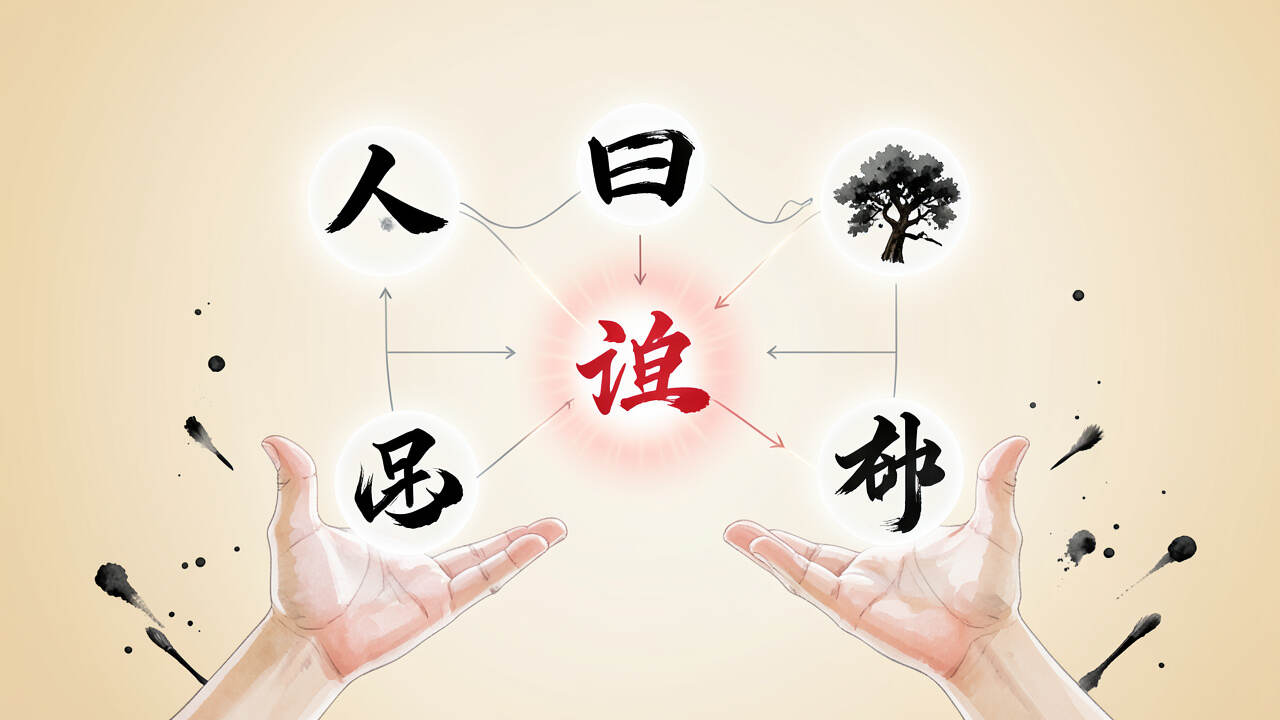
How Do Characters Combine to Form New Meanings?
The beauty of Chinese is in its compounding. Two or more characters combine to create a new word with a specific meaning, often different from the sum of its parts. This process mitigates the problem of multiple meanings by placing single characters in clear, defined roles.
Consider the character 生. Alone, it can mean “life,” “to be born,” or “raw.” But in compounds, its meaning becomes precise:
- 学生 (xuéshēng): Student (learning + life/person)
- 生活 (shēnghuó): Life, livelihood (life + living)
- 先生 (xiānshēng): Mr., sir, husband (first/early + birth)
- 发生 (fāshēng): To occur, happen (emit/send out + birth/arise)
- 生日 (shēngrì): Birthday (birth + day)
The character 生 contributes a core idea of “arising” or “life” to each compound, but the final meaning is locked in by its partner. Focusing on learning these whole words is more efficient than trying to guess every possible shade of meaning for a single character.
Which Tools Can Help You Learn Multi-Meaning Characters?
Modern technology offers powerful aids for this specific challenge. Digital dictionaries and learning apps are designed to present characters in context, which is exactly what you need.
- Pleco: This app is the gold standard. Its dictionary entries show multiple meanings with example sentences for each pronunciation. The character recognizer and document reader let you see characters in real texts.
- Google Translate / Microsoft Translator: While not perfect, their camera features and sentence translations can quickly show you how a character is being used in a specific line of text.
- Hanzi Writer: This open-source tool provides stroke order and animation. Seeing how a character is written can help anchor its multiple meanings in your memory.
- Anki / Spaced Repetition Systems (SRS): Create flashcards that show a character on one side and its different pronunciations, meanings, and example sentences on the other. Reviewing these at spaced intervals solidifies long-term memory.
The key is not just looking up a character, but spending time with the example sentences provided. See how it behaves in different company.

How to Practice Recognizing Characters in Different Contexts?
Active practice is essential. Passive reading is good, but targeted exercises will accelerate your ability to distinguish meanings on sight.
- Context Drills: Use flashcard apps that show a full sentence. Cover the pinyin and try to determine the character’s meaning and pronunciation from the context alone.
- Minimal Pair Reading: Find or create pairs of sentences that use the same character with two different meanings. Read them aloud and note the difference. For example: 我去银行 (I go to the bank) vs. 我去步行 (I go walking).
- Shadowing: Listen to audio of native speech and repeat it. This builds an intuitive feel for which pronunciation sounds natural in which phrases.
- Writing Practice: Copy out example sentences by hand. This physical act of writing reinforces the connection between the character, its sound, and its contextual meaning.
Warning: Do not try to memorize all possible meanings of a character in isolation. This leads to frustration and overload. Instead, learn the character through its most common compounds and add new meanings as you encounter them in reading.
Frequently Asked Questions
How many Chinese characters have multiple meanings?
The vast majority of high-frequency characters have multiple meanings or uses. It’s estimated that the top 500 characters cover over 80% of written Chinese, and most of these are multi-purpose. The ability to handle this is a core skill of the language.
Is the multiple meaning a problem for native speakers?
No. For native speakers, the correct meaning and pronunciation are completely intuitive based on context. They learn the language as a complete system of words and phrases, not as isolated characters with meaning lists.
Their fluency comes from massive exposure to correct usage.
Do Traditional and Simplified Chinese have different meanings for the same character?
Generally, no. The meaning of a character is consistent across both systems. However, some characters were simplified by merging two originally distinct characters (like 髮 and 发) into one.
In these cases, the Simplified character inherits all the meanings of both original characters.
What’s the best strategy for a beginner?
Focus on learning whole words, not just characters. When you learn the word 学生 (xuésheng – student), you learn the character 学 and 生 in a useful, unambiguous context. Build a vocabulary of 500-1000 words first, and the character meanings will become clearer naturally.
How do dictionaries handle this?
Quality dictionaries list each pronunciation as a separate entry, complete with its specific part of speech and example sentences. When you look up a character, you’ll see sections for “Pronunciation 1, Meaning 1” and “Pronunciation 2, Meaning 2,” which is extremely helpful for structured learning.
Final Thoughts
Encountering common Chinese characters with multiple meanings is not a flaw in the language but a feature of its efficiency and history. The key is to shift your focus from memorizing isolated characters to learning them within words and sentences. With consistent practice using context and the right tools, distinguishing between a 行 that means “okay” and one that means “profession” will become second nature.