How Chinese Typewriters Actually Worked Before Digital Age
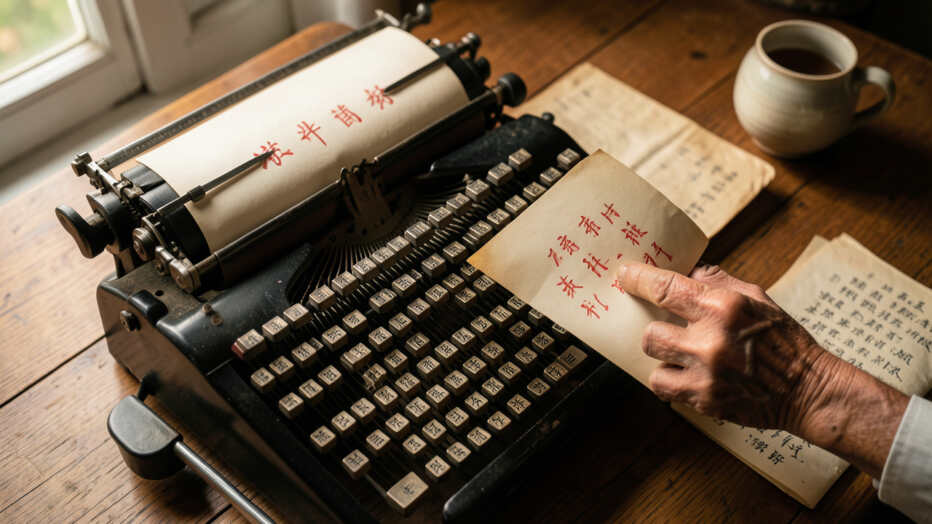
How Chinese typewriters worked before computers is a fascinating story of mechanical ingenuity tackling a language with thousands of characters. Unlike alphabetic typewriters with around 50 keys, Chinese machines faced the monumental task of making nearly 5,000 common characters easily accessible. This post explains the ingenious solutions inventors devised, from massive character arrays to radical modular systems, and why these complex devices played a crucial role in modernizing Chinese communication.
Simply put, Chinese typewriters used massive rotating trays or expandable modules containing thousands of individual character slugs. The typist located the desired character on a diagram and used a mechanical linkage to select and print it, a process that required significant skill and memorization to achieve reasonable speed.
Key Takeaways
- Traditional Chinese typewriters had to overcome the lack of an alphabet by providing physical access to thousands of individual character slugs.
- Two primary designs dominated: the large “matrix” style with a tray of characters and the more portable “movable type” style with an expandable typebar basket.
- Mastery was essential, as typists needed to memorize the layout of hundreds of characters to work efficiently, making it a specialized skill.
- These machines were expensive, complex, and required meticulous maintenance, limiting their use mostly to government offices, news agencies, and large businesses.
- The evolution of the Chinese typewriter represents a crucial step in the history of information technology and global communication.
What Is a Chinese Typewriter?
A Chinese typewriter is a mechanical device designed to print Chinese characters, which are logograms rather than letters from an alphabet. Invented in the early 20th century, its core challenge was representing a large character set on a single machine. Early models could weigh over 40 pounds and contained over 2,000 individual metal character slugs.
According to historian Thomas Mullaney, the earliest successful commercial Chinese typewriter, the Commercial Press model, was introduced in 1919 and became the standard for decades.
The machine was not just a tool but a complex information storage and retrieval system. Each character was a tiny, individually cast piece of metal type, arranged for selection. This fundamental difference from Western typewriters meant that typing Chinese was a slower, more deliberate process, often compared to “picking characters” rather than flowing text.
Why Were Chinese Typewriters So Incredibly Complex?
The complexity stemmed directly from the Chinese writing system. While an English typewriter needs only about 44 keys to cover the entire alphabet plus numbers and symbols, a basic Chinese typewriter required access to between 2,000 and 5,000 characters. This presented three major engineering hurdles:
- Physical Scale: How do you fit thousands of character slugs on a single, desk-sized machine? The solution was a large, movable tray or a complex basket of typebars.
- User Interface: How does a typist find one specific character among thousands in seconds? This required a visual index or a memorized layout system.
- Mechanical Linkage: How does pressing a single key or lever translate into selecting and printing the correct, distant character slug? This involved intricate racks, pinions, and selector arms.
Warning: Operating these machines required care. A small misalignment could cause the delicate character slug to miss the paper or jam the entire mechanism, requiring manual intervention.
The “complexity” wasn’t just mechanical; it was cognitive. The typist bore a heavy mental load. To be fast, you couldn’t hunt and peck.
You needed to develop muscle memory for character locations, much like a pianist learns scales. This made skilled Chinese typists highly valued professionals.
How Did the “Matrix” Style Typewriters Work?
The most common design, often called the “matrix” or “tray” typewriter, looked like a massive, flat chessboard. The typewriter had a large sliding tray containing hundreds of rectangular slugs, each holding one or more characters. The tray moved left-right and forward-backward on a rail system, controlled by two handles on either side of the keyboard area.
The process was a precise, two-part motion. The typist would first slide the tray to bring the correct row of characters under a central pointer. Then, using the other handle, they would slide it forward to align the specific character column.
A large, overarching lever was then pressed to strike the selected slug against the ribbon and paper. This entire movement was done while referencing a paper diagram glued to the typewriter, showing the location of every character on the tray.
How Did the “Movable Type” Style Typewriters Function?
An alternative design tried to mimic the more compact form of Western typewriters. Instead of a flat tray, it used a circular or rectangular basket containing hundreds of long, thin typebars, each with a character on the end. A keyboard with a few dozen keys acted as a selector.
Pressing a key didn’t directly strike the paper. It moved a complex mechanical selector arm to a particular position in the typebar basket. A second “print” key was then struck, which pulled the selected typebar up to print.
This design was more compact but still required the typist to either remember a complex key layout or use a visual guide. Some advanced models had a system where two keys were pressed in sequence to select a character, expanding the potential character set without a massive tray.
| Feature | Matrix (Tray) Style | Movable Type (Basket) Style |
|---|---|---|
| Character Access | Large tray with 2,000+ characters visible | Expandable basket, often 500-1000 visible |
| Portability | Very heavy (20-40+ lbs), desk-bound | Lighter and more compact (10-20 lbs) |
| Typing Speed | Faster for experts (up to 40-50 CPM) | Slower, due to more keystrokes (20-30 CPM) |
| Learning Curve | Steep, required memorizing tray layout | Steep, required memorizing key codes |
*CPM = Characters Per Minute. Expert Western typists achieved 60+ WPM (words per minute), where one word averages 5 letters.
What Skills Did a Chinese Typist Need?
Becoming a Chinese typist was a serious vocational training, not a casual skill. It required a unique combination of knowledge, memory, and physical dexterity. Training programs, often run by the typewriter manufacturers or large institutions, could last for months.
Typists were first trained in a standard character layout system. The most famous was the “Four-Corner System,” which assigned each character a four-digit code based on its shape. Typists had to memorize the codes for thousands of characters and their location on their specific machine’s tray or in its key system.
Speed was built through repetitive drilling, much like learning piano scales.
Tip: For anyone studying this history, seeking out a copy of the “Four-Corner Code” reference book provides incredible insight into the mental framework typists had to master.
Expert typists developed a personal system of shortcuts and associations to find characters faster. Their skill was measured in characters per minute. A novice might manage 10-15 characters per minute, while a highly skilled professional could reach 40-50, which was considered very fast for mechanical Chinese typing.
This speed required knowing the tray layout so well it became instinctual.
Why Were Chinese Typewriters Important Historically?
These machines were more than office equipment; they were engines of modernization and agents of cultural change in the early to mid-20th century. Their adoption by newspapers, publishing houses, and government ministries enabled the rapid, large-scale production of printed materials in Chinese. This was crucial for education, administration, and the spread of ideas during a period of immense social and political transformation in China.
The existence of a functional Chinese typewriter challenged the Western assumption that the Chinese writing system was incompatible with modern technology. It demonstrated that the language could be mechanized and efficiently processed, paving the way for its future in computing. The technology also had political implications, as control over the character sets installed in government typewriters could subtly influence official communication.
How Did Technology Eventually Make Chinese Typewriters Obsolete?
The mechanical Chinese typewriter’s decline was driven by the digital revolution. Two key technological breakthroughs rendered them obsolete: word processing software and the personal computer. Early Chinese input methods for computers, like the Cangjie or Pinyin systems, translated alphabetic keystrokes into character selection via software, eliminating the need for thousands of physical slugs.
The final blow came with the development of intelligent predictive input and predictive text on smartphones. Today, typing Chinese on a phone is often faster than it ever was on a mechanical typewriter. The complex mechanical systems were replaced by elegant software algorithms that handle the character selection problem far more efficiently, making the old machines fascinating relics of a unique technological path.
What Can We Learn from These Mechanical Marvels?
Studying Chinese typewriters offers profound lessons for modern design and engineering. They are a perfect example of user-centered design solving an extreme constraint problem. Engineers and designers had to deeply understand both the mechanical possibilities and the cognitive workflow of the user to create a workable solution.
They prioritized function and reliability in a challenging environment.
Furthermore, these devices remind us that the path to digital technology was not linear. Different linguistic and cultural needs spawned parallel, equally sophisticated mechanical solutions. They are a testament to human ingenuity and a crucial chapter in the global history of information technology, showing that the “desktop computer” was not the only way to solve the problem of writing and text production.
Frequently Asked Questions
How fast could someone type on a Chinese typewriter?
Speed varied widely based on skill. A beginner might manage 10-15 characters per minute. A professionally trained typist in a government office could achieve 40-50 characters per minute.
For context, an average English typist types about 40 words per minute, which is roughly 200 characters, highlighting the mechanical speed difference.
Were all Chinese typewriters the same?
No, there were significant variations. The two main types were the large, tray-based “matrix” style and the more compact “movable type” basket style. Within these categories, different models had different character sets (for Simplified vs.
Traditional Chinese), tray layouts, and mechanical designs from various manufacturers like Commercial Press or overseas Chinese communities.
Did Chinese typewriters have keyboards like Western ones?
Most classic models did not. They typically had a few keys or levers for functions like carriage return, space, and in some movable type models, a preliminary selection function. The primary character selection was done through sliding the large tray or using a sequence of mechanical inputs, not by pressing a dedicated key for each character.
Why didn’t they just create an alphabet for Chinese?
This was actually debated. Some reformers promoted alphabetic systems like Zhuyin (Bopomofo). However, the logographic system was deeply ingrained in Chinese culture and literature.
Creating a phonetic system faced challenges with dialects and homophones. The typewriter solved the immediate problem of mechanizing the existing, established writing system without requiring a full linguistic overhaul.
Where can I see a Chinese typewriter today?
You can find them in several museums. The Computer History Museum in California, The Smithsonian’s National Museum of American History, and the National Museum of China in Beijing all have examples. Some private collectors and history enthusiasts also maintain and occasionally display working machines.
Final Thoughts
The story of how Chinese typewriters worked is a brilliant chapter in mechanical engineering. It showcases human ingenuity in adapting a complex, ancient writing system to the demands of the machine age. These devices, though now obsolete, were essential stepping stones that helped modernize Chinese communication and proved that any language could be mechanized.
Their legacy lives on in the elegant software solutions that allow us to type thousands of characters effortlessly today.