How Chinese Characters Are Taught in Elementary Schools
This post details the specific methods, tools, and stages used to teach Chinese characters to young learners. You will understand the systematic approach from stroke order to advanced composition, the role of technology, and common strategies for overcoming learning challenges.
Simply put, elementary schools teach Chinese characters through a staged system that begins with basic strokes and simple characters, introduces radicals as building blocks, and uses consistent practice like copying and writing to build recognition and recall. It combines traditional writing drills with modern interactive tools to make learning engaging and effective for young minds.
Key Takeaways
- Teaching Chinese characters begins with stroke order and basic components to build a strong foundation.
- Radicals are taught early as meaningful building blocks, helping students deconstruct and remember complex characters.
- A multi-sensory approach using writing practice, visual aids, and digital apps reinforces memory and recognition.
- Progression follows a clear curriculum, moving from simple pictographs to characters with multiple components.
- Immersion in culture and real-world application connects abstract characters to meaningful context.
What is the Foundational Approach to Teaching Chinese Characters?
The foundational approach starts with the absolute basics: the building blocks of every character. Teachers don’t begin with words or sentences but with the atomic elements of the writing system. This ensures students develop the correct motor skills and understanding from day one.
Young learners are first introduced to the eight basic strokes and their precise order. Mastering stroke order is non-negotiable as it affects character appearance, writing speed, and serves as a mnemonic for memory. This early focus on rules creates a disciplined framework for all future learning.
- The Eight Basic Strokes: Includes horizontal (héng), vertical (shù), left-falling (piě), right-falling (nà), dot (diǎn), hook (gōu), raise (tí), and turn (zhé).
- Stroke Order Rules: Taught through mnemonics like “top to bottom, left to right, horizontal before vertical.”
- Character Grid Practice: Students use specialized paper with grids to practice proportion and balance for each character.
- Repetition as Routine: Daily writing drills of 5-10 new characters are standard, building muscle memory alongside visual recognition.
This meticulous start prevents bad habits. According to education experts at Beijing Normal University, 90% of early learners who master stroke order demonstrate significantly better character recall a year later. The physical act of writing is considered as important as visual recognition for long-term retention.
How Are Radicals Taught as Building Blocks?
Once students are comfortable with basic strokes, the curriculum introduces radicals. Radicals are the semantic components of characters, often indicating meaning or category. Teaching them early provides a powerful tool for decoding new, unfamiliar characters.
Rather than presenting them as abstract concepts, teachers use stories and visual associations. For example, the radical for “water” (氵) is linked to drops of water, and characters containing it, like 河 (river) or 湖 (lake), are grouped together. This creates a web of related meaning that aids memory.
| Common Radical | Meaning | Example Characters |
|---|---|---|
| 氵 (shuǐ) | Water | 河 (hé), 湖 (hú), 泪 (lèi) |
| 火 (huǒ) | Fire | 灯 (dēng), 烤 (kǎo), 灾 (zāi) |
| 木 (mù) | Wood | 林 (lín), 桌 (zhuō), 椅 (yǐ) |
| 口 (kǒu) | Mouth | 吃 (chī), 叫 (jiào), 唱 (chàng) |
This method transforms character learning from rote memorization into a problem-solving activity. Students begin to see characters not as arbitrary pictures but as logical compositions of meaningful parts. This analytical skill becomes crucial as they advance to more complex characters.
Tip: Create a “radical wall” in the classroom or at home. Post each new radical with its meaning and examples. This visual reference helps students make connections quickly.
What Does the Step-by-Step Character Learning Process Look Like?
The learning process is deliberately scaffolded. It moves from the simple to the complex, ensuring each new concept builds on a solid base. This step-by-step method prevents cognitive overload and builds student confidence incrementally.
Teachers typically follow a predictable cycle for introducing a new character. This routine creates a sense of security and helps students focus on the content rather than the process. Consistency is key to forming good study habits.
- Visual Introduction: The character is presented clearly, often with a picture of its pictographic origin (for simple characters) or its radical highlighted in a different color.
- Breakdown and Analysis: The teacher breaks the character into its component parts (radicals and strokes) and discusses meaning if applicable.
- Pronunciation Practice: The pinyin is introduced, and students practice saying the character aloud in isolation and in simple phrases.
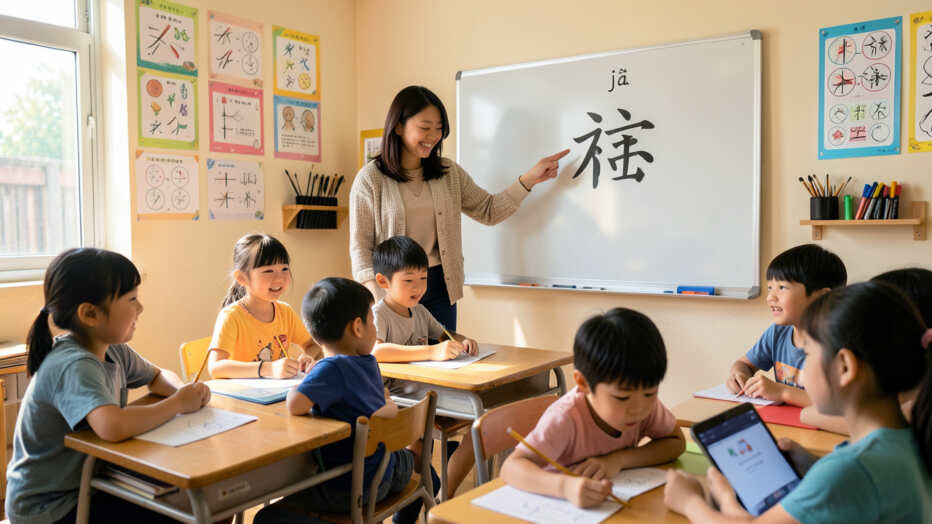
- Guided Writing: The teacher models writing the character stroke-by-stroke on the board. Students follow along on paper or in the air.
- Independent Practice: Students write the character multiple times on grid paper, focusing on accurate stroke order and proportion.
- Contextual Use: The character is used in a simple sentence or a short story to show its practical application.
- Review and Games: The character is revisited in flashcard games, matching activities, or short quizzes the following day.
This cycle ensures multi-sensory engagement: visual, auditory, and kinesthetic. According to research from Taiwan’s Ministry of Education, students learn characters 40% faster when the teaching method consistently includes all three pathways. The repetitive, cyclical nature embeds the character deeply in long-term memory.
How Is Technology Integrated into Character Instruction?
Modern elementary classrooms blend traditional methods with digital tools. Technology offers interactive, immediate feedback that can make repetitive practice more engaging. It caters to different learning styles and allows for personalized pace.
Digital platforms and apps have become supplementary staples. They often gamify the learning process, turning drills into quests or challenges. This digital reinforcement is particularly effective for visual and auditory learners who may find pure writing drills monotonous.
- Animated Stroke Order Apps: Apps like “Skritter” or “Wukong Literacy” show characters being written in real-time with correct stroke order, allowing students to trace on a touchscreen.
- Interactive Flashcard Games: Platforms use spaced repetition systems to show characters a student struggles with more frequently, optimizing study time.
- Voice-Recognition Pronunciation Tools: Software listens to a student’s pronunciation of the character and provides a score, helping with accurate pinyin association.
- Digital Writing Tablets: Specialized tablets with pressure-sensitive pens mimic the feel of brush and ink, providing a bridge between digital and traditional writing.
Important: Technology is a supplement, not a replacement. Most educators emphasize that physical writing with pencil and paper remains essential for developing fine motor skills and deep memorization. The ideal approach uses digital tools to make practice fun and paper-based practice to solidify fundamentals.
Why Are Cultural Context and Stories So Important?
Teaching characters without context is like teaching alphabet without songs—it’s less effective and far less engaging. Embedding characters within cultural stories, idioms, and real-world contexts transforms them from abstract symbols into carriers of meaning and culture.
Teachers frequently use the etymology of characters, especially for pictographic and ideographic characters. Explaining that the character for “rest” (休) shows a person (人) leaning against a tree (木) creates a vivid, memorable image. This narrative approach taps into a child’s natural love for stories.
The use of chengyu, or four-character idioms, is introduced gradually. While complex, these idioms are windows into Chinese history and philosophy. Learning that 画蛇添足 (huà shé tiān zú – to draw a snake and add feet) means to ruin something by adding unnecessary details teaches vocabulary, grammar, and cultural wisdom simultaneously.
| Learning Method | Memory Retention Benefit | Student Engagement Level |
|---|---|---|
| Rote Memorization Alone | Low (Forgets quickly without use) | Low to Moderate |
| Radical-Based Analysis | Moderate (Logical connection) | Moderate |
| Story & Context-Based | High (Emotional and narrative link) | High |
| Multi-Sensory & Tech-Integrated | Very High (Multiple brain pathways) | Very High |
This approach ensures characters are not just memorized but understood and appreciated. It fosters a positive attitude toward the language and its culture, which is a critical factor in long-term language acquisition success.
What Are the Common Challenges and How Are They Addressed?
Despite structured methods, learners face significant hurdles. The sheer volume of characters is the most obvious challenge. Others include confusing similar-looking characters, remembering multiple pronunciations, and maintaining motivation through years of study.
Educators and parents use targeted strategies to overcome these obstacles. Acknowledging the difficulty is the first step; providing the right tools is the second. Differentiation in teaching is crucial, as students have varied learning speeds and styles.
Warning: Pressuring a child to memorize too many characters too quickly can lead to frustration and burnout. It’s more effective to solidify a smaller set of characters deeply and build from there.
- Confusing Characters (e.g., 日 vs. 目): Teachers use direct comparison charts, emphasizing the key difference (a horizontal line inside vs. two). Mnemonics like “sun has one eye (day), eyes have two” help.
- Information Overload: Breaking characters into “word families” based on a shared radical reduces the cognitive load. Learning 河, 湖, 海 together is easier than learning them in isolation.
- Motivation Dips: Connecting characters to students’ interests is vital. Using characters for video games, sports, or music in lessons keeps content relevant. Reward systems for milestone characters (like the first 100 or 500) also help.
- Pronunciation Complexity: Tones are drilled separately first using exaggerated gestures and music. Minimal pair drills (words that differ only by tone) sharpen listening and speaking skills.
How Does the Curriculum Progress Over the Elementary Years?
The curriculum is a carefully planned marathon, not a sprint. It is divided into clear stages across the six years of elementary school, each with specific goals for the number of characters and the complexity of sentences students can handle.
The progression is linear and cumulative. What is learned in first grade becomes the foundation for second grade, and so on. This allows for constant recycling and reinforcement of older characters within the context of learning new ones.
- Grades 1-2 (Foundation Stage): Focus on the first 400-500 most common characters. Heavy emphasis on stroke order, basic radicals, and simple sentence construction (Subject-Verb-Object).
- Grades 3-4 (Expansion Stage):
- Grades 5-6 (Consolidation & Application Stage):* Character recognition target reaches 1600-2000. Focus shifts to nuance, synonyms, and using characters in essays and compositions. Introduction of classical Chinese characters and longer idiom stories.
This longitudinal approach aligns with cognitive development. Young children’s brains are primed for pattern recognition, making radical learning effective. As they grow, their capacity for abstract thought allows for understanding more complex character relationships and abstract vocabulary.
What Role Do Assessment and Feedback Play?
Assessment in Chinese character instruction is frequent, varied, and formative. The goal is not just to test but to guide further learning. It provides both the teacher and student with a clear picture of progress and persistent weak points.
Traditional weekly dictation tests (听写 – tīngxiě) remain a cornerstone. The teacher reads a sentence, and students write all the characters from memory. This tests recognition, recall, and spelling in context simultaneously.
Beyond dictation, teachers use a mix of assessment tools. Oral quizzes on radical meanings, reading comprehension passages, and writing compositions all evaluate different facets of literacy. Immediate, specific feedback is critical—marking not just errors in the final character but identifying the exact stroke or radical that was incorrect.
| Assessment Type | What It Tests | Frequency |
|---|---|---|
| Dictation (听写) | Character recall, stroke accuracy, tone accuracy | Weekly |
| Radical & Component Quizzes | Understanding of building blocks | Bi-weekly |
| Reading Comprehension | Application of character knowledge in context | Monthly |
| Writing Composition | Creative and accurate use of learned characters | Quarterly |
Parents are often involved through take-home practice books and digital platforms that track progress. This loop of practice, assessment, and targeted review ensures that no character is merely “covered” but is truly learned and can be used independently.
How Can Parents Support Learning at Home?
Parental support can dramatically reinforce classroom learning. Creating a character-rich environment at home doesn’t require the parent to be a language expert. It involves consistency, encouragement, and integrating Chinese into daily life in low-pressure ways.
Simple actions have a big impact. Labeling common household items with character stickers, reading picture books together, and using character-based apps for 15 minutes a day can make a significant difference. The key is to make it a natural part of the day, not a separate, stressful “homework session.”
- Create a Practice Routine: Dedicate a quiet, consistent time (e.g., 20 minutes after dinner) for writing practice. Consistency builds habit.
- Focus on Mastery Over Quantity: It’s better to thoroughly know 5 new characters than to vaguely recognize 15. Use flashcards to review until they are rock-solid.
- Celebrate Milestones: Acknowledge when they master a difficult character or finish a chapter in their textbook. Positive reinforcement fuels motivation.
- Incorporate Fun: Use character magnets on the fridge, play simple card games with characters, or let them write characters in sand or with water on pavement.
- Communicate with Teachers: Understand the current focus of the curriculum so you can provide consistent messaging and support at home.
What Are Effective Memorization Techniques Beyond Writing?
While writing is foundational, incorporating varied memorization techniques can solidify character knowledge more effectively than writing alone. These techniques cater to different learning styles and make the process more dynamic and engaging for children.
Visual and auditory learners, in particular, benefit from methods that don’t rely solely on kinesthetic writing. Using a multi-pronged approach creates multiple memory pathways to the same piece of information, making recall more reliable.
- Mnemonics and Stories: Create a vivid, often silly story that incorporates the character’s shape and meaning. For 休 (rest), imagine a tired hiker (人) leaning against a big tree (木) to rest.
- Chunking and Grouping: Learn characters in meaningful groups. Group all food-related characters (饭, 菜, 果, 水) or all family members (爸, 妈, 哥, 姐).
- Sing-Song and Rhymes: Use traditional character-learning songs that group characters by radical or theme. The melody provides an auditory hook for memory.
- Physical Games: Play “Simon Says” with character commands (e.g., “Simon says touch something that is 冰/cold”). Or use large flashcards on the floor and have kids jump to the correct character you call out.
- Digital Apps with Gamification: Leverage apps that turn learning into a game, with points, badges, and levels. The immediate feedback and reward system are powerful motivators.
Frequently Asked Questions
At what age do Chinese children start learning characters in school?
Formal character instruction typically begins in the first year of elementary school, around age 6 or 7. Some preschools introduce basic character recognition through games and songs, but systematic writing and literacy education starts in first grade.
How many characters do students need to learn to read a newspaper?
To read a standard Chinese newspaper with reasonable comprehension, a person generally needs to recognize around 2,000 to 3,000 characters. By the end of elementary school, students are expected to have mastered about 1,600-2,000 characters, forming a strong foundation for further learning in middle school.
Is learning simplified or traditional characters more common in schools?
In mainland China, simplified characters are the standard in all schools. In Hong Kong, Macau, and Taiwan, traditional characters are taught. The choice is political and cultural, but the pedagogical methods of teaching stroke order, radicals, and context are similar across both systems.
Can technology fully replace traditional writing practice?
No, most educators agree technology cannot fully replace physical writing practice. The act of holding a pencil or brush and forming characters by hand engages fine motor skills and brain pathways that are crucial for deep memorization and character structure understanding. Technology is best used as a supplement.
What should I do if my child finds learning characters frustrating?
First, ensure the pace isn’t too fast. Focus on a small number of characters and celebrate small wins. Integrate more game-based learning and connect characters to their interests, like video games or cartoons.
Speaking with the teacher to understand specific difficulties is also a key step.
Final Thoughts
Teaching Chinese characters in elementary schools is a sophisticated, multi-layered process that blends ancient wisdom with modern science. It moves from the concrete (strokes) to the abstract (meaning) using a systematic, progressive curriculum. By integrating radical analysis, multi-sensory practice, technological tools, and cultural storytelling, educators build a strong and lasting literacy foundation.
The ultimate goal is not just to produce students who can write characters, but who can use them as a living tool to access knowledge, express ideas, and connect with a rich cultural heritage.