
How to Practice Chinese Speaking Without a Native Tutor
Practicing Chinese speaking without a native tutor is entirely possible with the right strategies and tools. Many learners assume fluency requires constant conversation with a native speaker, but consistent solo practice can build strong foundations.
This guide provides actionable methods to develop your speaking skills, from tech-assisted drills to structured self-immersion. You can start improving your pronunciation and conversational flow today.
Simply put, you can effectively practice Chinese speaking alone by using shadowing techniques, AI conversation partners, and self-recording to build confidence and correct pronunciation before engaging with native speakers.
Key Takeaways
- Shadowing native audio is one of the most powerful techniques for improving pronunciation and rhythm without a tutor.
- AI-powered language apps and voice assistants provide instant, judgment-free feedback for daily speaking practice.
- Recording yourself and comparing your speech to native models is essential for self-correction.
- Creating a personal immersion environment through media and self-talk accelerates conversational fluency.
- Structured self-study with clear goals and regular review prevents plateaus and maintains motivation.
What is Shadowing and How Does It Work?
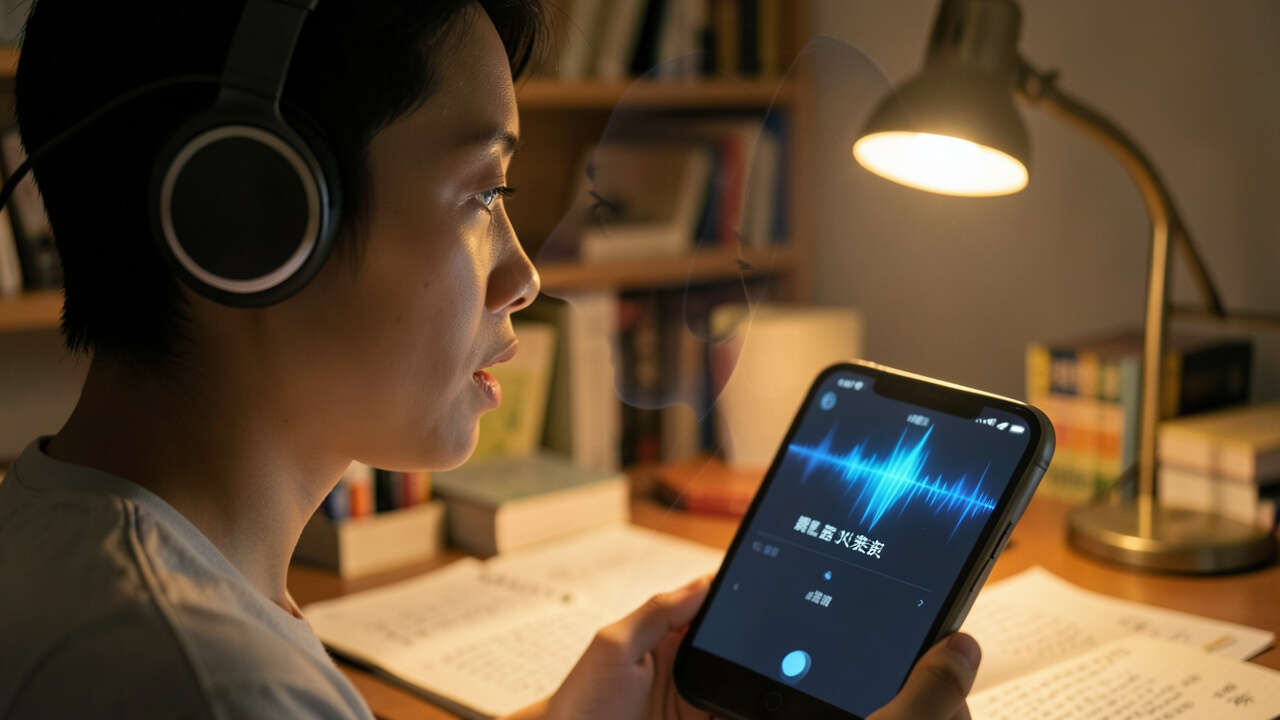
Shadowing is a language learning technique where you listen to a short audio clip of a native speaker and immediately repeat what they say, trying to match their pronunciation, intonation, and speed exactly. It’s like being their “shadow.” This method builds muscle memory for the sounds of Mandarin Chinese, which are often very different from English.
It directly trains your ear-to-mouth connection. You stop thinking about grammar rules and start producing sounds naturally. For solo practice, this is invaluable because it requires only audio material and your own voice.
How to Start Shadowing Today
Follow these steps to begin. Start with short, clear audio clips of about 10-15 seconds. Podcasts for learners, news broadcasts, or movie dialogues work well.
- Listen First: Play the clip once without speaking. Focus on the overall sound and flow.
- Listen and Speak: Play the clip again. Speak along with the native speaker in real-time. Try to overlap their voice completely.
- Record Yourself: Use your phone’s voice memo app to record your shadowing attempt.
- Compare and Repeat: Listen to the native audio and your recording. Note where your tones or sounds differ. Shadow the same clip 5-10 times until you match it closely.
- Progress to Longer Clips: As you improve, use 30-second to 1-minute clips. Gradually increase the complexity and speed.
| Shadowing Resource Type | Pros | Cons |
|---|---|---|
| Podcast for Learners | Slower speed, clear enunciation, often has transcripts. | Can be less natural, vocabulary may be limited. |
| Movie/TV Clips | Natural speed, emotional intonation, cultural context. | Can be very fast, background noise, slang heavy. |
| News Broadcasts (CCTV) | Standard pronunciation (Putonghua), formal vocabulary. | Can be monotonous, advanced vocabulary for beginners. |
Consistency is key. Dedicate 15-20 minutes daily to shadowing, and you will notice significant improvements in your accent and fluency within weeks.

How to Use AI Tools for Conversational Practice
Artificial intelligence has revolutionized solo language practice. Modern AI chatbots and voice assistants can simulate conversations, provide instant feedback, and are available 24/7. They remove the fear of making mistakes in front of a person.
Tools like advanced chatbots, language learning apps with speech recognition, and even general-purpose AI assistants can be your practice partners. You can have low-stakes, repetitive conversations to build automaticity.
Top AI-Powered Methods for Speaking
- AI Chatbots with Voice Input: Use apps like ChatGPT or other conversational AIs in voice mode. Set the context: “I am a beginner. Let’s practice ordering food in Chinese. Start the conversation.” Respond with your voice. The AI will reply, creating a dialogue loop.
- Language Exchange Apps’ AI Features: Many apps (like HelloTalk) now have AI correction tools. You can send voice messages to their AI bots and receive automated feedback on grammar and pronunciation.
- Dedicated Speech Recognition Apps: Apps like Duolingo or Speechling use speech recognition to score your pronunciation. Repeat sentences and get instant scores and corrections.
- Use Your Phone’s Assistant: Change your phone’s Siri or Google Assistant language to Mandarin. Ask it simple questions, set reminders, or have it read the news to you. Try to respond in Chinese.
Why Recording Yourself is a Non-Negotiable Step
You cannot fix what you cannot hear. Most learners are unaware of their own pronunciation errors because their brain auto-corrects while speaking. Recording yourself creates an objective mirror for your speech.
This process might feel uncomfortable at first, but it is the fastest way to identify and fix systematic errors in your tones, sounds, and rhythm. You become your own best coach.
A Simple Self-Review Framework
Make this a regular habit. Choose a short paragraph or dialogue script. Here’s a step-by-step process for effective review:
- Record a Baseline: Read the text aloud naturally into a recording app. Save this as “Attempt 1.”
- Listen and Transcribe: Listen to your recording. Write down exactly what you think you said. Where do you hesitate? Which words are unclear?
- Compare to Native Model: Find a native speaker reading the same text online (YouTube is great for this). Listen carefully to the tones and sounds.
- Mark Up Your Script: On your written script, use pinyin marks to write the correct tones over words you got wrong. Circle sounds you mispronounced.
- Re-record with Corrections: Practice the difficult parts slowly. Then, record “Attempt 2” focusing on those specific corrections.
| Common Issue in Recordings | What It Sounds Like | How to Fix It |
|---|---|---|
| Flat Tones | All words sound monotone, key meaning is lost. | Exaggerate tone movements while practicing. Use a tone diagram. |
| Missing Retroflex Sounds (zh, ch, sh, r) | Sounds like “z, c, s”. E.g., “shi” becomes “si”. | Curl your tongue tip back. Practice minimal pairs (si/shi, zi/zhi). |
| Unnatural Rhythm & Pauses | Words are spoken in a choppy, word-by-word manner. | Shadow native audio focusing on linking words. Practice “chunking” phrases. |
Over time, comparing “Attempt 1” and “Attempt 5” shows concrete progress, which is a huge motivational boost.

What is Immersion and How Can You Create It Solo?
Immersion means surrounding yourself with the language as much as possible, making it a part of your daily environment. While living in China is ideal, you can create a powerful “artificial immersion” at home. This is crucial for training your brain to think in Chinese.
The goal is to move from “studying” Chinese to “using” Chinese for parts of your day. This builds the neural pathways for faster, more intuitive speaking.
Practical Solo Immersion Strategies
- Change Your Digital Environment: Switch your phone, computer, and social media language settings to Mandarin Chinese. This forces you to interact with the language daily.
- Label Your Home: Use sticky notes to label common objects (桌子 – table, 冰箱 – refrigerator). Say the word out loud every time you see or use the object.
- Narrate Your Actions: Talk to yourself. Describe what you’re doing: “我现在在喝水” (I am drinking water now). “今天天气很好” (The weather is nice today). This is low-pressure speaking practice.
- Consume Chinese Media Daily: Watch a Chinese drama, listen to a C-pop song, or follow a Chinese TikTok (Douyin) account. Even passive listening helps your brain acclimate to the sounds.
- Think in Chinese: Before you speak, try to form the sentence in your head in Chinese first. Start with simple thoughts like “I’m hungry” -> “我饿了”.

How to Overcome the Fear of Making Mistakes
The biggest barrier to speaking practice is often psychological fear. Without a tutor’s supportive environment, the fear of sounding foolish can stop you from trying. You must reframe your mindset about mistakes.
Mistakes are not failures; they are essential data points. Every error tells you exactly what to work on next. Solo practice is the safest space to make all the mistakes you need to make.
Mindset Shifts for Confident Solo Practice
- Embrace the “Ugly Phase”: Accept that you will sound strange and make errors. Every expert speaker went through this phase. It’s a natural part of the process.
- Focus on Communication, Not Perfection: Did the AI or your recording understand your main point? Then it was a successful practice. Fluency comes before accuracy.
- Celebrate Small Wins: Did you correctly use a new tone? Understand a fast-paced clip? Successfully describe your day? Acknowledge these victories.
- Practice with “Dummy” Audiences: Talk to your pet, a stuffed animal, or a picture. This removes all pressure while you build verbal flow.
How Can You Find Low-Stakes Conversation Partners?
While the focus is on solo practice, eventually you need real interaction. You can find partners who are also learning, creating a mutual, no-pressure environment. This is a bridge between solo drills and full native conversations.
Language exchange platforms and online communities connect you with learners worldwide. The key is to set clear expectations: you are there to practice, not to be perfect.
Best Platforms for Finding Practice Partners
- HelloTalk / Tandem: These are dedicated language exchange apps. You can find native Chinese speakers learning English. You can chat via text, voice messages, and live calls. Set your profile to “beginner” and be clear about your goals.
- Discord Servers: Search for Discord servers for Mandarin Chinese learners. Many have voice channels specifically for practice sessions. You can join and listen before you feel comfortable speaking.
- italki Community: While known for tutors, italki has a community feature where learners post about topics and find partners for free exchanges.
- Reddit: Subreddits like r/ChineseLanguage have weekly speaking practice threads where you can post voice messages and get feedback from the community.

What are the Best Resources for Solo Chinese Learners?
Having the right tools makes all the difference. A good combination of audio, text, and interactive apps can create a comprehensive learning ecosystem for you. These resources are specifically chosen for their utility in speaking practice.
| Resource Category | Example Tools | Primary Use for Speaking |
|---|---|---|
| Podcasts | ChinesePod, Coffee Break Chinese | Listening for pronunciation, shadowing source material. |
| Speech Recognition | Speechling, FluentU, Duolingo | Immediate feedback on your spoken sentences. |
| Textbooks with Audio | Integrated Chinese, New Practical Chinese Reader | Structured dialogues for reading aloud and shadowing. |
| Video Platforms | YouTube (Slow Chinese, MandoSpot) | Visual context for words, subtitles for shadowing practice. |

How to Structure a Daily 30-Minute Solo Practice Session
Consistency beats intensity. A focused 30-minute daily routine is more effective than sporadic 3-hour sessions. This structure ensures you cover all aspects of speaking practice in a balanced way.
Rotate activities to keep it engaging. The key is to make this a non-negotiable appointment with yourself, like brushing your teeth.
A Sample 30-Minute Practice Blueprint
- Warm-up (5 minutes): Review vocabulary from the previous day. Use flashcards (Anki) and say each word out loud multiple times, focusing on tones.
- Shadowing Drill (10 minutes): Choose a 1-2 minute audio clip. Shadow it line by line. Record a section and compare your pitch to the native model. Focus on one sound or tone pattern.
- AI Conversation (10 minutes): Open a chatbot with voice capability. Have a conversation on a simple topic (e.g., “My hobbies,” “What I did today”). Aim for 10-15 exchanges.
- Self-Talk / Narration (5 minutes): Look around the room. Describe three objects you see in full sentences. Or, summarize what you just did in the AI conversation in Chinese.
Frequently Asked Questions
Can I really become fluent without ever speaking to a native?
You can reach an intermediate level and achieve high comprehension, but conversational fluency and cultural nuance require interaction with native speakers. Solo practice builds an incredibly strong foundation that makes subsequent conversations much easier and less intimidating.
How do I know if my tones are correct without a tutor?
Use a combination of methods: use tone-checking apps like “Tone Trainer” or “Sinosplice Tone Pair Drills,” record yourself and compare to native audio using software like Praat, and rely on AI speech recognition tools that provide tone feedback. Consistent practice with these tools builds accurate tone production.
What is the best way to practice Chinese speaking for 10 minutes a day?
Shadowing is your best bet. Find a short 30-60 second clip from a podcast or video. Shadow it repeatedly for 10 minutes, trying to match the speed and intonation perfectly.
This delivers maximum speaking practice in a minimal time frame.
Are language exchange apps safe for practicing with strangers?
Use reputable apps like HelloTalk or Tandem which have moderation and reporting features. Start with text or voice messages before any live calls. Never share personal contact information or meet in person without extreme caution.
Trust your instincts.
How long does it take to see improvement using solo methods?
With consistent daily practice (30+ minutes), you should notice improved pronunciation clarity and faster recall of phrases within 2-4 weeks. Significant gains in fluency and the ability to speak without translating in your head typically take 3-6 months of dedicated effort.
Final Thoughts
Practicing Chinese speaking without a native tutor is a powerful way to build confidence and foundational skills. Use shadowing for pronunciation, AI tools for conversation, and regular recording to self-correct. Create immersion in your daily life to keep the language active in your mind.
The strategies outlined here provide a complete roadmap. Start with one method today, be consistent, and you will make steady, measurable progress toward your speaking goals.