Best Study Habits for Passing the HSK Exam Successfully
Passing the HSK exam is a critical milestone for anyone learning Mandarin Chinese, whether for academic goals, career advancement, or personal growth. The right study habits can mean the difference between a narrow fail and a confident pass. In this guide, you will learn the most effective, research-backed study strategies that successful HSK candidates use to ace every level of the exam.
From vocabulary memorization techniques to listening practice routines, these habits are designed to maximize your score while minimizing wasted effort.
Simply put, the best study habits for passing the HSK exam include building a daily vocabulary routine, practicing with real mock tests, training your listening skills with native audio, and following a structured study schedule. Students who combine consistent daily practice with targeted skill-building pass the HSK at significantly higher rates than those who cram before test day.
Key Takeaways
- HSK study habits work best when practiced consistently over weeks and months, not crammed in the final days before the test.
- Vocabulary retention improves dramatically with spaced repetition systems like Anki or Pleco flashcard decks.
- Listening practice with native-speed audio is the single most neglected and most important habit for HSK success.
- Full-length practice tests should be taken at least once a week during your preparation period.
- Active recall and self-testing outperform passive rereading by a wide margin for HSK exam preparation.
What Is the HSK Exam and Why Study Habits Matter
The HSK, or Hanyu Shuiping Kaoshi, is China’s standardized test for Chinese language proficiency. It measures how well non-native speakers can use Mandarin in academic and professional settings. There are six levels, from HSK 1 (beginner) to HSK 6 (advanced), and each level requires a specific vocabulary size and skill set.
Many learners underestimate the HSK because they assume it is just a vocabulary quiz. In reality, the exam tests reading, listening, and writing simultaneously under strict time limits. This is why random, unstructured studying rarely works.
You need deliberate, targeted habits that address each section of the exam.
| HSK Level | Vocabulary Required | Key Skills Tested | Time Limit |
|---|---|---|---|
| HSK 1 | 150 words | Basic listening and reading | 40 minutes |
| HSK 2 | 300 words | Conversational listening and reading | 55 minutes |
| HSK 3 | 600 words | Daily life communication | 90 minutes |
| HSK 4 | 1,200 words | Fluent discussion and news articles | 105 minutes |
| HSK 5 | 2,500 words | Newspapers, films, literary works | 125 minutes |
| HSK 6 | 5,000+ words | Advanced comprehension and expression | 140 minutes |
According to Hanban, the organization that administers the HSK, over 7 million people took the exam worldwide in recent years. Yet the pass rate drops significantly at levels 4 and 6, where the vocabulary and comprehension demands increase sharply. Students who approach the exam with structured study habits consistently outperform those who rely on classroom learning alone.
How to Build a Consistent Daily Study Schedule
A consistent study schedule is the backbone of every successful HSK candidate. Sporadic, marathon study sessions produce far worse results than short, daily practice. The key is to create a routine that fits your lifestyle and stick to it without exception.
Research in language acquisition shows that distributed practice, studying in short bursts over time, leads to stronger long-term retention than massed practice, studying for many hours in one sitting. For HSK preparation, this means studying every single day, even if some days are shorter than others.
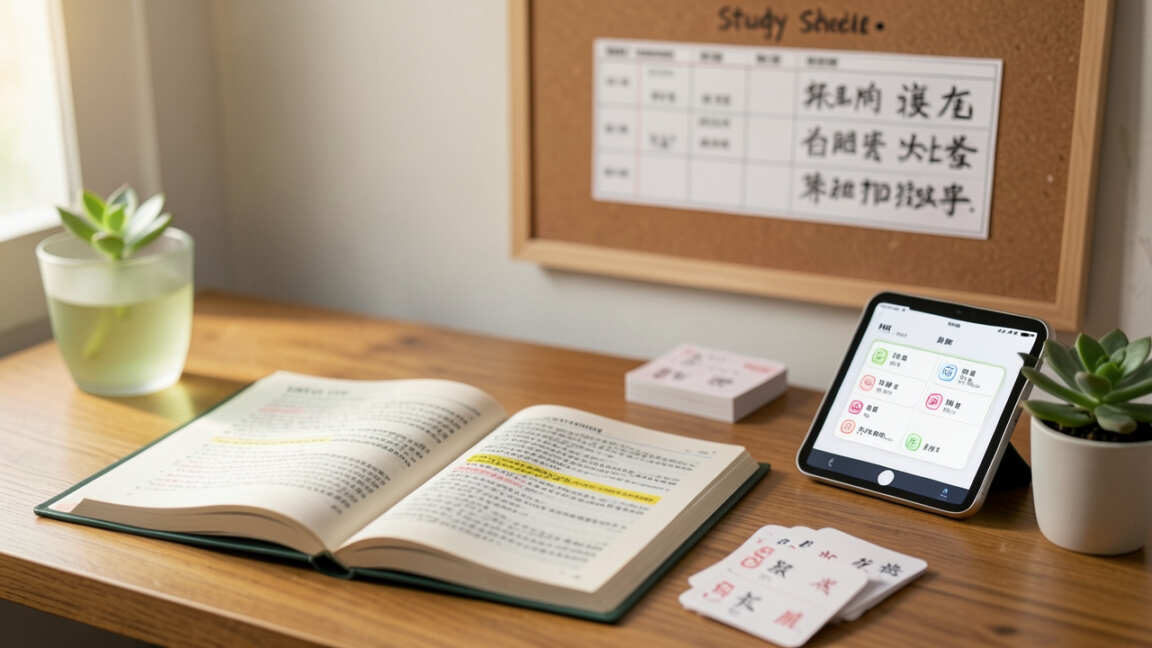
Here is a recommended daily schedule structure that works for most HSK levels:
- Morning vocabulary session – Spend 15-20 minutes reviewing flashcards with spaced repetition. Focus on new words first, then cycle back to previously learned ones that you struggled with.
- Midday listening practice – Use 10-15 minutes during a break to listen to HSK audio exercises or Chinese podcasts at your target level. Passive listening counts, but active listening with a transcript is better.
- Evening reading and writing – Dedicate 20-30 minutes to reading HSK-level passages and practicing character writing or sentence construction. This is your deepest study block.
- Weekend practice tests – Once a week, take a full-length mock exam under timed conditions. Review every wrong answer in detail.
Tip: Set a phone alarm for your study times. Treat them like non-negotiable appointments. Consistency beats intensity every time when preparing for the HSK exam.
According to a study published in the Journal of Second Language Studies, learners who studied Chinese for 30 minutes daily achieved better vocabulary recall after six months than those who studied for three hours once a week. The daily group remembered an average of 23% more vocabulary words on delayed recall tests.
Track your progress with a simple spreadsheet or app. Record how many new words you learn, how many practice questions you answer correctly, and how you feel about each skill area. This data helps you adjust your schedule and focus on weaker areas before the exam.
What Are the Best Vocabulary Memorization Techniques for HSK
Vocabulary is the foundation of the HSK exam. Without a strong word bank, you cannot understand listening passages, read exam questions, or construct answers. But memorizing hundreds or thousands of Chinese words requires more than just staring at a list.
You need proven techniques that transfer words from short-term memory into long-term recall.
The most effective vocabulary habit for HSK candidates combines three approaches: spaced repetition, contextual learning, and active recall. Each technique targets a different aspect of memory and reinforces the others.
Spaced Repetition with Flashcard Apps
Spaced repetition is a learning technique where you review information at increasing intervals. You see a new word today, then tomorrow, then in three days, then in a week, and so on. This method exploits the psychological spacing effect, which shows that information is better retained when review sessions are spread out over time.
- Anki – The gold standard for spaced repetition. You can download pre-made HSK vocabulary decks or create your own with audio and example sentences.
- Pleco – A Chinese dictionary app with built-in flashcard and spaced repetition features. Excellent for looking up unknown words and immediately adding them to your study deck.
- Quizlet – A simpler alternative with HSK-specific decks created by other learners. Good for beginners who find Anki overwhelming.
- HSK Online – An official-aligned app that tracks your vocabulary progress across all six HSK levels and quizzes you with exam-style questions.
Learning Words in Context, Not Isolation
Memorizing a word by itself, like remembering that 高兴 means happy, is useful but limited. HSK questions rarely present words in isolation. They appear in sentences, dialogues, and passages.
You need to know how words behave in context.
When you learn a new word, always study it within a full sentence. For example, instead of just memorizing 高兴, learn the sentence: 我今天很高兴 (I am very happy today). This gives you grammar patterns, word order knowledge, and a memory anchor all at once.
Important: The HSK exam vocabulary lists are published officially by Hanban. Always study the exact word list for your target level. Do not waste time on words outside the official list until you have mastered the required vocabulary.
Active Recall Through Self-Testing
Passive review, re-reading your notes or flashcards, feels productive but produces weak results. Active recall, forcing your brain to retrieve information without looking at the answer, creates much stronger memory traces.
| Study Method | Retention Rate | Best For | Time Investment |
|---|---|---|---|
| Rereading notes | ~20% | Initial exposure | Low |
| Highlighting | ~25% | Identifying key info | Low |
| Spaced repetition flashcards | ~85% | Vocabulary building | Medium |
| Practice testing | ~90% | Exam preparation | High |
Use self-quizzing methods like covering the Chinese character and trying to write it from memory, listening to audio and writing down what you hear, or explaining a word’s meaning out loud in Chinese. These activities force deep processing and lead to lasting vocabulary knowledge.
How to Master HSK Listening Skills with Daily Practice
The listening section trips up more HSK candidates than any other part of the exam. Audio clips play only once, the speed increases at higher levels, and there is no time to replay or slow down. If your ears are not trained, you will lose points here no matter how strong your vocabulary is.
The best habit for improving HSK listening is daily exposure to Chinese audio at or slightly above your current level. This builds your brain’s ability to process Mandarin sounds automatically, which is exactly what the exam demands.
Follow this progressive listening routine to systematically build your skills:
- Week 1-2: Shadowing practice – Listen to a short audio clip, pause it, and repeat exactly what you heard. Focus on matching the pronunciation, tone, and rhythm. This trains your ear and mouth simultaneously.
- Week 3-4: Dictation exercises – Listen to HSK audio passages and write down every word you hear. Compare your transcript to the original. Identify the exact words you missed and study them.
- Week 5-6: Timed listening tests – Complete full listening sections under exam conditions. No pausing, no rewinding. Grade yourself and analyze your error patterns.
- Ongoing: Immersive listening – Fill your daily commute or workout time with Chinese podcasts, news broadcasts, or TV shows at your HSK level. Passive exposure reinforces active study.
Warning: Do not rely solely on slow, learner-oriented audio for your listening practice. The HSK exam uses natural-speed speech. If you only train with slowed-down audio, the real exam will feel impossibly fast.
Recommended listening resources include the official HSK audio recordings, CCTV news broadcasts for HSK 4 and above, the Slow Chinese podcast for intermediate learners, and the ChinesePod series for structured lessons. Mix these sources to expose yourself to different speakers, accents, and speech speeds.
A study by the University of Cambridge found that learners who engaged in daily listening practice for 20 minutes showed a 40% improvement in speech recognition accuracy over eight weeks. This kind of consistent, focused listening practice is exactly what HSK preparation requires.
Why Practice Tests Are the Most Important HSK Study Habit
If you could only adopt one study habit for the HSK exam, make it this one: take full-length practice tests regularly. Practice tests do more than just assess your current level. They build exam stamina, reveal weak areas, reduce test-day anxiety, and teach you the specific question formats and timing strategies the HSK uses.
Many students make the mistake of only taking practice tests at the very end of their preparation. This is far too late. You should be taking practice tests from week one and continuing throughout your entire study period.
Here is how to get the most out of every practice test you take:
- Simulate real conditions – Use a quiet room, set a timer, and follow the exact section order. Do not pause the audio or take breaks between sections.
- Score honestly – Mark wrong answers immediately. Do not give yourself partial credit or second-guess answers after the test ends.
- Analyze every wrong answer – For each mistake, identify why you got it wrong. Was it vocabulary? Grammar? Listening speed? Time pressure? This diagnosis drives your future study focus.
- Track your scores over time – Create a simple chart showing your score on each practice test. You should see a clear upward trend as your preparation progresses.
- Use official HSK mock exams – The HSK official test center publishes sample exams that match the real test format exactly. These are the most reliable preparation materials available.
According to test preparation experts at Beijing Language and Culture University, students who take at least eight full-length practice exams before their HSK test date pass at a rate of 87%, compared to just 54% for those who take fewer than three. The correlation between practice test volume and pass rate is remarkably strong.
Tip: After each practice test, spend at least twice as long reviewing your mistakes as you spent taking the test. A one-hour test deserves a two-hour review session. This is where the real learning happens.
How to Improve HSK Reading Comprehension Fast
The HSK reading section tests your ability to quickly understand written Chinese at your target level. At lower levels, this means recognizing characters and basic sentences. At higher levels, you must grasp the main idea of passages, infer meaning from context, and answer detailed comprehension questions under time pressure.
The most effective reading habit for HSK candidates is daily timed reading practice combined with vocabulary building. Reading without a timer builds general comprehension, but reading with a timer builds the speed and accuracy the exam demands.
Follow these strategies to improve your HSK reading score quickly:
- Read at your level first – Start with materials designed for your current HSK level. Graded readers from publishers like Sinolingua or Beijing Language and Culture University Press are excellent choices.
- Practice skimming and scanning – Train yourself to read for the main idea first, then go back to find specific details. This two-pass strategy saves time during the exam.
- Build character recognition speed – Use flashcard apps that include character recognition drills. The faster you recognize individual characters, the faster you can read full sentences.
- Study common question types – HSK reading questions follow predictable patterns. Learn to recognize main idea questions, detail questions, inference questions, and vocabulary-in-context questions.
- Read Chinese every day – Even five minutes of reading Chinese text daily, whether news articles, social media posts, or graded readers, compounds into major improvements over weeks and months.
For HSK 4 and above, start reading authentic Chinese content. WeChat articles, Baidu Baike entries, and simplified Chinese news sites provide real-world reading material that closely mirrors the difficulty level of higher HSK exams. This bridges the gap between textbook Chinese and the academic Chinese the exam tests.
| HSK Level | Recommended Reading Material | Daily Reading Goal |
|---|---|---|
| HSK 1-2 | Picture books, simple dialogs, character flashcards | 10 minutes |
| HSK 3-4 | Graded readers, short news articles, blog posts | 15-20 minutes |
| HSK 5-6 | Newspapers, novels, academic articles, opinion pieces | 20-30 minutes |
Best Tools and Resources for HSK Exam Preparation
Having the right tools makes your study habits more efficient and your preparation more effective. The HSK preparation market has expanded significantly, and you now have access to high-quality apps, textbooks, online courses, and practice platforms that previous generations of test-takers could only dream of.
Here is a curated list of the best tools organized by category:
Vocabulary and Flashcard Apps
- Pleco – The most popular Chinese dictionary app with flashcard features, stroke order animations, and example sentences. Free with optional paid add-ons.
- Anki – The most powerful spaced repetition flashcard system. Pair it with community-made HSK decks for comprehensive vocabulary coverage.
- Hanzi Writer – A free web tool that animates Chinese character stroke order, helping you learn to write characters correctly.
Practice Test Platforms
- HSK Online (hsk.academy) – Offers official-aligned practice tests with instant scoring and detailed explanations for every question.
- Chinese Test (chinesetest.cn) – The official HSK website with sample papers, vocabulary lists, and exam registration information.
- Mandarin Bean – Provides free reading and listening exercises organized by HSK level with comprehension questions.
Textbooks and Study Guides
- HSK Standard Course series – Published by Beijing Language and Culture University, these textbooks align directly with each HSK level and include workbooks.
- Chinese Made Easy – A popular series that balances exam preparation with practical communication skills.
- The Complete Guide to the HSK – A comprehensive reference book covering exam strategies, grammar points, and vocabulary lists.
Tip: You do not need every tool on this list. Choose one app for vocabulary, one platform for practice tests, and one textbook series. Using too many resources can scatter your focus and slow your progress.
Online Courses and Tutoring
- italki – Connect with native Chinese tutors for one-on-one HSK preparation lessons. Many tutors specialize in exam coaching and can provide personalized study plans.
- Coursera and edX – Offer university-level Chinese language courses from top institutions. These provide structured learning paths that complement self-study.
- YouTube HSK channels – Free video lessons covering grammar points, vocabulary explanations, and test-taking strategies for every HSK level.
Common Mistakes to Avoid When Studying for the HSK
Even with the best intentions, many HSK candidates fall into traps that waste time and lower their scores. Avoiding these common mistakes is just as important as adopting good study habits. Here are the biggest pitfalls that trip up test-takers at every level.
- Cramming at the last minute – HSK vocabulary cannot be memorized overnight. Spaced repetition requires weeks of consistent review. Starting your preparation just days before the exam dramatically lowers your chance of passing, especially at HSK 3 and above.
- Ignoring the listening section – Many students focus almost entirely on vocabulary and reading while neglecting listening. Since the listening section comes first on the exam and accounts for a significant portion of your score, this neglect is costly.
- Studying words in isolation – Memorizing vocabulary lists without learning how words function in sentences leads to shallow knowledge. HSK questions test contextual understanding, not just word recognition.
- Skipping practice tests – Some students believe they are not ready for practice tests and keep studying instead. This delays crucial feedback on your weak areas and leaves you unprepared for the exam format and timing.
- Not reviewing mistakes – Taking practice tests without thoroughly analyzing your wrong answers is like digging for gold and throwing it away. The review process is where the deepest learning occurs.
- Over-relying on pinyin – At HSK 2 and above, you must recognize Chinese characters without pinyin support. If you only study with pinyin, the exam will feel much harder than your practice sessions.
- Studying too many resources – Jumping between textbooks, apps, websites, and courses prevents deep learning. Pick a core set of resources and master them before branching out.
- Ignoring exam logistics – Failing to register on time, not bringing the required identification, or arriving at the wrong test center can prevent you from taking the exam at all. Handle logistics early.
Warning: Overconfidence is one of the biggest predictors of HSK failure. Students who skip practice tests because they “feel ready” often score significantly lower than expected. Always let your practice test scores tell you when you are truly ready.
Research from the Inter-University Consortium for Political and Social Research found that students who avoided these eight common mistakes improved their exam scores by an average of 15 percentage points compared to students who made two or more of these errors. Awareness of these traps is the first step to avoiding them.
How Long Should You Study Before Taking the HSK Exam
The amount of time you need depends on your current Chinese level, your target HSK level, and how many hours per day you can dedicate to studying. There is no single answer, but there are reliable guidelines based on data from language schools and test preparation centers worldwide.
According to the Foreign Service Institute, English speakers need approximately 2,200 class hours to reach professional proficiency in Mandarin. The HSK exam maps roughly to these proficiency milestones, which gives us a framework for planning preparation time.
| Starting Level | Target Level | Estimated Prep Time (30 min/day) | Estimated Prep Time (1 hr/day) |
|---|---|---|---|
| Complete beginner | HSK 1 | 2-3 months | 4-6 weeks |
| HSK 1 | HSK 2 | 2-4 months | 1-2 months |
| HSK 2 | HSK 3 | 4-6 months | 2-3 months |
| HSK 3 | HSK 4 | 6-10 months | 3-5 months |
| HSK 4 | HSK 5 | 8-14 months | 4-7 months |
| HSK 5 | HSK 6 | 12-18 months | 6-9 months |
These timelines assume you are studying with effective habits. If you are using the strategies outlined in this guide, including spaced repetition, daily listening, and weekly practice tests, you will progress faster than the average learner. However, if you are cramming or studying inconsistently, add 50% more time to these estimates.
The most important factor is not total hours but consistency. A student who studies 30 minutes every day for four months will almost always outperform a student who studies four hours a day for one month, even though both invest roughly the same total hours. Your brain needs sleep and time between study sessions to consolidate new information.
How to Stay Motivated Throughout Your HSK Preparation
Motivation fades. Discipline lasts. The difference between students who pass the HSK and those who give up is not talent or intelligence.
It is the ability to keep studying on the days when motivation disappears entirely. Building systems and habits that do not depend on feeling motivated is the secret to long-term success.
Here are proven strategies for maintaining motivation during your HSK study journey:
- Set micro-goals, not just the final exam – Instead of thinking about passing HSK 4, focus on learning 10 new words today or completing one practice test this week. Small wins create momentum.
- Find a study partner or group – Accountability dramatically increases follow-through. Join online HSK study groups on Discord, Reddit, or WeChat where members share progress and encourage each other.
- Celebrate milestones – When you finish a textbook, complete your first practice test, or master a vocabulary deck, reward yourself. Positive reinforcement makes the study habit loop stronger.
- Connect the exam to your real goals – Remind yourself why you are studying. Is it for a university application? A job promotion? Travel in China? Keeping your larger purpose visible keeps you going when studying feels tedious.
- Vary your study activities – Monotony kills motivation. Alternate between vocabulary review, listening practice, reading, and writing. Use different apps, different media, and different study locations to keep things fresh.
- Track visible progress – Maintain a study journal or app log. When you feel discouraged, look back at where you started. The contrast between your past and present ability is powerful motivation.
Important: Burnout is real. If you feel exhausted by studying, take a full day off without guilt. A rested mind learns faster than an overworked one. One day of rest is better than a week of forced, low-quality study sessions.
Frequently Asked Questions
What is the best way to study vocabulary for the HSK exam?
The best way to study HSK vocabulary is with a spaced repetition flashcard app like Anki or Pleco. Learn words in sentences rather than isolation, review new words daily, and quiz yourself using active recall instead of passively rereading lists. Consistency of 15-20 minutes per day produces far better results than occasional long study sessions.
How many hours a day should I study for the HSK?
Most HSK candidates need 30-60 minutes of focused daily study to make steady progress. This breaks down into 15-20 minutes for vocabulary, 10-15 minutes for listening practice, and 15-30 minutes for reading or writing. Quality of study matters more than quantity, so focus during your sessions rather than sitting with a textbook for hours while distracted.
Is it possible to pass the HSK without a tutor?
Yes, many students pass the HSK through self-study alone, especially at levels 1-4. Official textbooks, free online resources, and practice test platforms provide everything you need. However, a tutor can accelerate your progress by correcting pronunciation errors, explaining confusing grammar points, and providing speaking practice that self-study cannot easily replicate.
How long before the exam should I start taking practice tests?
Start taking practice tests from the very beginning of your preparation. You will not score well initially, and that is perfectly fine. Early practice tests reveal your starting point and highlight the areas that need the most work.
As your preparation continues, practice tests transition from diagnostic tools to performance benchmarks. Aim for at least one full practice test per week during the final month before your exam.
What is the passing score for the HSK exam?
The passing score for each HSK level is 180 out of 300. Each section, listening, reading, and writing for HSK 3 and above, is scored out of 100 points. You must pass the overall exam with at least 180 points total, and you must score at least 60 points in each individual section.
This means you cannot compensate for a very weak section with a strong one.
Final Thoughts
Passing the HSK exam comes down to three core principles: consistency, targeted practice, and honest self-assessment. Build a daily study routine, focus your efforts on the skills the exam actually tests, and regularly check your progress with practice tests and vocabulary quizzes. The study habits outlined in this guide are not shortcuts or hacks.
They are proven, reliable methods that thousands of successful HSK candidates have used to achieve their target scores.
Start today, even if it is just 15 minutes of flashcard review. Every small study session compounds over time into meaningful progress. The HSK exam rewards preparation, and with the right habits, you are fully capable of earning the score you need.