The Role of Yin and Yang in Chinese Astrology
Yin and Yang serve as the foundational dual forces in Chinese astrology by classifying all energy, including the Ten Heavenly Stems, Twelve Earthly Branches, and 12 zodiac animals, as either passive Yin or active Yang. The specific Yin or Yang nature of each component directly influences an individual’s personality traits, compatibility, and life events as interpreted through their Bazi destiny chart. A balanced chart containing a dynamic mix of both energies reveals strengths and challenges, while an imbalance points to areas needing adjustment for a harmonious life path.
Chinese astrology relies on the balance of Yin and Yang to interpret personality traits and predict life events. This guide explains how these two opposing forces shape your zodiac sign and Bazi destiny chart.
Quick Verdict: Simply put, the role of Yin and Yang in Chinese astrology is to classify all energy as either passive (Yin) or active (Yang). This classification applies to every Heavenly Stem, Earthly Branch, and Zodiac Animal. The balance between these forces in your Bazi chart determines your personality strengths, challenges, and overall life path. A healthy chart contains a dynamic mix of both energies.
Key Takeaways
- Yin and Yang are the foundational dual forces in Chinese astrology that determine the nature of the Ten Heavenly Stems and Twelve Earthly Branches.
- Each of the 12 Chinese zodiac animals is strictly classified as either Yin or Yang, which directly influences the personality traits and compatibility of that sign.
- A balanced Bazi (Four Pillars of Destiny) chart contains a healthy mix of Yin and Yang elements, signaling adaptability and harmony in a person’s life.
- The interaction of Yin and Yang with the Five Elements (Wu Xing) creates 10 unique Stem combinations that astrologers use to make detailed predictions.
- You can determine your personal Yin-Yang balance by looking at the Heavenly Stem associated with your birth year in the Chinese sexagenary cycle.
How Does Yin and Yang Affect Your Destiny Chart?
In Chinese astrology, the destiny chart is called Bazi or the Four Pillars of Destiny. It uses your birth year, month, day, and hour to create a unique map of your life. Each pillar contains a Heavenly Stem (top) and an Earthly Branch (bottom).
Every single one of these components has a Yin or Yang nature. For example, the Heavenly Stem Jia is Yang Wood, while Yi is Yin Wood. According to the, this binary classification is the most fundamental concept in Chinese metaphysical systems.
Tip: Check your Day Pillar first. It represents your inner self and marriage partner. The Heavenly Stem of your Day Pillar is called the “Day Master” and defines your core Yin or Yang identity.
An astrologer analyzes the ratio of Yin to Yang in your four pillars. A chart with too much Yang energy may show aggression or burnout. A chart with too much Yin can indicate passivity or difficulty taking action. The ideal chart has a dynamic tension between the two forces.
The Role of Heavenly Stems
The Ten Heavenly Stems are the purest expression of the Five Elements in their Yin and Yang forms. They are:
- Yang Wood (Jia) – Strong, tall, leadership qualities.
- Yin Wood (Yi) – Flexible, artistic, gentle growth.
- Yang Fire (Bing) – Bright, passionate, expansive.
- Yin Fire (Ding) – Warm, focused, steady light.
- Yang Earth (Wu) – Mountain-like, stable, protective.
- Yin Earth (Ji) – Soil-like, nurturing, receptive.
- Yang Metal (Geng) – Sword-like, sharp, decisive.
- Yin Metal (Xin) – Jewelry-like, refined, detailed.
- Yang Water (Ren) – Ocean-like, powerful, free-flowing.
- Yin Water (Gui) – Rain-like, intuitive, adaptable.
Warning: Do not assume Yang is better than Yin. Both energies are necessary. A chart with only Yang Stems lacks depth and reflection. A chart with only Yin Stems lacks drive and visibility.
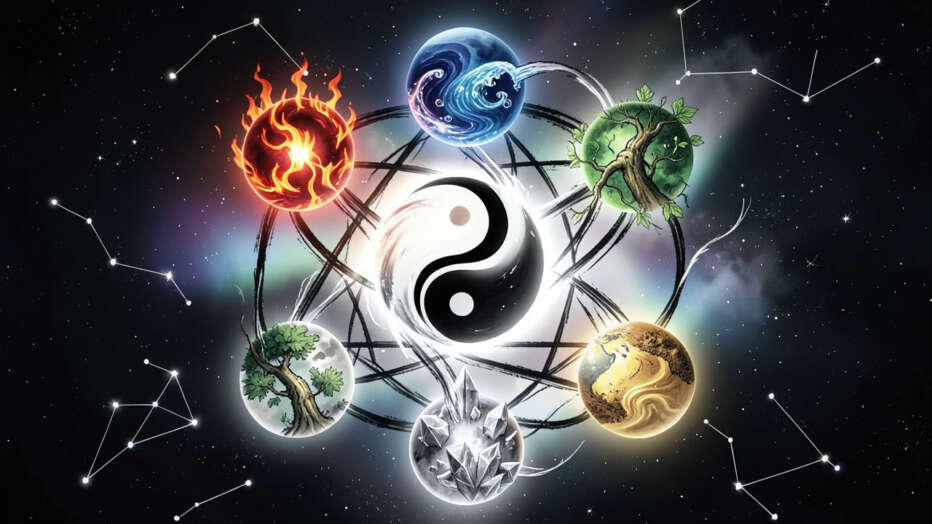
The Connection Between Yin, Yang, and the Five Elements
The Five Elements (Wu Xing) are Wood, Fire, Earth, Metal, and Water. Each element cycles through a Yin and Yang phase. This creates 10 distinct energies that appear in the Heavenly Stems. The interaction between these elements creates the generating and controlling cycles used in prediction.
| Element | Yang Expression | Yin Expression |
|---|---|---|
| Wood | Jia – Tall tree, strong will, leadership | Yi – Vine, flexibility, artistic talent |
| Fire | Bing – Sun, passion, outward expression | Ding – Lamp, warmth, focused attention |
| Earth | Wu – Mountain, stability, reliability | Ji – Soil, nurturing, receptivity |
| Metal | Geng – Sword, cutting, justice-oriented | Xin – Jewelry, refined, detail-oriented |
| Water | Ren – Ocean, deep, strategic thinking | Gui – Rain, intuitive, philosophical |
The generating cycle shows how Yin and Yang energies support each other. Wood feeds Fire, Fire creates Earth, Earth bears Metal, Metal collects Water, and Water nourishes Wood. The controlling cycle keeps energies in check. Wood parts Earth, Earth dams Water, Water quenches Fire, Fire melts Metal, and Metal cuts Wood.
Classical Chinese astrologers look for harmony in these cycles. A Yin Wood person (Yi) may thrive with a Yang Water person (Ren) because Water nourishes Wood. But too much Yang Metal (Geng) can cut the Wood and create conflict.
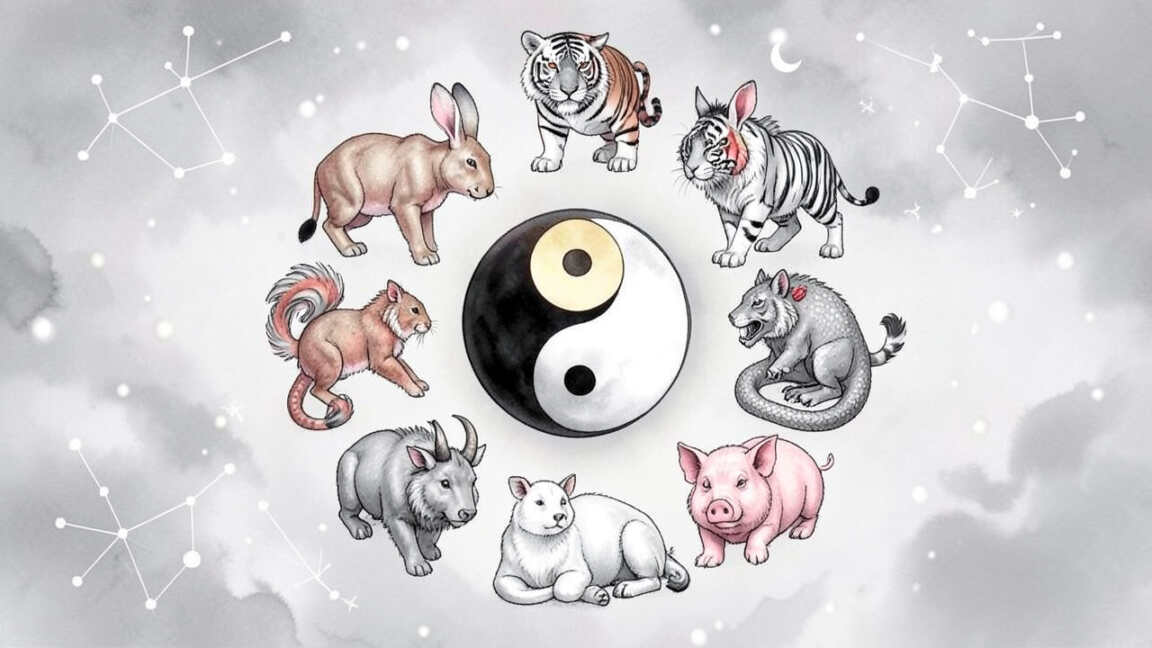
Yin and Yang in the 12 Chinese Zodiac Animals
Each of the 12 zodiac animals has a fixed Yin or Yang nature. This classification comes from the Earthly Branches. The animals alternate strictly between Yang and Yin in the traditional sequence.
- Yang Zodiac Animals: Rat (子), Tiger (寅), Dragon (辰), Horse (午), Monkey (申), Dog (戌).
- Yin Zodiac Animals: Ox (丑), Rabbit (卯), Snake (巳), Goat (未), Rooster (酉), Pig (亥).
This alternating sequence creates natural pairings and oppositions. Yang animals tend to be more extroverted, active, and visible. Yin animals are often more introverted, receptive, and reflective. However, a Yin animal can still exhibit Yang traits depending on the Heavenly Stem in its pillar.
Tip: Do not rely only on your zodiac animal to judge your personality. Your Day Master (Heavenly Stem of the Day Pillar) is more important. You could be a Rat (Yang) but have a Yin Day Master, making you more reserved than typical.
Compatibility Based on Yin and Yang
Compatibility in Chinese astrology is not just about matching animals. It is about balancing Yin and Yang energies between two charts. A person with a very Yang chart may find peace with a partner who has a strong Yin chart. Two strong Yang charts can cause power struggles. Two strong Yin charts can lack passion or forward motion.
The I Ching (Yi Jing) further explores these dynamics through hexagrams. Each hexagram is a combination of six lines that are either Yin (broken) or Yang (solid). According to, this system of divination has been used for thousands of years to assess the balance of forces in a given situation.

How to Find the Balance of Yin and Yang in Your Life
You can find your personal Yin-Yang balance by calculating your Bazi chart. Many free online tools generate your Four Pillars instantly. You need your date of birth and time of birth. The output shows your Year, Month, Day, and Hour Pillars.
Steps to Assess Your Balance
- Look at the Heavenly Stems in your four pillars. Count how many are Yang (Jia, Bing, Wu, Geng, Ren) and how many are Yin (Yi, Ding, Ji, Xin, Gui).
- Identify your Day Master. This is the Heavenly Stem of your Day Pillar. It represents your core self.
- Check the Earthly Branches. Each branch has a hidden Heavenly Stem. Count the total Yin and Yang elements in the entire chart.
- Look at the ratio. A 50-50 split is rare but ideal. A 60-40 or 70-30 split is common. A 80-20 split indicates strong imbalance.
If your chart is too Yang, you may need to cultivate rest, meditation, and receptive activities. If your chart is too Yin, you may need physical exercise, social engagement, and goal-oriented action. practitioners adjust the Yin-Yang balance of living spaces using color, light, and spatial arrangement.
Important: The role of Yin and Yang in Chinese astrology is not to label people as good or bad. It is to show natural tendencies. Use this knowledge for self-awareness, not self-judgment.
Common Myths vs Facts About Yin and Yang in Astrology
Many misconceptions exist about how these forces work in Chinese astrology. Here are the most common myths corrected by classical sources.
Myth 1: Yin represents evil and Yang represents good.
Fact: Yin and Yang are not moral values. They are descriptive labels for complementary energies. Night (Yin) is not evil. Day (Yang) is not good. Both are necessary for a full cycle. The explains that the Tao Te Ching views both forces as natural and necessary.
Myth 2: You are either Yin or Yang for life.
Fact: Your balance changes over time. The Ten Year Luck Cycles in Bazi astrology shift your energy every decade. A person born with strong Yang energy may enter a Yin cycle later in life. This brings new challenges and growth opportunities.
Myth 3: Yin and Yang in astrology can predict exact outcomes.
Fact: Yin and Yang analysis shows tendencies, not fixed events. It reveals how energy flows in a specific period. An astrologer uses this to suggest favorable timing for actions, but free will and environmental factors always play a role.
Frequently Asked Questions
What is the role of Yin and Yang in Chinese astrology?
Yin and Yang provide the binary framework for classifying all energies in a Bazi chart. They determine whether a Heavenly Stem, Earthly Branch, or Zodiac Animal expresses introverted or extroverted traits. According to, this dualistic system is essential for understanding Chinese cosmological systems.
How do I know if my zodiac animal is Yin or Yang?
The animals follow a strict alternating sequence in the zodiac wheel. Rat, Tiger, Dragon, Horse, Monkey, and Dog are Yang. Ox, Rabbit, Snake, Goat, Rooster, and Pig are Yin. You can find your animal by your birth year and then check which group it belongs to.
What happens if my Bazi chart is too Yang?
A chart with excessive Yang energy may indicate a person who is overly aggressive, impatient, or prone to burnout. The person may dominate conversations and struggle with rest. Astrologers recommend cultivating Yin activities like meditation, swimming, or spending time in nature to restore balance.
Does Yin and Yang change over time in my life?
Yes. The Luck Cycles in Bazi astrology systematically shift your energy every ten years. These cycles are driven by the interaction of Yin and Yang elements. A current imbalance may be corrected by an upcoming cycle, and a current balance may be disrupted.
How does Yin Yang relate to the Five Elements?
Each of the Five Elements (Wood, Fire, Earth, Metal, Water) exists in both a Yin and Yang phase. This creates the Ten Heavenly Stems. For example, Yang Wood is a strong tree, while Yin Wood is a flexible vine. The interaction of these ten energies forms the basis of Bazi analysis.
Final Thoughts
The role of Yin and Yang in Chinese astrology is to provide a clear, energetic lens for understanding your personality and life path. Check your Day Master and count your Yin versus Yang elements to start. Use this ancient wisdom to create more harmony in your daily choices and relationships.