
How Many Chinese Characters You Need to Read a Newspaper
How many Chinese characters do you truly need to know to pick up a newspaper and understand the main articles? This is a fundamental question for any learner, and the answer is more specific than you might think. This guide breaks down the exact numbers, the most effective characters to learn, and a clear roadmap to reach newspaper reading level.
Reading a Chinese newspaper is a major milestone. It’s a direct line to culture, politics, and daily life. Reaching that goal requires a strategic approach, not just memorizing random words.
We’ll show you exactly what’s needed.
Simply put, you need to recognize approximately 2,000 to 3,000 Chinese characters to comfortably read a mainstream newspaper like Xinhua or People’s Daily. With 2,500 characters, you can understand the gist of most stories. Mastering 3,000+ characters allows you to read with detail and nuance, covering over 99% of common characters in print media.
Key Takeaways
- The standard benchmark is around 2,500 to 3,000 Chinese characters for functional newspaper reading.
- Chinese characters are not learned equally; focusing on the most frequent 1,000 characters gives you about 90% coverage of everyday text.
- Learning is about characters and words; understanding common two-character words is just as critical as individual characters.
- The official HSK (Hanyu Shuiping Kaoshi) level 4-5 vocabulary aligns closely with the requirements for reading newspapers.
- Active practice, including reading graded news and using frequency lists, is the most efficient path to your goal.

What Is the Standard Character Count for Newspaper Reading?
The concept of “reading a newspaper” isn’t binary. There’s a spectrum from understanding headlines to analyzing editorials. For the average learner, the goal is comprehending the main news articles.
Language studies and curriculum designers have established clear benchmarks for this.
The most cited figure comes from research on character frequency. A 1985 study by Jun Da found that knowing the most frequent 3,500 characters allows you to recognize 99.48% of characters in modern Chinese texts. For newspapers specifically, which use a slightly more formal and condensed set of characters, the number is somewhat lower.
Xinhua News Agency, China’s official state press agency, conducted an analysis of its own publications. The study concluded that 95% of the characters in its newspaper articles could be understood by someone who knows approximately 3,500 characters. However, many of these are very specialized.
For practical comprehension, the following tiers are more useful.
| Character Knowledge Level | Coverage of Newspaper Text | Practical Ability |
|---|---|---|
| 1,500 characters | ~80-85% | Understand headlines and simple photo captions. |
| 2,500 characters | ~95% | Follow the main points of most news articles. |
| 3,500 characters | ~99.5% | Read with detail, including opinion pieces and specialized reports. |
As the table shows, the 2,500-character mark is a critical threshold. It’s where you transition from guessing to genuine comprehension. This number is your primary target.
What Are the Most Important Chinese Characters to Learn First?
Not all characters are created equal. Memorizing the character for “cuckoo bird” (杜鹃) before the character for “report” (报) is inefficient. The key is to learn characters based on their frequency in real-world use, especially in newspapers.
Frequency lists, based on large-scale analysis of texts, are your best guide. The top 500 characters alone can give you a foothold in reading simple texts. By the time you reach the top 1,000, you’ve covered the vast majority of words you’ll encounter in daily communication and news.
Here’s a breakdown of what the most frequent characters typically include. They form the grammatical and conceptual backbone of the language.
- Pronouns and Basic Nouns: 我 (I), 你 (you), 他 (he), 她 (she), 人 (person), 天 (day), 国 (country).
- Common Verbs: 是 (is), 有 (have), 在 (at), 说 (say), 看 (see), 做 (do), 去 (go).
- Core Function Words: 的 (possessive/associative particle), 了 (past tense marker), 在 (progressive aspect), 和 (and), 但 (but), 就 (then/just).
- Newspaper-Specific Terms: 新 (new), 闻 (hear/news), 经 (manage), 济 (economy), 社 (society), 会 (meeting/society), 发 (emit/develop), 展 (exhibit/develop).
Tip: Use a flashcard app like Anki or Pleco with a pre-made “Newspaper Frequency List” deck. This ensures you’re always learning the highest-value characters for your goal.
How Do HSK Levels Relate to Reading Newspapers?
The HSK is China’s standardized test for Chinese language proficiency. Many learners use it as a roadmap. Understanding how HSK vocabulary maps to newspaper reading provides a structured learning path.
The correlation is strong but not perfect.
HSK focuses heavily on vocabulary in context (words), while newspaper reading requires strong character recognition. However, the HSK lists are built on frequency data, making them an excellent proxy. Here’s the general alignment.
- HSK Level 3 (600 words): You can understand simple sentences and paragraphs. This is below the level needed for newspapers.
- HSK Level 4 (1,200 words): You can understand the main idea of clear, standard speech on familiar topics. This aligns with roughly 1,500 characters. You can start to grasp headlines and simple articles.
- HSK Level 5 (2,500 words): You can read newspapers and magazines, enjoy movies and TV shows. This is the sweet spot. The vocabulary directly translates to the ~2,500 characters needed for newspaper comprehension.
- HSK Level 6 (5,000+ words): You can understand information in Chinese newspapers and magazines, and understand Chinese movies and TV shows. This level provides mastery and nuance.
Focusing on mastering all HSK 5 vocabulary will give you the character and word knowledge required to read newspapers effectively. It provides a complete, structured curriculum for reaching your goal.
Why Is It Not Just About Individual Characters?
A common beginner mistake is treating Chinese like an alphabet. In English, “water” is one word. In Chinese, it’s two characters: 水 (shuǐ – water) that carry meaning individually but form a standard word together.
In newspapers, you’ll constantly encounter multi-character words.
Knowing the characters 水 (water) and 果 (fruit) separately is useful. But seeing the word 水果 (shuǐguǒ – fruit) requires you to recognize the compound word as a single unit. A newspaper sentence might use characters like 经 (manage), 济 (economy), and 增 (increase) individually, but the critical term is 经济增长 (jīngjì zēngzhǎng – economic growth).
This means your learning strategy must shift from characters-only to characters-and-words. Flashcards should show a word, its characters, pinyin, and an example sentence. This builds the neural pathways needed for fluid reading.
| Learning Approach | Individual Character Focus | Integrated Character & Word Focus |
|---|---|---|
| Flashcard Front | Character: 经 | Word: 经济 (economy) |
| Benefit | Builds raw recognition skill. | Builds immediate reading comprehension. |
| Newspaper Application | You recognize all parts but may not grasp the meaning. | You see “经济” and instantly understand “economy.” |
Always learn new vocabulary in the context of common words and phrases. This is the most direct route to understanding a newspaper article.
How Can You Practice for Newspaper Reading Effectively?
Knowing the target number is one thing; achieving it is another. Deliberate practice using authentic materials is essential. Your practice should progress from easy to hard, mirroring your character knowledge growth.
Start with “graded news” websites like The Chairman’s Bao or Du Chinese, which adapt real news for learners at HSK 3-5 levels. These use controlled vocabulary and provide pinyin, translations, and grammar notes. They are the training wheels for newspaper reading.
Once comfortable, move to simplified online portals. Many Chinese news sites have a “阅读版” (reading edition) or “少儿版” (children’s edition) with simpler language. The key is to read actively, not passively.
Important: Use a pop-up dictionary browser extension like “Zhongwen” or “Perapera” for desktop reading. On mobile, apps like Pleco let you copy-paste newspaper text for instant translation and character breakdowns.
- The 95% Rule: Choose texts where you know at least 95% of the characters. This allows you to guess the remaining 5% from context, which is crucial for learning.
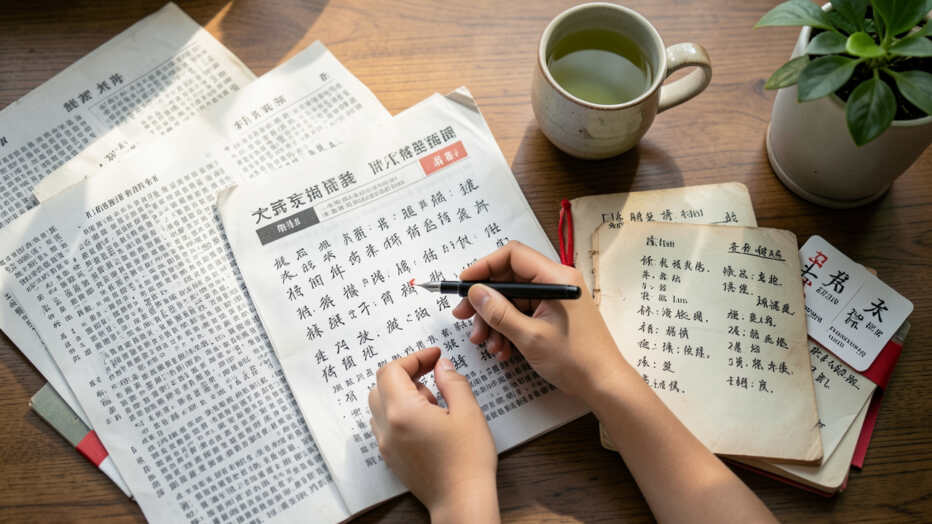
- Active Reading Strategy:
- Scan headlines and subheadings to get the main idea.
- Read through the first paragraph without stopping, even if you don’t know every word.
- Circle or highlight unknown characters and phrases.
- After reading, look up key unknown words and add them to your study deck.
- Re-read the article; it should be much clearer now.
- Time Investment: Dedicate 20-30 minutes daily to this active reading practice. Consistency is more important than marathon sessions.
What Common Mistakes Should You Avoid?
On the journey to reading Chinese newspapers, learners often take inefficient detours. Avoiding these pitfalls can save you months of effort. The biggest mistake is pursuing passive knowledge over active recognition.
Many learners focus on writing characters by hand endlessly. While good for muscle memory, it’s time-consuming if your goal is reading. The modern equivalent is typing pinyin and selecting characters.
Focus your time on spaced repetition systems (SRS) for active recognition and on reading practice.
Another major error is neglecting grammar. Characters and words are the bricks, but grammar is the mortar. Newspaper Chinese uses specific structures like the 把 (bǎ) construction, the 是.的 (shì.de) emphasis frame, and complex clauses.
Without understanding these, you’ll have a list of words but no sentence meaning.
- Mistake: Ignoring Measure Words. Newspapers are formal and use measure words correctly. Seeing 一本书 (a book) vs. 一家公司 (a company) is common. Learn measure words in context with their associated nouns.
- Mistake: Over-relying on Pinyin. As you advance, challenge yourself to read articles with pinyin turned off. This forces your brain to process the characters directly.
- Mistake: Skipping Unfamiliar Topics. Don’t only read entertainment news. Deliberately choose articles about the economy (经济), politics (政治), and technology (科技) to build specialized vocabulary. Use a tool like Zhonghua Zidian to look up radical components of unfamiliar characters.
- Mistake: Not Reviewing. Reading an article once is not enough. Re-read the same article days later. Your improved comprehension will be a powerful motivator.

How Does Simplified vs. Traditional Chinese Affect This Goal?
The character count goal (2,500-3,500) applies to both Simplified Chinese (简体字) used in mainland China and Traditional Chinese (繁體字) used in Taiwan, Hong Kong, and Macau. The underlying vocabulary and grammar are the same.
The main difference is the visual form of the characters. Some characters are simplified in the mainland system (e.g., 龍 becomes 龙). This doesn’t change the number you need to learn, but it does change which specific characters you memorize.
Newspapers in mainland China use Simplified; those in Taiwan use Traditional.
For a learner, it’s most efficient to choose one system based on your target region and media. If you want to read newspapers from Beijing, focus on Simplified. For Taipei’s newspapers, learn Traditional.
Trying to learn both simultaneously will double your workload for minimal benefit at this stage.
Warning: Do not use a Simplified-to-Traditional conversion tool for serious study. The mapping isn’t always one-to-one, and it ignores many important traditional characters that have no simplified counterpart. Learn the proper system for your goal.
What Tools and Resources Accelerate Your Progress?
Having the right tools turns frustrating character guessing into efficient learning. Modern technology provides incredible resources for this specific goal. Your toolkit should include a dictionary, a frequency list, and authentic reading material.
Pleco is the gold-standard dictionary app for Chinese learners. Its OCR (optical character recognition) camera feature lets you point your phone at a newspaper and get instant definitions. This is a game-changer for breaking down unfamiliar articles.
For systematic study, use a frequency list based on newspaper text. Several scholarly and community-made lists exist. Search for “newspaper character frequency list” to find resources.
These ensure your flashcard deck is optimized for your reading goal.
Finally, bookmark authentic news sources. For mainland Simplified Chinese, start with Xinhua News Agency (xinhuanet.com), CCTV News (news.cctv.com), and People’s Daily (people.com.cn). For Taiwan Traditional Chinese, use Liberty Times (ltn.com.tw) or United Daily News (udn.com).
Many of these have apps and websites.
Frequently Asked Questions
Can I read a newspaper after HSK 4?
HSK 4 provides a solid foundation, but you will likely find full newspaper articles challenging. The HSK 4 vocabulary aligns with about 1,500 characters, allowing you to understand headlines, simple statements, and photo captions. For comfortable reading of news articles, you should aim for HSK 5 level.
How long does it take to learn 2,500 characters?
This varies greatly based on study intensity and method. With a dedicated daily routine using SRS flashcards and active reading, a common estimate is 2-3 years to reach a comfortable 2,500 characters. Consistency is more important than total hours—30 minutes daily is better than 5 hours once a week.
Should I learn to write all 2,500 characters by hand?
For the primary goal of reading newspapers, writing every character by hand is not necessary and can be inefficient. Focus your effort on active recognition (seeing and knowing the meaning/pronunciation). If you want to write, prioritize the top 500 most common characters.
Use typing practice on a smartphone to reinforce character recognition.
Is there a difference between reading a physical newspaper and a digital one?
The vocabulary and grammar are identical. The main difference is the tool. Digital newspapers allow for instant lookups with apps like Pleco, making them far more convenient for learners.
Physical newspapers require a dictionary app with a camera feature. The core reading challenge remains the same.
What about punctuation? Do I need to learn that too?
Yes, Chinese uses standard punctuation like commas (,), periods (。), and quotation marks (“ ”). They are much simpler to learn than characters and are essential for parsing sentence structure. You will pick them up quickly by reading.
Newspapers also use specific punctuation like the book title mark (《》) and the间隔号 (·) in foreign names.
Final Thoughts
Reaching the goal of reading a Chinese newspaper is a clear, achievable milestone with a defined target. The magic number lies between 2,500 and 3,000 characters, with a strong focus on the most frequent words and characters. By following a frequency-based learning plan and using graded materials to build your skills, you can systematically bridge the gap from beginner to competent reader.
The journey requires patience, but the ability to connect directly with Chinese media makes it profoundly rewarding.