Difference Between Chinese Character and Word Explained
Difference between a character and a word in Chinese is a foundational concept that confuses almost every new learner. Understanding this distinction is the first step to mastering reading, writing, and speaking Mandarin. This guide breaks down what characters and words truly are and how they work together.
Simply put, a Chinese character (字, zì) is a single, indivisible unit of meaning and sound. A Chinese word (词, cí) is a unit of vocabulary that can be made of one or more characters working together. Most modern Chinese words are compounds of two or more characters.
Key Takeaways
- The difference between a character and a word in Chinese is that a character is a basic building block, while a word is the actual vocabulary item you use.
- One character often equals one word in Classical Chinese, but modern Mandarin heavily relies on two-character words for clarity and specificity.
- To build your vocabulary, you must learn both individual characters and the compound words they create.
- The sound of a character is its Pinyin, but a word’s pronunciation is the combined Pinyin of its characters.
- Context is everything; a single character can sometimes function as a complete word on its own.
What is a Chinese Character?
A Chinese character, known as 汉字 (hànzì), is the fundamental unit of the Chinese writing system. Each character represents a syllable and, in most cases, a morpheme—a unit of meaning. You can think of it like a letter in English, but with a critical difference: each character carries its own meaning.
Characters are not letters. They do not simply represent a sound. They are logograms, meaning they symbolize concepts or words.
The character 山 (shān) means “mountain,” and 水 (shuǐ) means “water.” This one-to-one relationship between a character, a sound, and a core meaning is the essence of the system.
- Independent Meaning: Most characters have a standalone meaning, even if it’s very broad.
- Fixed Pronunciation: Each character has one primary pronunciation, written in Pinyin (e.g., 人 = rén).
- Visual Structure: Characters are composed of radicals (部首) and strokes, which often give clues to meaning or sound.
- Building Blocks: They serve as the bricks from which more complex words are built.
- Limited in Modern Use: While a character can be a word, using only single characters often sounds archaic or is unclear.
Common Character Types
Understanding the main types helps demystify the writing system. There are six traditional categories, but most characters you learn will fall into these three practical groups.
| Character Type | Description | Example |
|---|---|---|
| Pictographs (象形) | Simplified pictures of objects. | 山 (shān, mountain) |
| Simple Ideographs (指事) | Abstract ideas shown symbolically. | 上 (shàng, up) |
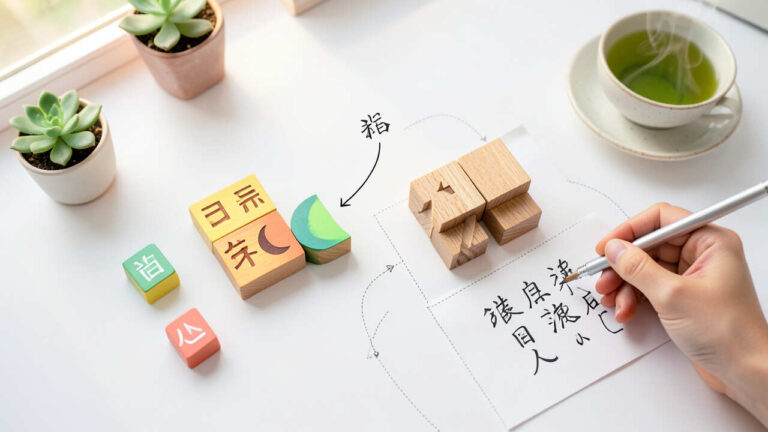
| Compound Ideographs (会意) | Combine two characters for a new idea. | 明 (míng, bright) = 日 (sun) + 月 (moon) |
| Phono-semantic (形声) | One part suggests meaning, one suggests sound. | 妈 (mā, mother) = 女 (woman) + 马 (mǎ, horse – sound) |
Tip: Don’t get overwhelmed trying to memorize the etymology of every character. Focus on learning the most common radicals, as they are the key to understanding and remembering new characters.
What is a Chinese Word?
A Chinese word (词, cí) is the basic unit of vocabulary. It is what you use in a sentence to convey a complete or specific idea. The crucial point is that a word can be composed of one, two, or even more characters combined.
This is where the distinction becomes so important.
In modern Standard Mandarin, the vast majority of common vocabulary consists of two-character compounds. Using a single character as a word often sounds overly formal, poetic, or is simply ambiguous. The word for “library” is not the character 书 (shū, book) alone; it is 图书馆 (túshūguǎn), which combines “picture,” “book,” and “building.”
Types of Chinese Words by Composition
Words are categorized by the number of characters they contain. This structure directly impacts how the language sounds and is understood.
- Monosyllabic Words (Single-Character Words): These are words formed by a single character. They are very common but often have broad or fundamental meanings.
- Examples: 人 (rén, person), 大 (dà, big), 好 (hǎo, good)
- Function: Often act as grammatical particles, basic adjectives, or core nouns.
- Disyllabic Words (Two-Character Words): This is the dominant word form in modern Chinese. Over 80% of common vocabulary falls into this category.
- Examples: 学生 (xuéshēng, student), 电脑 (diànnǎo, computer), 高兴 (gāoxìng, happy)
- Function: Provide specificity and reduce ambiguity. They are the core of everyday speech.
- Polysyllabic Words (Three or More Characters): These are less common but include important terms, especially in technical or formal contexts.
- Examples: 图书馆 (túshūguǎn, library), 巧克力 (qiǎokèlì, chocolate), 社会主义 (shèhuì zhǔyì, socialism)
The trend in the language is clearly towards disyllabic words. According to linguistic analyses, about 73% of vocabulary in modern Chinese texts are two-character words. This shift happened over centuries to compensate for the loss of certain phonetic distinctions and to make speech more precise.
How Characters Combine to Form Words
The magic happens when characters are combined. This process, called compounding, creates new, specific meanings from basic components. It’s like building words in English from Greek or Latin roots, but it’s the standard, everyday method in Chinese.
There are several main ways characters combine. Understanding these patterns will dramatically accelerate your ability to guess the meaning of new words you encounter.
- Coordinate Compounds: Two characters with similar meanings join to create a new word with the same core meaning. Often, both characters contribute equally.
- 例子: 人民 (rénmín, people) = 人 (person) + 民 (people)
- 例子: 语言 (yǔyán, language) = 语 (speech) + 言 (words)
- Modifier-Head Compounds: The first character modifies or describes the second, which is the core “head” of the word. This is an extremely common pattern.
- 例子: 电脑 (diànnǎo, computer) = 电 (electric) + 脑 (brain) = “electric brain”
- 例子: 铅笔 (qiānbǐ, pencil) = 铅 (lead) + 笔 (pen) = “lead pen”
- Verb-Object Compounds: The first character is a verb, and the second is its object. Together, they often form a noun or a more abstract verb.
- 例子: 劳动 (láodòng, labor) = 劳 (to labor) + 动 (to move)
- 例子: 司机 (sījī, driver) = 司 (to operate) + 机 (machine)
- Subject-Predicate Compounds: The first character is the subject, and the second is the predicate.
- 例子: 心疼 (xīnténg, to love dearly) = 心 (heart) + 疼 (to ache)
- 例子: 地震 (dìzhèn, earthquake) = 地 (earth) + 震 (to shake)
Important: A compound word’s meaning is often not the simple sum of its character parts. While patterns exist, you must learn the word as a whole. “火车” (huǒchē) is “fire” + “vehicle,” but it means “train,” not a burning car.
Why is the Distinction So Important for Learners?
Confusing characters with words is the single most common mistake that leads to frustration and incorrect usage. If you try to learn Chinese by memorizing characters as if they were English words, you will build sentences that sound bizarre and are difficult to understand.
This distinction affects every part of your learning journey. It changes how you read, how you speak, and how you use a dictionary. Recognizing it early gives you a massive advantage.
Practical Impact on Daily Learning
| Learning Aspect | If You Confuse Characters & Words | If You Understand the Difference |
|---|---|---|
| Vocabulary Building | You learn disjointed characters and struggle to combine them. You sound unnatural. | You learn useful, high-frequency words (e.g., 我们, wǒmen) from the start. Your speech is fluid. |
| Reading | You try to understand text character-by-character. Comprehension is slow and often wrong. | You scan for word units. Reading speed and accuracy improve dramatically. |
| Dictionary Use | You can’t find the word you want. Searching “electric brain” for “computer” doesn’t work well. | You look up the full compound word. You find correct definitions and usage examples. |
| Listening & Speaking | You can’t segment the sound stream. You can’t tell where one word ends and another begins. | You naturally group syllables into words. This makes listening comprehension and natural speaking possible. |
A study published by the Chinese Language Society found that students who learned vocabulary in the context of common words (rather than isolated characters) progressed 40% faster in reading fluency after three months. The brain’s language processing center is wired to handle words, not individual characters.
Practical Examples: Seeing the Difference in Action
Let’s look at concrete sentences to see how characters and words interact. This is where theory becomes clear. Pay attention to how single characters sometimes stand alone, but are more often part of a larger word unit.
Example 1: Using Basic Words
Sentence: 我 是 中国 人。 (Wǒ shì Zhōngguó rén.)
- 我 (wǒ) – A single-character word meaning “I/me”. It functions completely on its own.
- 是 (shì) – A single-character verb meaning “to be”. Another standalone word.
- 中国 (Zhōngguó) – A two-character word meaning “China”. Literally “Central Kingdom”. You cannot split this.
- 人 (rén) – A single-character word meaning “person”. Here, it combines with the previous word to mean “Chinese person”.
Even here, “中国人” functions as a compound word meaning “Chinese person.” Breaking it apart (“China person”) would be unnatural.
Example 2: The Power of Compounds
Sentence: 他 喜欢 听 音乐。 (Tā xǐhuān tīng yīnyuè.)
- 他 (tā) – “He/him” – single-character word.
- 喜欢 (xǐhuān) – “To like” – a two-character word. 欢 (huān) on its own means “joyful,” but the word is 喜欢.
- 听 (tīng) – “To listen” – a single-character verb.
- 音乐 (yīnyuè) – “Music” – a two-character word. 乐 can mean “happy” or “music” but the word is 音乐.
This example shows the rhythm of Chinese: a mix of single and double-syllable words creating a natural flow. Over 60% of this sentence’s vocabulary is two-character words.
How Does Chinese Pronunciation Relate to Characters and Words?
Pronunciation is where the confusion can really cause problems. Each character has its own pronunciation (its Pinyin), but the pronunciation of a word is simply the sequence of the characters’ Pinyin sounds read together. There is no special “word pronunciation.”
This means two-character words are pronounced by saying the first character’s Pinyin, then the second character’s Pinyin. However, a critical phenomenon called tone sandhi (tone change) occurs when certain tones are adjacent. This is a word-level pronunciation rule, not a character-level one.
The Critical Tone Sandhi Rule
The most important rule for beginners is when two third-tone characters are next to each other. The first one changes to a second tone in speech.
Warning: You must learn tone sandhi at the word level. If you pronounce 你好 (nǐ hǎo, hello) as “nǐ hǎo,” it sounds robotic. The correct pronunciation is “ní hǎo” because the first character changes from third to second tone.
- Character Pronunciation: Static. 你 is always written as nǐ. 你好 is written as nǐ hǎo in Pinyin.
- Word Pronunciation: Dynamic. The actual spoken word is “ní hǎo.” The rule applies to the word.
- Other Tones: The first, second, and fourth tones do not change when combined.
- Neutral Tone: Some second characters in a word lose their original tone and become neutral. e.g., 妈妈 (māma, mother).
Other common sandhi rules apply to “一” (yī, one) and “不” (bù, not), which change tone based on the character that follows. These are word-internal rules you must learn with the word.
Who Needs to Understand This Difference?
Every single learner of Chinese as a foreign language needs this understanding. It is non-negotiable for achieving competence. However, certain learners will find this knowledge particularly crucial for their goals.
- Beginners: You are building your foundation. Learning this concept correctly from Day 1 prevents fossilized errors that are hard to correct later.
- Intermediate Learners: You are hitting a plateau. Understanding word formation helps you break through by letting you analyze and remember new vocabulary logically.
- Learners Focused on Reading: Character and word segmentation is the core skill for reading. You cannot read fluently without identifying word boundaries in a continuous string of characters.
- Learners Preparing for HSK or TOCFL: These standardized tests are built around a word-based vocabulary list (HSK 1-6), not a character list. You must learn words.
- Translators and Interpreters: Mistranslating a character when it’s part of a compound leads to catastrophic errors. You must grasp the unit of meaning.
Even heritage speakers who grew up hearing Chinese benefit from formalizing this knowledge. It explains why they might struggle with reading or writing despite fluent speech. The sound system is wired for words; the writing system is built on characters.
Common Mistakes to Avoid
Even with this knowledge, learners fall into certain traps. Being aware of these pitfalls helps you avoid them consciously.
- Treating Characters as English Words: This is the primary error. It leads to overly literal translations and “Chinglish.” Avoid: Translating “电脑” as “electric brain” instead of “computer.”
- Learning Characters in Isolation: Memorizing that 车 = car and 火 = fire does not help you remember that 火车 = train. Always learn new vocabulary in the context of common words.
- Ignoring Word Boundaries in Reading: Reading “中国人民共和国” as individual characters is impossible. You must see it as 中国 / 人民 / 共和国 (China / People’s / Republic).
- Forgetting Neutral Tones in Words: Words like 爸爸 (bàba) and 漂亮 (piàoliang) have neutral tones on the second syllable. Pronouncing the full tone sounds unnatural.
- Over-relying on Single-Character Words: While some are fine (我, 他, 是), using too many makes your speech sound like a children’s book or ancient poetry.
The key is to shift your mindset. Stop counting how many “characters” you know and start tracking how many “words” you know. This simple change aligns your learning with how the language actually functions.
Frequently Asked Questions
Is a Chinese character the same as a Chinese word?
Not usually. A character is a basic unit of writing with one syllable and often a core meaning. A word is a unit of vocabulary that can be one or more characters and is what you actually use in speech and sentences.
In modern Chinese, most words are two characters combined.
Why are some Chinese words one character and others two?
This is largely due to historical evolution. Classical Chinese often used single characters as words. Modern Mandarin developed two-character words to increase clarity and compensate for sound changes.
Today, two-character words are dominant for specificity.
How do I know if a character is also a word?
You need to learn vocabulary in context. If a character frequently appears alone in sentences with a clear meaning (like 人, rén, “person”), it is also a word. If it only appears in compounds (like 图 in 图书馆), it is primarily a morpheme building a word.
Does learning characters help me learn words faster?
Yes, absolutely. Knowing common radicals and characters helps you decode and remember new compound words. However, you must learn the compound as a complete unit.
Characters provide the building blocks; words are the finished structures you need to use.
Should I focus on learning characters or words first?
You should focus on learning high-frequency words from your first lesson. As you learn these words, you will naturally acquire the characters they contain. This word-first approach builds practical vocabulary immediately while implicitly teaching characters.
Final Thoughts
The difference between a character and a word in Chinese is the fundamental architecture of the language. A character is a building block; a word is the actual unit of meaning and use. Mastering this distinction transforms how you learn, read, and speak.
Focus your efforts on learning common, practical words, and let the characters reveal their logic within that framework. This approach builds a solid and natural foundation for your Chinese skills.