Why Chinese Characters Don’t Use an Alphabet Explained
Why Chinese characters don’t have an alphabet is a fundamental question about the structure of one of the world’s oldest writing systems. Unlike English or Spanish, which rely on a small set of letters, Chinese uses thousands of unique symbols. This distinction isn’t arbitrary; it’s rooted in deep historical and linguistic principles that prioritize meaning over sound alone.
Understanding this difference explains how Chinese functions as a logographic system and why it has remained effective for millennia. This post breaks down the core reasons, the structure of the characters, and the practical implications for learners and linguists.
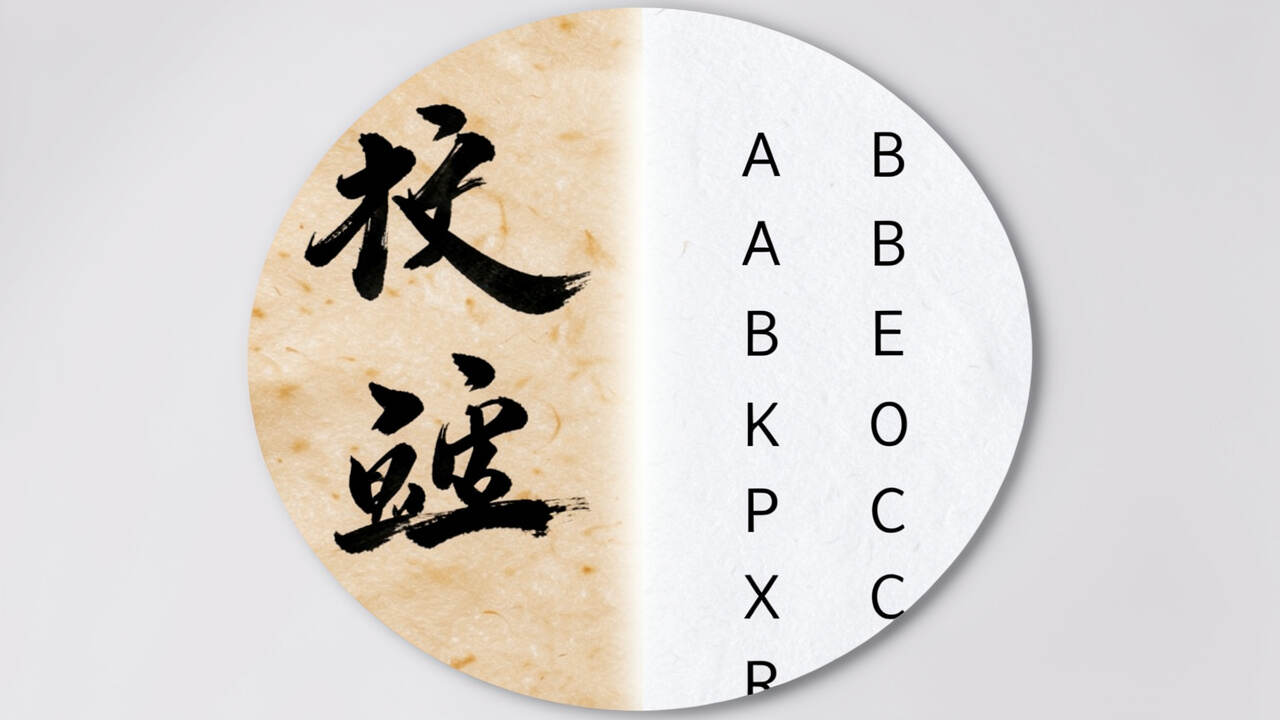
Simply put, Chinese characters do not have an alphabet because they are logograms that represent entire words or morphemes (units of meaning), not individual sounds. An alphabet maps symbols to phonemes (sounds), which is inefficient for a tonal language with thousands of homophones, where the same sound can have dozens of different meanings.
Key Takeaways
- Chinese characters are logograms, meaning each symbol represents a concept or word, not a sound.
- The system evolved from pictographs and ideographs, making it fundamentally different from phonetic alphabets.
- Why Chinese characters don’t use an alphabet is due to the vast number of homophones in the language, which would cause ambiguity with a sound-based system.
- While characters contain phonetic components, they are not pure phonetic symbols and cannot be “sounded out” consistently like letters.
- The logographic system allows speakers of different dialects and languages within China to read the same text, even if they pronounce the words differently.
What Is a Logographic Writing System?
A logographic system is one where each written symbol, or logogram, represents a word or a meaningful unit of language (a morpheme). This is the core category that Chinese characters fall into. In contrast, an alphabetic system uses a limited set of letters, where each letter primarily represents a single consonant or vowel sound.
The key distinction lies in the relationship between the symbol and its value. In “cat,” the letters c-a-t combine to represent the sounds /kæt/. In Chinese, the character 猫 (māo) represents the entire concept of “cat.” You cannot break it down into smaller sound-based components in the same way.
| Feature | Logographic System (Chinese) | Alphabetic System (English) |
|---|---|---|
| Symbol Represents | A whole word or morpheme (meaning). | A phoneme (sound). |
| Number of Symbols | Thousands required (3,000-5,000 for literacy). | Typically 20-30 letters. |
| Learning Process | Memorization of individual symbols and their meanings. | Learning letter-sound correspondences to decode words. |
| Pronunciation Aid | Characters often contain hints (phonetic components) but are not definitive. | Letters are the primary guide to pronunciation. |
This table highlights why learning Chinese involves memorizing characters, while English learning focuses on phonics and spelling rules. The logographic nature is the foundational reason why an alphabet isn’t used.
How Did Chinese Characters Evolve from Pictographs?
The origin of Chinese characters lies in ancient pictographs, where a drawing directly resembled the object it represented. The character for “mountain” (山) started as a sketch of three peaks. This pictographic origin is why Chinese is often called a “pictographic” language, though this is a simplification.
Only a small fraction of modern characters are clear pictographs.
Over centuries, these simple drawings were stylized, abstracted, and combined to create new characters. This evolution followed several key methods of character formation, known as the “Six Principles of Chinese Characters.”
- Pictographs (象形, xiàngxíng): Direct drawings of objects (e.g., 日 – sun, 月 – moon).
- Ideographs (指事, zhǐshì): Abstract symbols for ideas (e.g., 上 – above, 下 – below).
- Ideogrammic Compounds (会意, huìyì): Combining pictographs to suggest a new meaning (e.g., 休, “rest,” combines 人 “person” and 木 “tree”).
- Phono-semantic Compounds (形声, xíngshēng): The most common type, combining a semantic (meaning) component and a phonetic (sound) component.
- Derivative Characters (转注, zhuǎnzhù): Characters that evolved from others with shared meaning.
- Phonetic Loan Characters (假借, jiǎjiè): Borrowing a character for its sound to write a different, homophonous word.
The development of phono-semantic compounds was crucial. This is the closest the system gets to a “phonetic” element, but it’s key to understanding why it’s not an alphabet. For example, in the character 妈 (mā – mother), the radical 女 (woman) gives the semantic clue, while the component 马 (mǎ – horse) provides a phonetic hint.
However, 马 is not a letter “m”; it’s a full character meaning “horse” that happens to share a similar sound.
Why Are There So Many Homophones in Chinese?
A primary reason an alphabet isn’t feasible for Chinese is the massive number of homophones. Mandarin Chinese has a limited set of possible syllables—only about 400 unique syllables without tones, and around 1,300 when tones are included. Compare this to English, which has over 8,000 possible syllables.
With a limited number of sounds, a huge number of words sound identical or very similar. The syllable “shì” can mean over a dozen different things, including “to be,” “matter,” “room,” “style,” “to try,” and “city,” depending on the character and context.
Warning: Relying solely on pronunciation to understand Chinese is impossible. The character provides the essential visual distinction needed for clear communication in writing.
If Chinese used an alphabet, writing the sound “shì” would be useless without context. Is it 事 (matter), 是 (to be), or 市 (city)? The logographic system solves this problem instantly.
Each homophone has its own unique character, providing immediate semantic clarity.
- Limited phonetic inventory (syllables).
- Tonal nature: four main tones in Mandarin further define meaning but don’t eliminate homophones.
- Historical sound changes: Many characters that sound different today were once pronounced similarly, leading to a proliferation of similar-sounding words.
- The writing system adapted to this linguistic reality by preserving visual distinctions where auditory ones were insufficient.
What Are the Components Inside a Chinese Character?
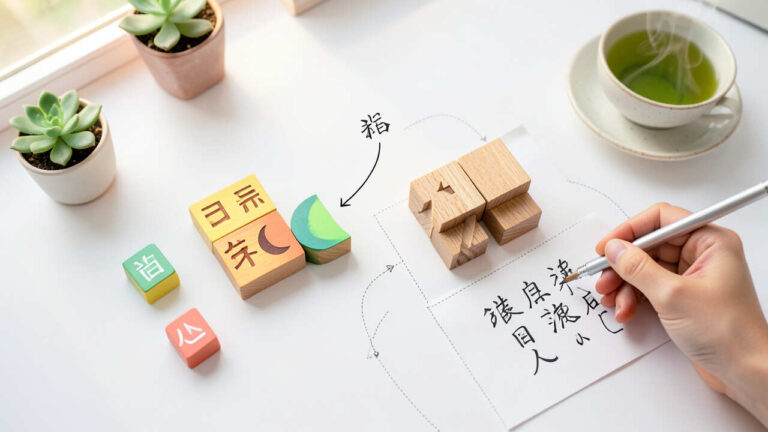
Most modern Chinese characters are not monolithic symbols. They are constructed from smaller building blocks called components or radicals. The most important of these are the semantic radicals, which were standardized in ancient dictionaries like the Shuowen Jiezi.
There are 214 traditional Kangxi radicals. These radicals often give a clue about the character’s general category of meaning. For instance, characters related to water (河 – river, 湖 – lake, 海 – sea) all contain the three-dot water radical (氵).
Characters related to wood (林 – forest, 树 – tree, 桌 – table) often contain the wood radical (木).
| Radical (Component) | General Meaning | Example Characters |
|---|---|---|
| 氵 (water) | Related to water or liquids | 河 (river), 湖 (lake), 汗 (sweat) |
| 木 (wood) | Related to trees, wood, or wooden objects | 林 (forest), 桌 (table), 板 (board) |
| 口 (mouth) | Related to mouth, speaking, or openings | 吃 (eat), 唱 (sing), 叫 (call) |
| 女 (woman) | Related to women or femininity | 妈 (mother), 姐 (older sister), 好 (good) |
This component-based system provides a structured way to learn and organize characters. It offers semantic and sometimes phonetic clues, but it operates on a completely different principle than an alphabet, where each component has a single, consistent sound value.
How Does the Logographic System Aid Cross-Dialect Understanding?
China is home to a vast array of mutually unintelligible spoken dialects and languages, such as Cantonese, Shanghainese, Hokkien, and Mandarin. A person from Guangzhou speaking Cantonese and a person from Beijing speaking Mandarin would struggle to understand each other’s speech.
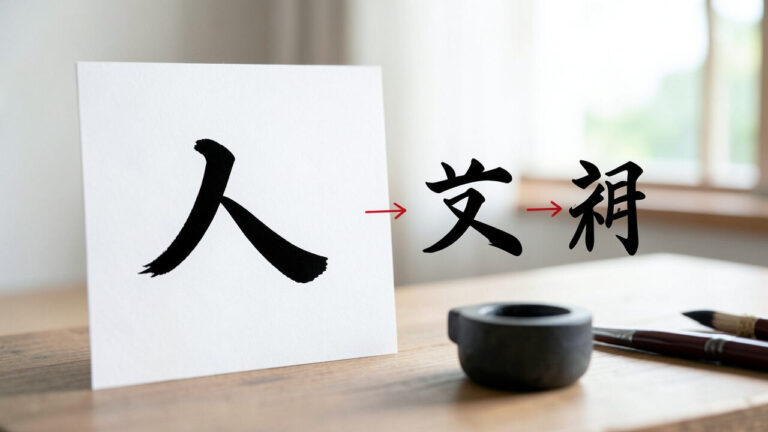
However, they can both read the same newspaper. The character 人 (person) is read as “yán” in Mandarin and “yàhn” in Cantonese, but its meaning—”person”—is identical. The writing system serves as a unifying medium of communication across linguistic diversity.
- Phonetic Divergence: Spoken Chinese has diverged significantly over time and geography.
- Visual Unity: The character-based writing remains constant, transcending pronunciation differences.
- Historical Continuity: This system has allowed scholars across different dynasties and regions to share literature and official documents for over two thousand years.
- Modern Implication: It is a key factor in the cultural cohesion of the Chinese-speaking world.
An alphabet is tied to the pronunciation of a specific language or dialect. If Chinese used an alphabetic system based on Mandarin, Cantonese speakers would be reading a script that doesn’t match their own speech, creating a significant barrier. The logographic system elegantly avoids this problem.
What Are the Modern Challenges of the Chinese Writing System?
The logographic system, while powerful, presents clear challenges in the modern era. The most obvious is the steep learning curve. Achieving basic literacy requires memorizing thousands of characters, a process that takes Chinese children years longer than children learning an alphabet.
Typing on digital devices also required innovative solutions. Early attempts used character-based input methods, but the modern standard is Pinyin input. Users type the Roman alphabet letters for a character’s pronunciation (e.g., “zhongguo”), and software suggests the correct characters (中国).
Tip: Learning common radicals and components is the most efficient way to tackle character memorization. It turns an overwhelming task into a system of understanding.
Other challenges include:
- Handwriting Difficulty: Complex stroke orders and similar-looking characters make handwriting a precise skill.
- OCR and Digital Processing: Optical Character Recognition for Chinese is more complex than for alphabetic scripts.
- Ambiguity in Typography: Simplified characters (used in mainland China) and Traditional characters (used in Taiwan, Hong Kong, and many overseas communities) can create confusion.
- Global Learning Barrier: It poses a significant hurdle for foreign learners compared to alphabetic languages.
Why Haven’t Chinese Characters Been Replaced by an Alphabet?
Despite the challenges, efforts to fully replace Chinese characters with an alphabetic system (known as the Romanization movement) have failed. This is due to the profound cultural, historical, and practical reasons outlined above.
The characters are deeply embedded in Chinese culture and identity. They connect modern speakers to thousands of years of literature, philosophy, and history. A novel by Lu Xun written in 1920 is readable today without a “translation” into a new script, which would be necessary if the writing system had fundamentally changed.
The Chinese government has promoted simplified characters to improve literacy but has never seriously considered abolishing them in favor of an alphabet. Pinyin is used as a phonetic aid for learning pronunciation and for digital input, not as a replacement for the characters themselves.
| Attempted Reform | Goal | Outcome |
|---|---|---|
| Simplified Characters | Reduce stroke count to speed up learning and writing. | Successful in mainland China; coexists with Traditional characters elsewhere. |
| National Romanization | Phase out characters entirely in favor of a Latin-alphabet script. | Largely abandoned due to loss of cultural connection and practical issues. |
| Pinyin as Auxiliary Tool | Teach pronunciation and aid in digital input. | Highly successful and widely integrated into education and technology. |
Frequently Asked Questions
Is Chinese the only language without an alphabet?
No, it is not. Japanese also uses a logographic system (Kanji, which are Chinese characters) alongside two syllabaries (Hiragana and Katakana). Ancient Egyptian hieroglyphs and Sumerian cuneiform were also primarily logographic or mixed systems.
However, Chinese is the only major modern language that relies almost exclusively on logograms for its standard writing.
How many Chinese characters do I need to know to be literate?
For basic functional literacy in modern Chinese (reading newspapers, simple books), you need to know about 2,000-3,000 characters. Educated adults typically know between 5,000 and 8,000 characters. The Chinese Ministry of Education publishes a list of “Commonly Used Characters in Modern Chinese” for educational guidance.
Can you guess the pronunciation of a Chinese character?
Often, yes, but it’s not guaranteed. As mentioned, about 80-90% of characters are phono-semantic compounds. If you recognize the phonetic component, you can make an educated guess at the pronunciation.
However, sound changes over centuries mean many phonetic components are no longer accurate guides, and you still need to learn the specific character’s correct pronunciation.
Is Simplified Chinese easier to learn than Traditional Chinese?
In terms of writing, Simplified Chinese has fewer strokes for many common characters, which can make handwriting and initial recognition somewhat easier. However, Traditional characters often provide more intuitive clues to meaning and etymology. The choice often depends on which region you plan to use the language in, with Simplified dominant in mainland China and Singapore, and Traditional used in Taiwan, Hong Kong, and Macau.
What is the difference between a character and a word?
A character is a single unit of writing. A word can be made up of one character (e.g., 人, rén – person) or multiple characters combined (e.g., 中国人民, Zhōngguó rénmín – Chinese people). In modern Chinese, most common words are two characters long.
Understanding this distinction is crucial for learning and avoiding confusion.
Final Thoughts
The absence of an alphabet in Chinese is not a technological lag but a sophisticated adaptation to the language’s inherent structure and history. The logographic system efficiently handles homophones, unifies a diverse linguistic landscape, and preserves cultural continuity. While it demands significant investment from learners, its ability to convey meaning directly across time and dialects makes it an enduring and effective writing system.