How Stroke Order Works When Writing Chinese Characters
Stroke order is the fundamental sequence for writing the lines and dots that make up a character. Understanding this system is the first step to writing Chinese, Japanese, or Korean characters neatly and efficiently. Without following the correct order, characters can look messy and become difficult to read.
This guide breaks down the core principles so you can build a strong foundation in character writing.
Simply put, stroke order is a set of universal rules that dictate the direction and sequence of strokes. Following these rules helps you write characters faster, remember them more easily, and produce handwriting that is clear and legible to others.
Key Takeaways
- Stroke order follows consistent rules like top-to-bottom and left-to-right, which apply to thousands of characters.
- Correct sequence is essential for proper character balance, form, and memorization, especially in calligraphy.
- The system uses eight basic strokes as building blocks; mastering these is key to learning any character.
- While dictionary order is different, stroke order is what you physically use when writing by hand.
- Digital tools and practice grids are excellent resources for checking and improving your stroke order.
What Is Stroke Order and Why Does It Matter?
Stroke order is the conventional method for writing the individual strokes that form a character. It is not arbitrary; it evolved over centuries based on brush calligraphy. Writing in the correct sequence creates a natural, flowing motion of the hand.
Following the established stroke order for each character has practical benefits. It ensures your handwriting remains consistent and legible. When all writers follow the same rules, it becomes easier to decipher each other’s characters, even with different handwriting styles.
For learners, correct stroke order is a powerful mnemonic device. The physical act of writing a character in the right sequence helps embed it in your muscle memory. This makes recall much easier compared to just recognizing the character visually.
Tip: Think of stroke order like learning to play a musical piece. You follow the composer’s notes in a specific sequence to create the intended melody. Skipping or reordering notes disrupts the flow and the final result.
The Eight Basic Strokes You Must Know
All Chinese characters are built from a set of eight fundamental strokes. Each stroke has a specific name and a defined way it should be written. Mastering these building blocks is essential before tackling complex characters.
The primary strokes vary in shape, length, and angle. They include horizontal lines, vertical lines, dots, and various types of hooks. The order in which you combine these basic strokes forms more complex characters.
- Dot (点, diǎn): A small, downward press. Written from the top-left to the bottom-right.
- Horizontal (横, héng): A line drawn from left to right. Often the first stroke in a character.
- Vertical (竖, shù): A line drawn straight down. There are two main types: the needle (悬针) and the drop (垂露).
- Hook (钩, gōu): A small, sharp turn at the end of a stroke. It appears on vertical, horizontal, or other strokes.
- Upward (提, tí): A stroke that flicks upward from the bottom-left to the top-right.
- Press (捺, nà): A stroke that thickens as it moves from top-left to bottom-right.
- Left-falling (撇, piě): A stroke that sweeps downward and to the left.
- Right-falling (捺, nà): This is the same as the “press” stroke mentioned above.
| Basic Stroke | Name (Pinyin) | Primary Direction | Visual Example |
|---|---|---|---|
| Horizontal | héng | Left to right | 一 |
| Vertical | shù | Top to bottom | 丨 |
| Dot | diǎn | Top-left to bottom-right | 丶 |
| Left-falling | piě | Top-right to bottom-left | 丿 |
| Press/Right-falling | nà | Top-left to bottom-right | ㇏ |
Notice how each basic stroke has a clear start point and direction. This consistency is what allows you to build complex characters from these simple components.
How to Apply the Seven Core Stroke Order Rules
Once you know the basic strokes, you need the rules for sequencing them. These seven principles guide you on which stroke to write next in any character. Memorizing these rules will solve 90% of your stroke order questions.
- Top to Bottom: Write strokes from the highest part of the character to the lowest. For example, in the character for “three” (三), you write the top horizontal line first, then the middle, and finally the bottom one.
- Left to Right: Write strokes from the leftmost side to the rightmost side. The character for “river” (河) clearly shows this, with its three “water” dots on the left followed by the component on the right.
- Horizontal before Vertical: If a horizontal and vertical stroke cross, you usually write the horizontal one first. Look at the character for “ten” (十); the horizontal stroke is written before the vertical one that crosses it.
- Diagonal before Horizontal: When a left-falling diagonal (撇) crosses a horizontal stroke, the diagonal comes first. The character “factory” (厂) demonstrates this rule perfectly.
- Outside before Inside: If a character has an enclosing component, you often write it before the inside parts. However, if the enclosure has a bottom line, you write the inside first, then close it.
- Center before Sides (For Symmetrical Structures): For characters with a vertical axis of symmetry, like “small” (小), you write the central vertical stroke first, then the left-falling stroke, and finally the right-falling stroke.
- Enclosure Completion: For fully enclosed characters, you typically write the outside walls first, then the inside content, and finally the bottom closing stroke. The character for “country” (国) follows this pattern.
Warning: While these rules are standard, there are exceptions. Some characters, often due to historical calligraphic choices, do not follow these rules. It’s best to check a reliable dictionary or app for unfamiliar characters.
Understanding Stroke Order for Common Radicals
Radicals are recurring components that appear in many characters. They often determine the character’s category or meaning. Learning the stroke order for the most common radicals saves you time and confusion.
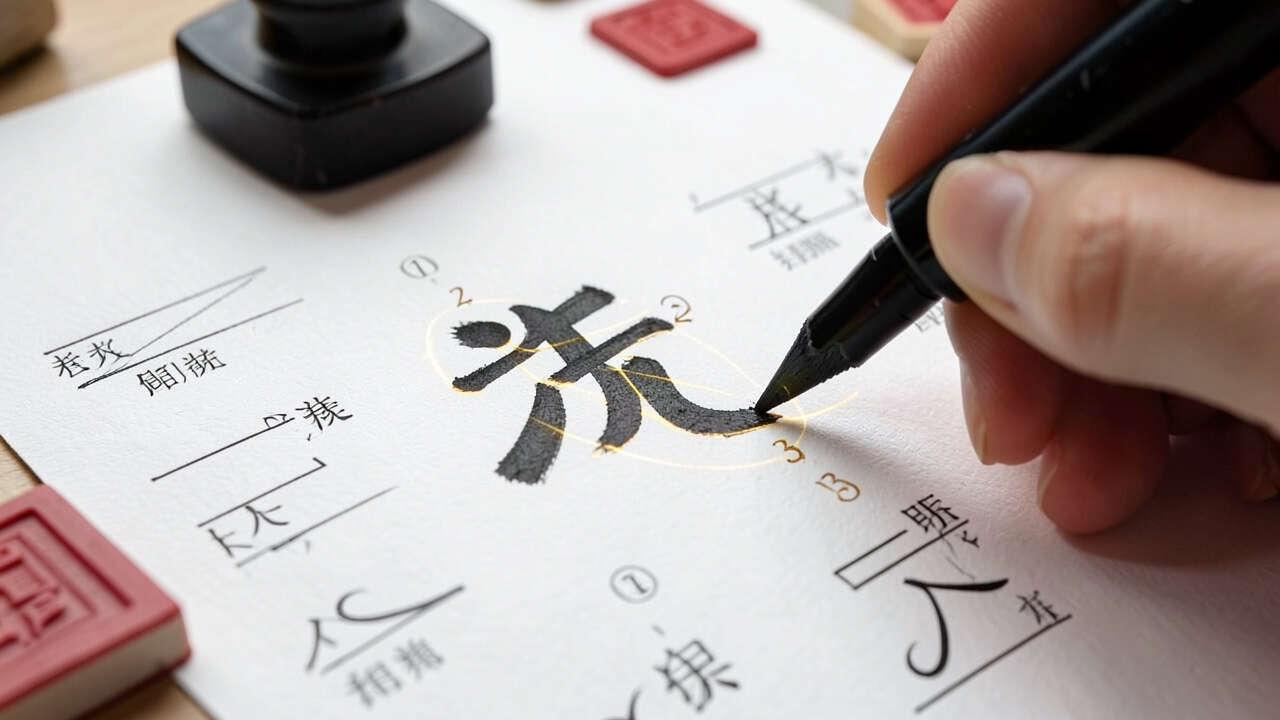
The “water” radical (氵) is a perfect example. It consists of three dots. The correct order is: first the top-left dot, then the middle dot, and finally the upward flick.
This sequence is non-negotiable across all characters containing this radical.
Similarly, the “person” radical (亻) is written with a left-falling stroke first, followed by a vertical stroke. The “heart” radical (心) has a specific sequence for its three dots and the main hook stroke. Knowing these patterns allows you to write unfamiliar characters more accurately.
| Radical | Name/Meaning | Stroke Order Pattern | Example Character |
|---|---|---|---|
| 氵 | Water | Dot, Dot, Upward flick | 河 (hé, river) |
| 亻 | Person | Left-falling, Vertical | 你 (nǐ, you) |
| 口 | Mouth | Vertical, Corner stroke, Horizontal close | 吃 (chī, eat) |
| 木 | Tree | Horizontal, Vertical, Left-falling, Right-falling | 树 (shù, tree) |
Using a radical reference chart is highly recommended. It helps you internalize the building blocks of the writing system. This knowledge directly transfers to hundreds of characters.
What Is the Difference Between Stroke Order and Dictionary Order?
A common point of confusion is the difference between how you physically write a character (stroke order) and how you look it up in a dictionary. They are two separate systems based on different needs.
Stroke order is for writing. It follows the logical, physical rules of brush or pen movement. It is consistent for everyone writing by hand.
Its purpose is to produce a character efficiently and legibly.
Dictionary order, such as the Pinyin system or the Kangxi Radical system, is for organizing and finding characters. Pinyin order is alphabetical by pronunciation. The Kangxi system groups characters by their radical and then by the number of remaining strokes.
While they are different, they occasionally overlap. A character’s first stroke often determines its radical, which is the starting point for looking it up. However, the exact sequence you write inside the radical is irrelevant for dictionary lookup.
How Does Stroke Order Apply to Traditional vs. Simplified Characters?
The core rules of stroke order are the same for both Traditional and Simplified Chinese. The principles of direction and sequence do not change. What changes is the character itself, as Simplified characters often have fewer strokes.
For example, the Simplified character for “dragon” (龙) has only 5 strokes, while the Traditional form (龍) has 16 strokes. You would apply the same top-to-bottom and left-to-right rules to both, but the specific sequence of strokes differs because the characters are built differently.
Important: When learning, focus on the stroke order for the character set you are studying. If you are learning Mandarin in mainland China, use Simplified stroke order. For learning in Taiwan or Hong Kong, use Traditional stroke order.
The components (radicals) may also be written slightly differently in their simplified forms, but the logic behind their stroke order remains consistent. This consistency is what makes the system learnable.
Why Is Stroke Order Crucial for Digital Input Methods?
Stroke order is not just for handwriting. It plays a key role in how you type characters on phones and computers. Two common input methods rely directly on your knowledge of stroke sequence.
The first is the handwriting recognition pad. When you draw a character on your device’s screen, the software analyzes the order, direction, and length of your strokes to guess the character. Writing in the correct stroke order significantly improves recognition accuracy.
The second is the Wubi or stroke-based keyboard input. Instead of using pronunciation, you type sequences of strokes (e.g., horizontal, vertical, dot) to input characters. This method is very fast for proficient users and is impossible without knowing stroke order.
| Input Method | How Stroke Order is Used | Advantage for the User |
|---|---|---|
| Handwriting Pad | Software interprets drawn strokes in real-time. | Allows input of any character, even unknown ones, by drawing. |
| Wubi/Stroke Keyboard | Users press keys corresponding to stroke types in sequence. | Extremely fast for experienced typists; no need to know pronunciation. |
Even if you primarily use Pinyin input, understanding stroke order gives you a deeper connection to the characters. It reinforces your visual and kinesthetic memory, aiding long-term retention.
What Are the Best Tools for Learning and Checking Stroke Order?
Fortunately, many excellent resources are available to help you master and verify stroke order. Combining digital tools with physical practice is the most effective approach.
Apps like Pleco and Skritter are invaluable. They provide animated stroke order diagrams for virtually any character. You can watch the animation repeatedly and then practice writing it yourself on a touchscreen.
For physical practice, worksheets with grids and directional arrows are classic and effective. Writing with a brush pen on rice paper provides authentic feedback on your stroke direction and pressure. Websites like Arch Chinese offer printable worksheets and interactive stroke order diagrams.
Tip: When using an app to check stroke order, pay attention to the starting point of each stroke. It is often marked with a red dot or a different color. This detail is crucial for correct form.
Frequently Asked Questions
Does stroke order matter if no one sees my handwriting?
Yes, it still matters. Correct stroke order builds muscle memory, which helps you remember characters long-term. It also makes handwriting recognition software work better on your devices.
The discipline of following rules translates to better overall character learning.
How many stroke order rules are there?
There are seven core rules that cover the vast majority of characters. These include principles like top-to-bottom, left-to-right, and outside-before-inside. While there are some exceptions, mastering these seven rules will guide you correctly for most characters you encounter.
Can I look up a character if I don’t know its pronunciation?
Absolutely. This is where dictionary order becomes useful. You can look up a character by finding its radical (the left, top, or enclosing part) and then counting the remaining strokes.
This method does not require you to know the character’s pinyin or meaning beforehand.
Is the stroke order the same in Japanese kanji as in Chinese characters?
For most shared characters, the standard stroke order is the same. However, there are some minor differences between the standards used in China, Japan, and Korea. If you are learning a specific language, follow the standard recommended by the educational materials for that language.
What is the fastest way to learn stroke order for beginners?
Start by learning the eight basic strokes and the seven core rules. Then, focus on the 100-150 most common characters. Use an app with animated diagrams, and practice writing them daily.
Repetition with correct form is key; quality of practice is more important than quantity.
Final Thoughts
Mastering stroke order is a non-negotiable part of learning to write characters. It transforms the process from a confusing puzzle into a logical, systematic skill. By internalizing the basic strokes and core rules, you build a framework that applies to every new character you learn.
Remember that consistency is more important than perfection at the start. Use digital tools to verify and practice daily. Over time, the correct sequence will become second nature, significantly improving your handwriting, recall, and overall connection to the written language.