Common Chinese Idioms (Chengyu) Explained
Chinese idioms (chengyu) are compact, four-character phrases that carry profound cultural wisdom and historical lessons. Learning these expressions can dramatically improve your fluency and help you understand the nuances of the Chinese language and mindset.
Many chengyu originate from ancient fables, historical events, and classic literature. Mastering a few common ones gives you a direct window into Chinese culture and makes your conversation sound more authentic and educated.
Simply put, chengyu are the essential building blocks of advanced Chinese expression. They are fixed phrases, usually four characters long, that convey a specific meaning, often with a moral or lesson drawn from history or mythology.
Key Takeaways
- Chinese idioms (chengyu) are typically four characters and are fixed expressions with deep historical or cultural roots.
- They are not just fancy words; using the correct chengyu shows a high level of language proficiency and cultural understanding.
- Many Chinese idioms tell a story or reference a classical text like the Shiji or Zhuangzi.
- Learning chengyu requires understanding their literal and figurative meanings, as direct translation often fails.
- Practical application in conversation or writing is the best way to retain these powerful expressions.
What Are Chinese Idioms (Chengyu)?
Chengyu are a specific form of Chinese proverb. They are almost always four characters long, though exceptions with other lengths exist. These phrases are considered the “gems” of the Chinese language, each encapsulating a complete idea, story, or piece of wisdom.
Their structure is rigid. You cannot change the word order or substitute characters without destroying the idiom’s meaning. This fixed nature makes them powerful rhetorical tools but also challenging for learners to master.
| Characteristic | Description |
|---|---|
| Length | Almost always exactly four characters. |
| Origin | Derived from ancient stories, historical events, poems, or philosophical texts. |
| Usage | Used as a single unit in speech or writing for emphasis or to convey a complex idea succinctly. |
| Meaning | Often figurative, not literal. The true meaning is tied to its original story. |
This table summarizes the core characteristics that define what a chengyu is and how it functions within the language.
Why Are Chinese Idioms So Important to Learn?
Understanding chengyu is not just about vocabulary expansion. It is about grasping cultural literacy. When a native speaker uses a chengyu, they are making a reference to a shared cultural background.
Understanding it means you are part of that conversation.
In formal settings, such as business negotiations, academic writing, or political speeches, chengyu are used frequently to add weight and elegance to the language. Using them correctly signals education and competence.
- Cultural Fluency: They are shortcuts to understanding Chinese values, humor, and worldview.
- Literary Appreciation: Much of classical Chinese poetry and prose is dense with chengyu.
- Efficiency: A single four-character idiom can replace a whole sentence of explanation.
- Social Bonding: Knowing and using them correctly earns respect and creates a deeper connection with native speakers.
- Cognitive Benefits: Learning them exercises your memory and ability to think in abstract concepts.
Tip: When learning a new chengyu, always find the original story behind it. The narrative makes the meaning stick and provides context for correct usage.
Common Categories of Chengyu
Chengyu can be grouped based on their origin, meaning, or grammatical structure. Recognizing these categories can help you learn and remember them more effectively. Many are literal while others are metaphorical.
One useful classification is based on the source story’s theme. This helps you see the type of lesson or value the idiom promotes. Here are several common categories you will encounter.
- Historical Events: Drawn from actual events in Chinese history, often from the Warring States period or the Three Kingdoms era.
- Fables and Legends: Originating from ancient myths or folk tales, often featuring animals or supernatural beings.
- Classical Literature: Phrases taken from foundational texts like the Analerta of Confucius or the writings of Laozi.
- Descriptive Metaphors: Use vivid imagery from nature or daily life to describe a state of being or situation.
- Parallel Structures: Follow a specific grammatical pattern, often with two matching phrases, to emphasize a point.
Knowing that an idiom falls into the “Historical Events” category immediately tells you it likely refers to a specific story from a famous general, strategist, or ruler.
How to Learn and Memorize Chinese Idioms Effectively
Memorizing chengyu requires a strategy beyond simple flashcards. Because their meaning is often figurative, rote memorization of characters alone is insufficient. You must engage with the context and story.
A multi-sensory approach works best. Combine reading the characters, listening to the pronunciation, understanding the story, and seeing it used in a sentence. This creates multiple neural pathways for recall.
| Learning Method | Why It Works |
|---|---|
| Story Mining | Reading the origin tale creates a narrative hook for memory. |
| Contextual Learning | Seeing the idiom in multiple real sentences shows you how it’s used. |
| Group by Theme | Learning idioms about “perseverance” together reinforces related concepts. |
| Create Sentences | Writing your own sentences forces active recall and application. |
| Use Visual Aids | Drawing the characters or a comic of the story engages visual memory. |
This table outlines proven strategies. Choose the method that fits your learning style best, or combine several for maximum retention.
Warning: Never use a chengyu in the wrong context. Using an idiom meant for a serious situation in a lighthearted one can cause confusion or offense. When in doubt, listen and observe before trying it yourself.
What Are Some of the Most Famous Chengyu?
While there are thousands of chengyu, a core group is used very frequently in daily life, media, and literature. Knowing these common examples is essential for any learner aiming for intermediate proficiency. Their meanings are often universal, touching on courage, foolishness, beauty, and perseverance.
Below is a list of ten widely recognized chengyu. For each, we provide the characters, literal translation, figurative meaning, and a brief note on its origin story.
1. 对牛弹琴 (duì niú tán qín)
Literal Meaning: To play the lute to a cow.
Figurative Meaning: To waste your effort explaining something to someone who cannot understand. It speaks to the futility of misdirected communication.
Origin: Comes from a Daoist text describing a musician who played beautiful music for a cow, which merely continued chewing its grass.
2. 画蛇添足 (huà shé tiān zú)
Literal Meaning: To draw a snake and add feet.
Figurative Meaning: To ruin something by adding unnecessary details or effort. It’s about superfluous actions that backfire.
Origin: From a story where men competed to draw a snake fastest. The winner, with time to spare, added feet to his drawing, only to lose because snakes don’t have feet.
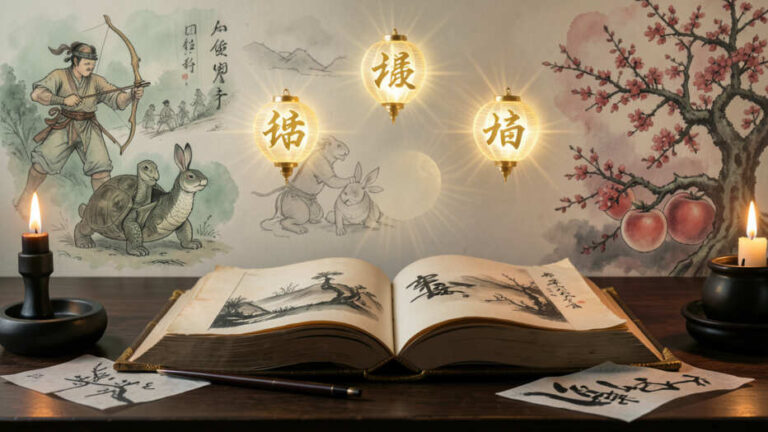
3. 守株待兔 (shǒu zhū dài tù)
Literal Meaning: To guard a tree stump waiting for rabbits.
Figurative Meaning: To rely on chance and be unwilling to work hard; to cling to a single fluke experience hoping it will repeat.
Origin: A farmer saw a rabbit run into a tree stump and die. He then abandoned farming to wait for another rabbit, which never came.
4. 井底之蛙 (jǐng dǐ zhī wā)
Literal Meaning: A frog at the bottom of a well.
Figurative Meaning: A person with a very limited outlook and experience who cannot see the bigger picture.
Origin: From the writings of the philosopher Zhuangzi, describing a frog who believes the small circle of sky it sees from the well is the entire heavens.
5. 班门弄斧 (bān mén nòng fǔ)
Literal Meaning: To wield an axe in front of Lu Ban’s door.
Figurative Meaning: To show off your slight skill in front of an expert. It implies you are not as capable as you think.
Origin: Lu Ban was a legendary master carpenter from ancient China. Wielding an axe at his door would be the height of arrogance.
6. 破釜沉舟 (pò fǔ chén zhōu)
Literal Meaning: To break the cauldrons and sink the boats.
Figurative Meaning: To cut off all retreat and commit fully to a course of action; to show determination by eliminating the option to go back.
Origin: Refers to the strategy of Xiang Yu during the Chu-Han Contention. He ordered his army to destroy their cooking pots and boats after crossing a river, forcing them to fight desperately for victory.
7. 塞翁失马 (sài wēng shī mǎ)
Literal Meaning: The old man at the frontier lost his horse.
Figurative Meaning: A blessing in disguise. Something that seems bad may turn out to be good, and vice versa. It promotes philosophical acceptance.
Origin: A story about an old man whose horse ran away. His neighbors commiserated, but he said it might be a good thing. Later, the horse returned with a fine stallion, and so on.
8. 愚公移山 (yú gōng yí shān)
Literal Meaning: The foolish old man who moved mountains.
Figurative Meaning: To accomplish a huge task through perseverance and sheer willpower, even if it seems impossible.
Origin: A fable about an old man named Yu Gong who decided to move two large mountains blocking his path. His perseverance was so great that the gods moved the mountains for him.
9. 卧薪尝胆 (wò xīn cháng dǎn)
Literal Meaning: To sleep on brushwood and taste gallbladder.
Figurative Meaning: To endure hardships and remind oneself of past humiliations to motivate future success and revenge.
Origin: Refers to King Goujian of Yue, who slept on firewood and tasted bitter gall after a defeat to keep his desire for revenge alive until he ultimately conquered the state of Wu.
10. 三心二意 (sān xīn èr yì)
Literal Meaning: Three hearts, two minds.
Figurative Meaning: To be indecisive, half-hearted, or distracted; to lack commitment and focus.
Origin: The phrase directly describes a person whose intentions are split and unstable, making it hard for them to commit to one path.
| Chengyu | Pinyin | Core Lesson |
|---|---|---|
| 对牛弹琴 | duì niú tán qín | Choose your audience wisely. |
| 画蛇添足 | huà shé tiān zú | Stop while you’re ahead. |
| 守株待兔 | shǒu zhū dài tù | Don’t rely on luck; work hard. |
| 井底之蛙 | jǐng dǐ zhī wā | Broaden your horizons. |
| 班门弄斧 | bān mén nòng fǔ | Respect true expertise. |
This table summarizes the core lesson from five of the common chengyu listed above, offering a quick reference for their practical application.
How Are Chengyu Used in Modern Chinese?
In contemporary usage, chengyu appear in news headlines, business meetings, daily conversations, and social media. They add a layer of sophistication and conciseness. A well-placed idiom can make your point more memorable.
However, the context must be right. You would not use a formal, literary chengyu in a casual chat with friends about weekend plans. Similarly, using a very casual one in a written report would be inappropriate.
Context is king.
- In Writing: Journalists and authors use them to create vivid imagery and economic prose. “The stock market crashed, causing sǒu zhū dài tù (守株待兔) investors to scramble.”
- In Speech: Speakers use them to persuade or illustrate a point. “We must be pò fǔ chén zhōu (破釜沉舟) if we want to win this project.”
- In Idioms: Sometimes they are used humorously or with slight variation to create a modern twist on an old saying.
- As Cultural Shorthand: Saying “You’re like the frog in the well” (你是井底之蛙) instantly communicates a complex criticism without a lengthy explanation.
Common Mistakes When Using Chinese Idioms
The most frequent error is using a chengyu incorrectly because of a superficial understanding. This includes misusing the idiom’s tone, applying it to the wrong scenario, or misunderstanding its connotation (positive, negative, neutral).
Another mistake is “word-for-word” translation. Translating 画蛇添足 as “draw snake add feet” means nothing in English. You must translate the concept: “to overdo it” or “to gild the lily.”
- Ignoring Connotation: Some chengyu are inherently critical or mocking. Using them without realizing can offend.
- Misplacing the Emphasis: In a sentence, the chengyu should fit naturally into the grammatical structure. It is not a standalone phrase you just insert randomly.
- Overuse: Sprinkling too many chengyu into one speech or piece of writing can sound pretentious and confusing. Use them sparingly for impact.
- Outdated Usage: Some chengyu are archaic and only found in literature. Using them in modern conversation might sound unnatural.
- Incorrect Characters: Changing even one character in the idiom (e.g., 画蛇添”是” instead of 足) destroys it entirely and creates nonsense.
Important: When you hear a chengyu you don’t know, ask for the story behind it. Understanding the narrative is the fastest path to mastering its meaning and proper use.
Resources for Deepening Your Chengyu Knowledge
For learners ready to dive deeper, specialized resources are invaluable. Many apps and websites now have dedicated sections for chengyu, often with the origin stories and example sentences you need.
Classic literature, especially tales from the Warring States period and folklore collections, is a rich source. Reading with a dictionary nearby can reveal dozens of chengyu in their natural habitat.
- Dictionaries: A good Chinese-English dictionary will have a special section for four-character idioms. ABC Chinese-English Comprehensive Dictionary is an excellent academic resource.
- Online Databases: Websites like Hanziyuan or Chinese-Tools often list common chengyu with pinyin and English explanations.
- Children’s Books: Many are specifically designed to teach chengyu through illustrated stories, which is perfect for visual learners.
- Language Exchange: Ask your language partner or teacher to explain a chengyu they use and why they chose it in that sentence.
- Thematic Lists: Study lists grouped by theme (courage, idiocy, perseverance) to build conceptual connections between different idioms.
Frequently Asked Questions
How many Chinese idioms are there?
It is impossible to give an exact number, as the Chinese language is vast and constantly evolving. Scholars estimate there are tens of thousands of chengyu in existence. However, for practical communication, knowing the 300-500 most common ones will cover the vast majority of everyday situations.
Can I make up my own Chinese idiom?
Technically, you can create any four-character phrase, but it would not be considered a true chengyu unless it entered common usage and developed a story or established meaning over time. Creating a new one that people understand is extremely difficult. It’s best to learn and use the established ones.
Are chengyu only four characters long?
The overwhelming majority are exactly four characters, which is why the term “four-character idiom” (四字成语, sì zì chéngyǔ) is often used synonymously with chengyu. However, there are some famous idioms with three, five, or more characters. The four-character form is the most classic and common.
Is knowing chengyu necessary for learning Chinese?
For basic survival Chinese, no. For intermediate and advanced proficiency, and especially for understanding literature, news, and cultural nuances, absolutely yes. They are a fundamental component of a rich and expressive vocabulary.
How do I practice using chengyu correctly?
The best practice is to find a good example sentence for each one you learn, then try to create your own similar sentences. Use them in written exercises first. When speaking, wait until you are sure of the context before trying to use one.
Listening to native podcasts or watching news programs can help you hear how they are naturally deployed.
Final Thoughts
Chinese idioms (chengyu) are a challenging yet rewarding aspect of language learning. They are direct links to thousands of years of Chinese history, philosophy, and storytelling. Mastering even a dozen common ones will significantly elevate your comprehension and expression.
Remember to always seek the story behind the characters. Approach them with curiosity and respect for their cultural weight. With consistent exposure and practice, these powerful phrases will become a natural and impressive part of your Chinese linguistic toolkit.