Daily Life in the Tang Dynasty for Ordinary People
Daily life for commoners during the Tang Dynasty offers a fascinating glimpse into the world of ordinary people, far from the imperial court’s grandeur. This era, from 618 to 907 AD, was a golden age of Chinese civilization, marked by prosperity, cultural flourishing, and a well-organized society. Understanding how farmers, merchants, and artisans lived reveals the true engine of this historical peak, showing the customs, challenges, and simple joys that defined their existence.
This post explores the realities of life for the majority, from what they ate to how they worked and entertained themselves.
Simply put, daily life for Tang Dynasty commoners revolved around agricultural labor, a strict social hierarchy, and simple pleasures. They lived in modest homes, wore practical cotton clothing, and enjoyed community-based entertainment like folk music and seasonal festivals, all while contributing to a vast and thriving economy.
Key Takeaways
- The vast majority of commoners in the Tang Dynasty were farmers tied to the land and the agricultural calendar.
- Tang society was structured into four distinct classes, with commoners (farmers and merchants) forming the economic backbone.
- Commoners’ homes were simple structures of mudbrick or wood, centered around a family courtyard for multi-generational living.
- Diet was grain-based with rice or wheat, supplemented by vegetables, tofu, and occasional pork, with tea becoming a widespread daily beverage.
- Work for most meant farming, but other commoner occupations included artisans, merchants, and low-level government runners.
- Leisure time involved community gatherings, seasonal festivals, board games like Go, and listening to traveling performers.
What Was the Social Structure Like for Commoners in the Tang Dynasty?
The Tang Dynasty operated on a four-tiered social hierarchy that defined a person’s occupation and status. At the top were the Scholar-Officials, followed by Farmers. Artisans came third, and Merchants were placed last.
This ranking was philosophical, not purely economic, valuing production and governance over commerce.
For commoners, their class dictated their daily opportunities and obligations. Farmers were highly respected because they produced the essential food for the empire. Artisans created vital goods, while merchants facilitated trade but were often viewed with some suspicion.
This structure was relatively fluid, especially through the imperial examination system, which allowed some exceptionally talented commoners, particularly farmers’ sons, to enter the scholar-official class.
The Four Official Classes of Commoners
- Farmers (Nong): The largest and most respected group, they formed the economic foundation of the dynasty. Their labor fed the population and funded the state through grain taxes.
- Artisans (Gong): Skilled workers who produced everything from pottery and textiles to metal tools and furniture. They often lived in specialized quarters or worked in state-run workshops.
- Merchants (Shang): Though essential for trade, they were officially ranked lowest because they did not directly produce goods. Despite this, many became wealthy and influential.
- Civilian Commoners (Shu): A catch-all category for lower-level government clerks, runners, and other service workers not fitting neatly into the three main groups.
| Class | Primary Role | Social Status | Key Detail |
|---|---|---|---|
| Farmers | Agricultural production | Respected | Largest population group, paid taxes in grain |
| Artisans | Crafting goods | Moderate | Often worked in family shops or state workshops |
| Merchants | Trade and commerce | Officially low | Could accumulate wealth but faced legal restrictions |
This system influenced marriage prospects, clothing styles, and where one could live. A farmer’s family would work the same land for generations, creating a deep connection to the seasons and local community. Breaking into a higher class was difficult but not impossible, primarily through education.
Tip: Don’t assume all commoners were poor. While most lived modestly, successful merchants and master artisans in cities like Chang’an or Yangzhou could live very comfortably, sometimes rivaling lower-level officials in wealth.
What Did Typical Housing and Family Life Look Like?
The home for a Tang Dynasty commoner was a center of family life and economic production. For rural farmers, the house was typically a simple structure made of rammed earth, mudbrick, or wood with a thatched or tiled roof. It was designed for functionality and resilience against the elements rather than grandeur.
Urban commoners, including artisans and merchants, lived in denser city wards. Their homes might be part of a narrow “shop-house” with the business on the ground floor and living quarters above. Regardless of location, the home was organized around a central courtyard, which provided light, ventilation, and a private space for family activities and domestic work like weaving or food preparation.
Core Elements of the Commoner’s Home
- Kang (Heated Bed Platform): In northern regions, a large, hollow brick platform that was heated by a flue from the kitchen stove served as the primary sleeping and living area for the entire family during cold months.
- Family Ancestor Shrine: A dedicated space within the home to honor deceased family members, reflecting the deep importance of filial piety and lineage.
- Multi-Generational Layout: Homes were designed for extended families. Grandparents, parents, children, and sometimes aunts or uncles all shared the space, with rooms allocated by seniority.
- Domestic Workspace: Areas for storing grain, tools, and harvest. Women often managed silkworm cultivation and weaving in a dedicated part of the courtyard or home.
- Basic Furnishings: Furniture was simple: low tables, benches, and the kang. Storage was in chests or ceramic jars. Oil lamps provided light after dark.
Important: Privacy as we know it was a modern luxury. Rooms were often multi-purpose, and sleeping areas were shared by family members. The courtyard was the heart of the household, blending indoor and outdoor life.
Family life was governed by Confucian principles of hierarchy and duty. The father was the undisputed head, managing finances and representing the family. Mothers ran the household, managed servants if any, and were responsible for educating daughters.
Children, especially sons, were expected to show absolute respect to elders and care for them in old age. Marriage was an alliance between families, arranged by parents, with little personal choice involved for commoners.
How Did Commoners Sustain Themselves? Food, Diet, and Clothing
The diet of a Tang commoner was simple, grain-based, and heavily dependent on location. In the fertile south, rice was the staple food. In the drier north, wheat and millet were more common, often prepared as noodles, steamed bread (mantou), or porridge.
Vegetables like cabbage, radishes, and beans formed the core of most meals.
Meat was a luxury. Pork was the most common animal protein when available, often during festivals. Tofu, invented earlier but popularized during the Tang, provided an important source of protein.
Soy sauce and fermented bean pastes were key flavorings. Tea, which became the national beverage during this period, was drunk by almost everyone, from peasants to emperors.
Common Foods in the Tang Dynasty Diet
- Grains: Rice (south), wheat, millet, sorghum. Prepared as congee, noodles, steamed buns, and pancakes.
- Vegetables: Chinese cabbage, spinach, celery, radish, lotus root, bamboo shoots, mushrooms.
- Proteins: Tofu, soybeans, peanuts, occasional pork or chicken. Fish was common near rivers.
- Fruits: Peaches, plums, jujubes (dates), melons, oranges in the south.
- Condiments: Soy sauce, vinegar, salt, ginger, garlic, and chili peppers (though less common initially).
- Beverages: Tea (ubiquitous), rice wine, and water. Milk was not a common drink for adults.
| Meal | Common Dish (North) | Common Dish (South) |
|---|---|---|
| Breakfast | Millet porridge, flatbread | Rice congee, pickles |
| Lunch | Wheat noodles with vegetables | Steamed rice with stir-fried greens |
| Dinner | Steamed bread, vegetable stew | Rice, tofu, river fish |
Clothing was a direct reflection of social status due to sumptuary laws. Commoners were restricted to fabrics like hemp and coarse silk. Colors were limited to earthy tones like gray, brown, and dark blue.
The most common outfit for men was a short tunic over trousers, while women wore high-waisted, long-skirted robes. The Tang Dynasty saw fashion become more fluid, with influences from Central Asia, but these elaborate styles were mostly for the elite.
What Were the Primary Occupations and Work Conditions?
For most people, work was dictated by the seasons and the land. The agricultural calendar governed life. Spring meant plowing and planting.
Summer involved weeding and irrigation. Autumn was the crucial harvest period. Winter was for maintenance, threshing grain, and paying taxes.
A farmer’s life was a cycle of hard physical labor, with success dependent on weather and the local water system.
Beyond farming, other commoner jobs were emerging in the Tang’s growing economy. Artisans worked with specific materials in family workshops. They included potters, weavers, metalworkers, carpenters, and papermakers.
Cities also had service jobs: messengers, porters, hired laborers, and numerous vendors selling everything from snacks to lanterns.
Key Occupations for Tang Dynasty Commoners
- Farmer (Nong): Over 80% of the population. Worked family land, paid taxes in grain, and could be conscripted for labor projects like canal building.
- Artisan (Gong): Specialized skilled labor. Many were organized in guilds. State workshops produced luxury goods, while private shops served local markets.
- Merchant (Shang): Ranged from small stall owners to wealthy traders on the Silk Road. They operated within walled marketplaces in cities, which opened at dawn and closed at dusk.
- Runner/Courier (Li): Low-level government employees who delivered messages and transported documents. It was a low-status but steady job.
- Servant/Hired Labor (Yong): Worked for wealthier households or businesses for wages, often in exchange for food and lodging. A precarious existence.
Work conditions were tough. There was no concept of weekends or holidays beyond major festivals. A farmer’s workload was intense and directly tied to survival.
However, the Tang government did maintain a system of equal-field distribution, which allocated land to peasants, providing a measure of stability. Artisans faced the pressure of quality standards, especially for state contracts, and merchants navigated a complex system of markets and regulations.
Warning: The life of a commoner could be precarious. A single bad harvest due to drought, flood, or locusts could lead to starvation. Debt to local moneylenders was a constant threat, sometimes leading to the loss of land or family members being sold into servitude.
How Did Commoners Spend Their Leisure Time and Enjoy Culture?
Despite hard work, commoners enjoyed a rich cultural life, especially during festivals and market days. The Tang calendar was punctuated by major holidays like the New Year Festival, Lantern Festival, and Mid-Autumn Festival. These were times for feasting, visiting family, and public celebrations that offered a break from routine.
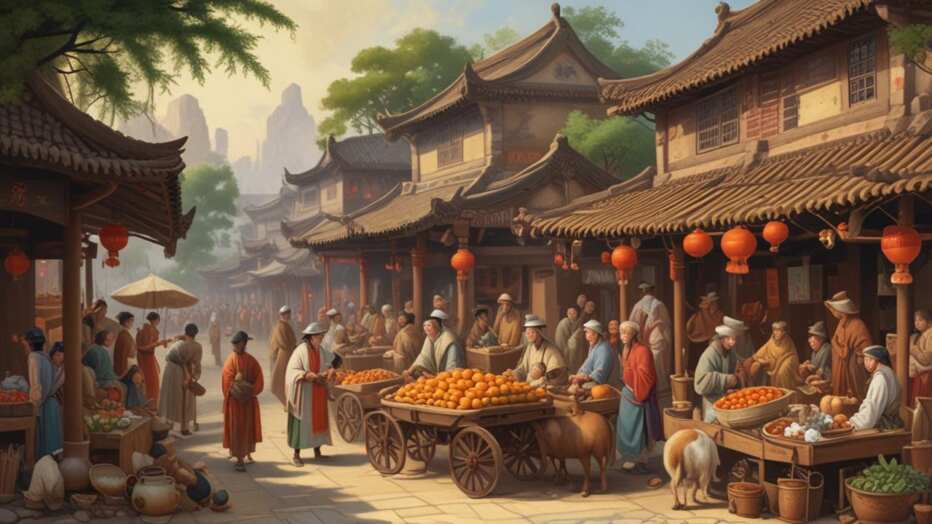
Entertainment was often community-based. Traveling performers—acrobats, musicians, storytellers, and shadow puppeteers—would visit villages and market squares. In cities, the bustling marketplaces were centers of social life.
People gathered to gossip, watch street performances, and sample food from vendors. A popular pastime was playing board games like Go (Weiqi) or Liubo, and card games were beginning to emerge.
Popular Activities and Pastimes for Commoners
- Festival Participation: Joining public parades, dragon dances, and lantern displays during New Year and Lantern Festival.
- Market Strolling: Visiting the weekly or bi-weekly market to shop, socialize, and see new goods from other regions.
- Board Games: Playing Go (Weiqi) or the strategic game Liubo with friends and neighbors.
- Music and Performance: Listening to itinerant musicians or participating in local folk singing and dances.
- Storytelling: Gathering to hear tales of history, legend, and moral instruction from village elders or professional storytellers.
- Kite Flying and Sports: Enjoying kite flying in open fields and engaging in sports like cuju (an early form of football).
Religious and spiritual practices were also part of daily life and leisure. Visits to local Buddhist temples or Daoist shrines for prayer, festivals, or to seek blessings were common. The vibrant culture of the Tang, influenced by Silk Road exchanges, meant even commoners had exposure to foreign goods, music, and ideas, which filtered down from the cosmopolitan cities.
What Role Did Religion and Belief Systems Play?
For the common Tang citizen, religion was interwoven with daily life, offering explanations for the world and hope for the afterlife. Buddhism was immensely popular, spreading widely among all classes. Monasteries were not just places of worship but also economic centers, lending money, and owning land.
Commoners might visit to pray for a good harvest, the health of a child, or for guidance in difficult times.
Folk religion and ancestor veneration were fundamental. The practice of honoring deceased relatives at home shrines and during annual festivals ensured their spirits remained content and provided support for the living family. This blended with Confucian ideals of family duty and Daoist concepts of living in harmony with nature.
Key Belief Practices for Commoners
- Buddhist Merit-Making: Donating small amounts to temples, lighting incense, or releasing captive birds to gain merit for a better rebirth.
- Ancestor Veneration: Regular offerings of food and incense at the family shrine to show respect and seek ancestral blessings.
- Daoist Practices: Consulting Daoist priests for fortune-telling, talismans for protection, or health advice based on balancing qi.
- Local Deities: Worshipping spirits believed to protect the village, the harvest, or a specific craft, often at small local shrines.
- Funerary Rites: Following prescribed rituals for burials, often incorporating Buddhist and Daoist elements, to ensure the soul’s peaceful journey.
This syncretic blend meant a commoner might pray to the Bodhisattva Guanyin at a temple, make offerings to ancestors at home, and consult a Daoist about an illness, all without seeing contradiction. These practices provided a strong sense of community, continuity, and comfort in an often-unpredictable world.
How Did the Tang Dynasty Government Affect Commoners?
The imperial government’s policies had a direct and profound impact on daily life. The cornerstone was the equal-field system, which allocated land to peasant households. This land was not owned but granted for use, with the obligation to pay taxes and perform labor service.
This system aimed to prevent the concentration of land in the hands of the elite and ensure a stable tax base.
Taxes were primarily paid in grain and cloth. In addition to annual taxes, commoners could be conscripted for corvée labor, working on state projects like building canals, walls, or roads for a set number of days per year. The local magistrate was the face of this authority, responsible for collecting taxes, maintaining order, and adjudicating disputes.
Key Government Impacts on Daily Life
- Land Allocation and Taxes: The equal-field system provided land but came with a guaranteed tax and labor burden that was the primary concern of rural life.
- Labor Service: Mandatory unpaid work for the state could take farmers away from their fields at critical times, straining family resources.
- Market Regulation: Cities had designated marketplaces with official supervisors who set standards, collected fees, and controlled opening hours.
- Legal Codes: The Tang Code was detailed and harsh. Punishments for crimes could be severe, reinforcing social order through fear.
- Social Advancement: The imperial examination system, while dominated by the elite, technically offered a path for exceptionally talented commoners to enter government service.
Important: According to historical records, at its peak, the Tang Dynasty governed a population of over 50 million people, with the tax and labor systems of the equal-field policy being the primary means of state revenue and public works construction.
While these systems provided structure and a degree of equity, they were also points of tension. As the dynasty aged, land inequality grew as powerful families found ways to accumulate private holdings, and the tax burden on small farmers became unsustainable, contributing to later unrest.
What Kind of Education and Knowledge Was Accessible?
Formal education was largely the privilege of the wealthy scholar-official class. Commoners had very limited access to literacy. Education for most was practical and oral—learning agricultural techniques from parents, craft skills through apprenticeship, and social norms from community elders and religious teachings.
However, the Tang era’s cultural openness did allow some knowledge to trickle down. Buddhist monasteries sometimes ran schools for children. In wealthy merchant families, boys might be taught to read and write for business purposes.
The widespread use of paper and woodblock printing, while still expensive, began making texts more available than in previous eras.
Pathways of Knowledge for Commoners
- Oral Tradition: Stories, folk songs, proverbs, and practical knowledge passed down through generations within the family and village.
- Apprenticeship: Young artisans learned their trade over many years under the guidance of a master in a workshop.
- Religious Institutions: Buddhist and Daoist monasteries offered basic literacy and moral education to some children, including orphans.
- Marketplace Information: The market was a hub for news, gossip, and the spread of ideas through conversation and itinerant storytellers.
- Practical Experience: Knowledge of the land, seasons, weather patterns, and plant lore was gained through direct, hands-on experience.
The illiteracy rate among commoners was high. Understanding came through symbols, rituals, and direct instruction. For a farmer, deep knowledge of the soil and sky was more critical than reading classical texts.
This created a society where practical skill was highly valued in its own sphere, even as scholarly learning was revered from afar.
Frequently Asked Questions
Were all commoners in the Tang Dynasty poor farmers?
While farmers made up the vast majority (over 80%), the “commoner” category also included artisans and merchants. A successful merchant in a city like Yangzhou or a master potter could live quite comfortably, owning a nice home and enjoying luxuries. Poverty was widespread, but there was a spectrum of living standards within the commoner classes.
What was a typical day like for a Tang Dynasty farmer?
A farmer’s day began at dawn with chores like feeding animals. The main work involved tending to crops—plowing, planting, weeding, or harvesting depending on the season. Meals were simple and eaten in the field or at home.
Evening might involve repairing tools, spinning hemp, or family time before early sleep to conserve energy for the next day.
Could commoners own land in the Tang Dynasty?
Under the equal-field system, commoners did not “own” land in the modern sense. They were allocated land to use and farm in exchange for taxes and labor. They could pass the use rights to heirs but could not freely sell it.
Over time, the system broke down, and private land ownership by elites and commoners alike became more common.
What did commoners wear?
Clothing was restricted by law. Commoners wore tunics and trousers for men or skirts and robes for women made from coarse hemp or wild silk. Colors were limited to dull, dark dyes like indigo blue, gray, or brown.
Only officials and the wealthy could wear fine silk, bright colors, or ornate patterns.
How did commoners get news and information?
Information spread orally through village elders, traveling merchants, and storytellers in marketplaces. Government edicts were posted in public squares and read aloud by officials. Religious festivals were also opportunities for news to be shared.
Literacy was low, so the written word was not a primary source for most commoners.
Final Thoughts
The daily life of commoners during the Tang Dynasty was a blend of hard work, deep family bonds, and vibrant community culture. From the rhythmic cycle of farming to the simple pleasures of a festival or a cup of tea, ordinary people built the foundation for one of history’s most celebrated eras. Their resilience and traditions, shaped by social structures and government policies, reveal a world both distant and fundamentally human.