How Long to Learn Mandarin Chinese: Realistic Timelines
Learning Mandarin Chinese is a major commitment that offers incredible personal and professional rewards. But one of the most common questions for any new learner is, “How long will this actually take?” The answer isn’t a simple number, as it depends on your goals, methods, and dedication. This guide breaks down realistic timelines for different proficiency levels and shares key strategies to help you learn as efficiently as possible.
Simply put, achieving basic conversational fluency in Mandarin typically requires 600-900 hours of dedicated study. For advanced professional proficiency, expect to invest 2,200 hours or more. Your personal timeline can vary dramatically based on your study consistency, methods, and whether you have immersion opportunities.
Key Takeaways
- The time to learn Mandarin is measured in hours of study, not just months or years.
- Basic conversational skills (HSK 1-2) can be achieved in 3-6 months with consistent, daily practice.
- Advanced fluency (HSK 5-6) is a multi-year journey requiring 2,200+ hours of study and immersion.
- Focusing on tones and characters from day one prevents foundational weaknesses that slow long-term progress.
- Your learning environment and daily exposure are just as important as formal study hours.

What Is the FSI Rating for Learning Mandarin?
The U.S. Foreign Service Institute (FSI) classifies languages by difficulty for native English speakers. Mandarin Chinese is in Category V, the “super-hard” category.
This means they estimate it takes 2,200 class hours to achieve professional working proficiency. This estimate assumes a full-time student in an immersive environment with constant support.
It’s crucial to understand that this timeline is for achieving a high-level, professional standard. For most casual learners, goals like ordering food, making friends, or basic travel are more attainable in a shorter period. The FSI number represents the upper end of the spectrum, not the minimum requirement to start using the language.
| FSI Category | Language Group | Estimated Class Hours | Examples |
|---|---|---|---|
| I | Easiest | 600-750 hours | Spanish, French, Italian |
| III | Medium | 1,100 hours | Hindi, Russian, Polish |
| V | Hardest | 2,200 hours | Mandarin Chinese, Cantonese, Japanese |
What Are the Realistic Timelines for Different Proficiency Levels?
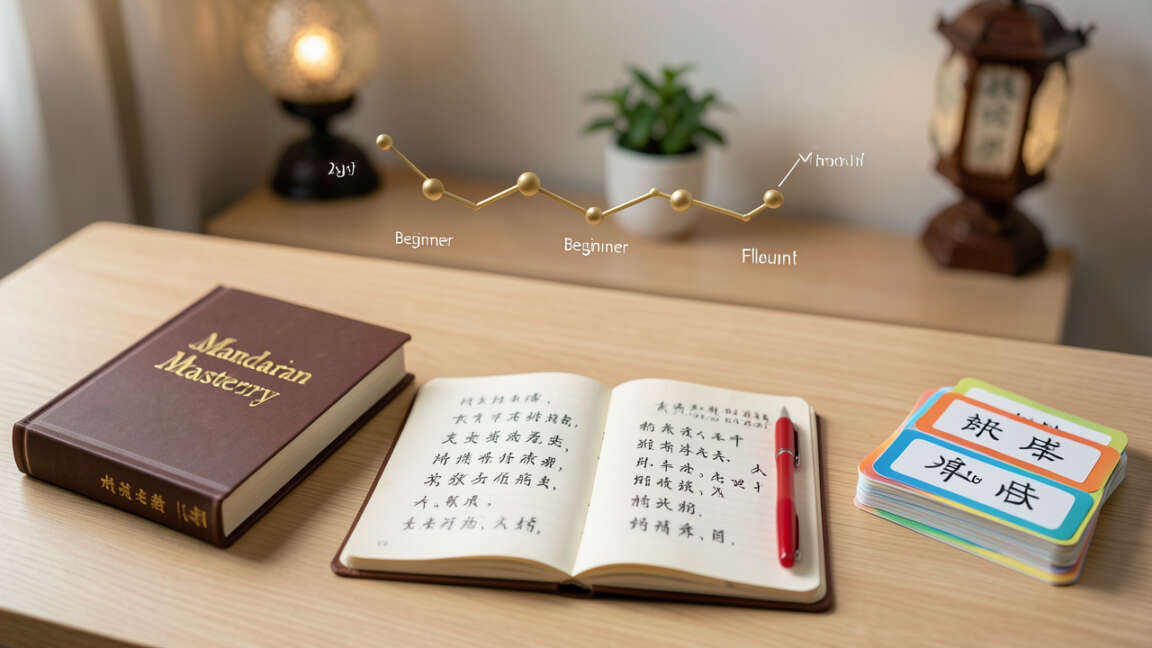
The journey to learn Mandarin Chinese is best broken into stages. Your “time” is measured by the number of hours you actively study and practice. Here’s a breakdown based on the widely-used HSK (Hanyu Shuiping Kaoshi) proficiency test.
- Beginner (HSK 1-2): 3-6 Months (150-300 Hours)
You’ll learn basic greetings, simple sentences, and 300-500 vocabulary words. You can handle simple, direct interactions. This stage requires mastering the four tones and about 150-300 basic characters. - Intermediate (HSK 3-4): 6-12 Months (300-600 Hours)
You can discuss familiar topics, express opinions, and read short paragraphs. Vocabulary expands to 1,000-1,500 words. This is often the “sweet spot” where Mandarin starts to feel truly useful for travel and casual friendships. - Advanced (HSK 5-6): 2-4 Years (1,500+ Hours)
You understand native media, read newspapers, and work professionally in Mandarin. You have a large vocabulary and grasp nuanced grammar. This level requires deep cultural understanding and consistent immersion.
Important: These hours are for active learning. Passive listening or casual app usage counts for less. Focused study with speaking practice is far more effective.

How Does Your Learning Method Impact Your Timeline?
Not all study hours are equal. The method you choose dramatically affects how quickly you learn Mandarin Chinese. Simply watching videos or using a single app is far less efficient than a multi-faceted approach.
An effective method combines several elements: structured curriculum, active recall, and real-world use. According to research in cognitive science, spaced repetition systems (SRS) like Anki are highly effective for character retention. Meanwhile, comprehensible input theory suggests extensive listening and reading at your level is key for acquisition.
- Formal Classroom (Slowest): University programs follow the FSI timeline but can be less flexible. Progress is steady but may lack conversational focus.
- One-on-One Tutoring (Fastest for Speaking): Platforms like iTalki provide immediate feedback. This accelerates speaking and listening skills more than any other method.
- App-Based Learning (Good for Basics): Tools like Duolingo or HelloChinese are great for daily consistency and character recognition, but often lack depth and speaking practice.
- Self-Study (Variable): Using textbooks, podcasts, and media requires discipline. Your progress depends entirely on your resource selection and consistency.
- Immersion (Transformative): Living in a Mandarin-speaking environment forces daily use. This is the fastest way to achieve fluency, but it’s not an option for everyone.
| Study Method | Key Benefit | Biggest Drawback | Best For |
|---|---|---|---|
| Weekly Tutor | Personalized feedback, speaking practice | Cost, need for self-study in between | Overcoming plateaus, refining accent |
| Language App | Convenience, gamification, daily reminders | Lack of depth, minimal speaking | Absolute beginners, building a habit |
| Media Immersion | Cultural context, natural speech patterns | Overwhelming for beginners, no structure | Intermediate learners, listening skills |
Why Do Tones and Characters Make Mandarin Unique to Learn?
Unlike languages in the same family, Mandarin Chinese presents two unique challenges: its tonal nature and its logographic writing system. These are the primary reasons it’s classified as a Category V language. Mastering them is non-negotiable for true fluency.
Tones change the meaning of a word entirely. The syllable “ma” can mean mother, hemp, horse, or scold, depending on its pitch contour. For English speakers, training your ear and mouth to produce these distinctions is a significant upfront investment.
Neglecting tones early creates habits that are extremely difficult to fix later.
Warning: Do not treat tones as optional or a detail to learn later. They are as fundamental to a word’s meaning as its consonants and vowels. Correct tone practice from lesson one is critical.
The Chinese writing system uses characters (汉字, hànzì) to represent words or morphemes. There is no phonetic alphabet to guide pronunciation. Learning to read requires memorizing thousands of individual characters.
However, many characters contain phonetic components that offer clues, and radicals provide hints to meaning. Modern tools like Skritter or Pleco have made this process far more manageable than it used to be.

How Can You Learn Mandarin Chinese Faster?
While the total hour count is relatively fixed, you can compress your timeline by maximizing the efficiency of every study session. Consistency beats cramming. Thirty minutes of focused practice every day is vastly more effective than a five-hour marathon once a week.
Spaced repetition ensures you review material just before you’re about to forget it.
- Focus on High-Frequency Vocabulary First: Learn the 1,000 most common words first. This covers roughly 80% of daily conversation and gives you immediate utility.
- Use Spaced Repetition Systems (SRS): Apps like Anki or Pleco are essential for efficiently memorizing characters and vocabulary without endless re-reading.
- Start Speaking from Day One: Use language exchange apps or hire a tutor. Making mistakes and getting corrected is the fastest way to internalize grammar and tones.
- Consume Comprehensible Input: Listen to podcasts and watch videos designed for learners (like MandarinBean or slow news). This builds intuitive understanding.
- Learn Characters and Pinyin Together: Don’t rely on Pinyin (the romanization system) forever. Associate each new word with its character from the beginning.
- Set Micro-Goals: Instead of “learn Mandarin,” aim for “order coffee in Mandarin this week.” Small, achievable goals maintain motivation.
- Find a Language Partner: Regular conversation with a native speaker keeps your skills sharp and teaches you natural phrasing.

What Role Does Immersion Play in Learning Mandarin?
Immersion is often considered the golden standard for language acquisition. When you are surrounded by Mandarin—whether in China, Taiwan, Singapore, or a local community—your brain switches into a problem-solving mode. You are forced to listen, interpret, and respond using the target language to meet daily needs.
This constant exposure accelerates listening comprehension and speaking fluency. It builds an intuitive “feel” for sentence structure and word choice that textbook study alone cannot provide. You learn slang, cultural references, and the natural rhythm of the language.
Many learners report a breakthrough after just a few weeks of full immersion.
However, immersion isn’t just about geography. You can create a “micro-immersion” environment at home. Change your phone’s language, follow Chinese social media accounts, listen to Chinese music during your commute, and watch Chinese shows with subtitles (first Chinese, then none).
The goal is to increase your daily passive exposure to the sounds and patterns of the language.

How Do I Set Realistic Goals for My Mandarin Journey?
Setting clear, stage-appropriate goals is vital for maintaining motivation over the long haul. The time to learn Mandarin can feel daunting if you only focus on the ultimate finish line. Break your journey into smaller, celebratory milestones.
- Month 1-3 Goal (Survival Skills): “I will learn to introduce myself, count to 100, and order a meal.” This focuses on immediately useful phrases.
- Month 4-6 Goal (Basic Conversation): “I will have a 5-minute conversation about my hobbies with a tutor.” This targets speaking stamina and basic interaction.
- Year 1 Goal (Practical Utility): “I will navigate a basic trip to a Chinese-speaking area using only Mandarin.” This applies your skills to a real-world scenario.
- Year 2+ Goal (Cultural Access): “I will watch a Chinese drama episode and understand 70% without subtitles.” This measures significant listening progress.
Track your progress not just in hours studied, but in what you can do with the language. Did you understand a snippet of a song? Did you read a menu item correctly?
Celebrating these small wins is what will carry you through the more challenging intermediate stages.
Frequently Asked Questions
Is Mandarin harder to learn than other languages?
For native English speakers, yes, it is considered one of the hardest. The FSI places it in their top difficulty category due to its tonal system and logographic writing. However, “harder” doesn’t mean “impossible.” It simply means it requires more hours of dedicated study.
Many people achieve high levels of proficiency with consistent effort.
Can I become fluent in Mandarin in a year?
Achieving true, professional-level fluency (HSK 5-6) in one year is extremely unlikely unless you are studying full-time in an immersive environment. However, you can reach a strong intermediate level (HSK 3-4) in a year with diligent study. This level allows for comfortable conversations on most everyday topics.
What’s the most important thing to focus on when starting?
The single most important foundation is the four tones. Invest significant time in listening to and producing them correctly from your very first lesson. This protects you from building bad habits that are incredibly difficult to undo later.
Mastering tones early makes everything else, especially listening and speaking, much easier.
How many Chinese characters do I need to know?
For basic literacy and to read simple texts, you need about 1,500-2,000 characters. To read a newspaper and understand most of it, you’ll need around 3,000-4,000 characters. The HSK 6 standard requires knowledge of over 5,000 characters.
Fortunately, you don’t need to write them all by hand; recognition is the key skill for reading.
Is it worth learning Mandarin in the age of AI translation?
While AI translation is improving rapidly, it cannot replace the human connection and cultural understanding that comes from speaking a language. Mandarin proficiency opens doors to deep relationships, business opportunities, and an appreciation of a rich culture that machines cannot replicate. The cognitive benefits of learning a complex language are also significant and lasting.
Final Thoughts
Learning Mandarin Chinese is a marathon, not a sprint. The realistic timeline ranges from months for basic skills to years for advanced fluency, all measured in hundreds and thousands of hours. Your pace depends on your consistency, methods, and willingness to embrace both tones and characters. Focus on small, daily goals and celebrate incremental progress to stay motivated on this incredibly rewarding journey.