How Mandarin Sentence Structure Works for Beginners
Mandarin sentence structure follows a clear and logical pattern that is different from English. Understanding this core framework is the first step to speaking and writing correct Chinese. This post will break down the fundamental rules of how words and phrases come together in Mandarin.
We will cover the basic SVO pattern, how to add details with modifiers, and how to ask questions. You will also learn where to place time words and how to negate sentences. Each section includes practical examples to make the concepts easy to grasp.
Simply put, Mandarin Chinese uses a Subject-Verb-Object (SVO) word order just like English, but it strictly places all modifiers (like descriptions, time, and location) before the word they describe. This consistency makes it a relatively straightforward system to master.
Key Takeaways
- The basic word order for a Mandarin sentence is Subject-Verb-Object (SVO), similar to English.
- All descriptive words and phrases must come before the noun they modify, which is a key difference from English.
- Time and place expressions are placed at the beginning of a sentence or before the verb, not at the end.
- Questions are formed by adding a particle like 吗 (ma) or using a question word in the same position as the answer.
- Negation is straightforward: simply add 不 (bù) or 没 (méi) directly before the verb.

What is the Basic Mandarin Sentence Pattern?
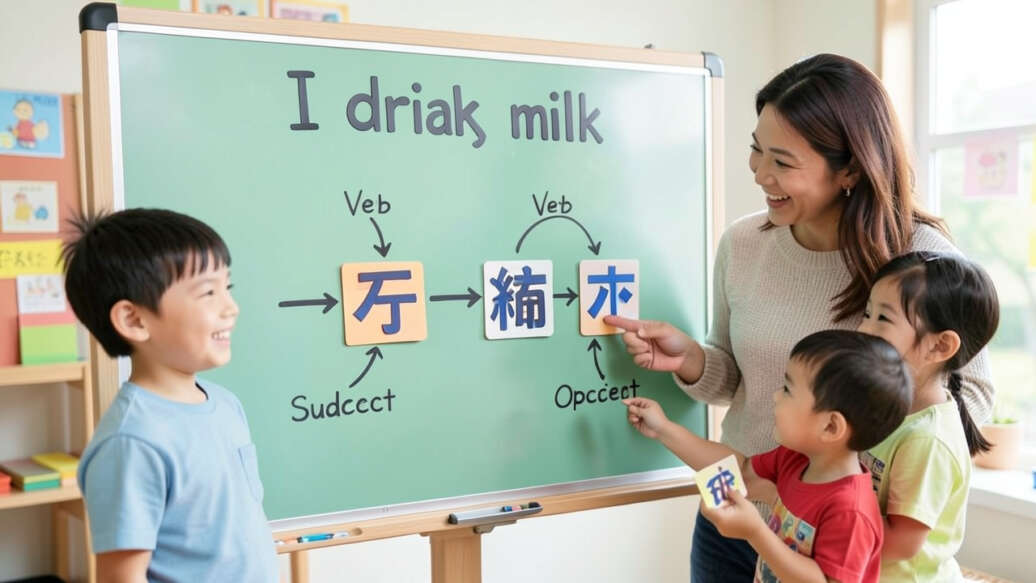
The foundational structure of a Mandarin Chinese sentence is remarkably consistent. It follows the Subject-Verb-Object order. Think of it as a simple formula: Who does the action (S), what is the action (V), and what or who receives the action (O).
For example, in the sentence “我 爱 你” (Wǒ ài nǐ), “我” (I) is the subject, “爱” (love) is the verb, and “你” (you) is the object. This pattern holds true for the vast majority of declarative sentences. There is no need to conjugate verbs for tense or person, which simplifies the structure considerably.
Consider these basic examples that showcase the SVO pattern:
- 他 喝 咖啡。 (Tā hē kāfēi.) – He drinks coffee.
- 我们 学 汉语。 (Wǒmen xué Hànyǔ.) – We study Chinese.
- 猫 吃 鱼。 (Māo chī yú.) – The cat eats fish.
- 他们 看 电影。 (Tāmen kàn diànyǐng.) – They watch a movie.
- 弟弟 打 篮球。 (Dìdi dǎ lánqiú.) – Younger brother plays basketball.
This core pattern is your anchor. Once you internalize SVO, you can start adding more complex elements by placing them in the correct positions relative to this main structure.
| Component | Function | Example Word |
|---|---|---|
| Subject (S) | Performs the action | 我 (wǒ) – I |
| Verb (V) | The action itself | 吃 (chī) – eat |
| Object (O) | Receives the action | 苹果 (píngguǒ) – apple |
This table summarizes the three essential parts of a complete Mandarin thought.

How Do You Describe Nouns in Mandarin?
This is where Mandarin differs significantly from English. In English, we often use adjectives after a noun, like a “big house” or a “red car.” In Mandarin, all modifiers come before the noun. This includes simple adjectives, descriptive phrases, and entire relative clauses.
The particle 的 (de) is the most common link between a modifier and a noun. It functions like an apostrophe ‘s or the word “of.” The structure is Modifier + 的 + Noun. However, for very common or short descriptors like colors or sizes, 的 can sometimes be omitted.
Let’s look at the structure with examples:
- 我的书 (wǒ de shū) – my book (literally: I’s book)
- 漂亮的衣服 (piàoliang de yīfu) – beautiful clothes
- 中国朋友 (Zhōngguó péngyou) – Chinese friend (的 is optional here)
- 他写的书 (tā xiě de shū) – the book that he wrote (relative clause modifier)
- 我们学校旁边的那个咖啡馆 (wǒmen xuéxiào pángbiān de nàge kāfēiguǎn) – that café next to our school (a long, complex modifier phrase)
Notice in the last example, a very long description (“that café next to our school”) all comes before the noun “café.” This consistency makes parsing sentences easier once you know to look for the 的 particle or identify the descriptive chunk before the main noun.
Tip: When you see a string of words ending with 的 (de), know that everything before it is describing the noun that immediately follows. This is a powerful pattern to recognize.
Where Do Time and Place Go in a Sentence?
In English, we might say, “I studied Chinese yesterday at the library.” In Mandarin, both the time and place expressions move to the front of the sentence, or are placed directly before the verb. They come after the subject but before the main action. Think of it as setting the scene before describing what happened.
The general order is: Subject + Time/Place + Verb + Object. Time and place can also be combined, with the more general location often coming first. The word 了 (le), indicating a completed action, is placed immediately after the verb.
Compare these English and Mandarin sentences to see the shift:
- English: I will go to Beijing next week.
Mandarin: 我 下个星期 去 北京。 (Wǒ xià gè xīngqī qù Běijīng.) – I next week go Beijing. - English: She reads books in the library every day.
Mandarin: 她 每天 在 图书馆 看书。 (Tā měitiān zài túshūguǎn kànshū.) – She every day at library read books. - English: We ate hotpot at that restaurant yesterday.
Mandarin: 我们 昨天 在 那家 吃 了 火锅。 (Wǒmen zuótiān zài nà jiā chī le huǒguō.) – We yesterday at that restaurant eat le hotpot.
Getting the time and place in the right position is crucial. Placing them at the end of the sentence, as in English, will sound unnatural and confusing to a native speaker.
| English Order | Mandarin Order | Example |
|---|---|---|
| S + V + O + Time/Place | S + Time/Place + V + O | 我 明天 去 上海。(I tomorrow go Shanghai.) |
| S + V + at place + O | S + at place + V + O | 他 在家 看电视。(He at home watch TV.) |
This comparison highlights the key positional difference. Memorizing this pattern will prevent a very common beginner mistake.

How Do You Ask Questions in Mandarin?
Asking questions in Mandarin is flexible and follows a few reliable methods. You can turn a statement into a yes/no question simply by adding the particle 吗 (ma) to the end. For “wh-” questions, you use specific question words and place them in the exact position where the answer would be.
There are three primary ways to form questions:
- Add 吗 (ma): Place it at the end of a declarative statement to form a yes/no question.
- Statement: 你是美国人。(Nǐ shì Měiguó rén.) – You are American.
- Question: 你是美国人吗?(Nǐ shì Měiguó rén ma?) – Are you American?
- Use a Question Word: Words like 谁 (shéi – who), 什么 (shénme – what), 哪里 (nǎlǐ – where), and 多少 (duōshao – how many) replace the unknown information.
- 你 喝 什么?(Nǐ hē shénme?) – You drink what?
- 他 去 哪里?(Tā qù nǎlǐ?) – He go where?
- Use the A-not-A Structure: Place a verb and its negative form together to offer a choice. This is common for verbs and adjectives.
- 你 喜欢 不喜欢 西餐?(Nǐ xǐhuan bù xǐhuan xīcān?) – Do you like or not like Western food?
- 这个 贵不贵?(Zhège guì bù guì?) – Is this expensive or not?
The key principle is to identify what part of the statement is unknown and place the appropriate question marker there. The sentence structure (SVO) remains intact around the question element.
Important: When using question words like 谁 (who) or 什么 (what), do not use 吗 (ma) at the end of the same sentence. Choose one question method per sentence.
How Do You Make a Sentence Negative?
Making a sentence negative in Mandarin is direct and systematic. You primarily use two negative adverbs: 不 (bù) and 没 (méi). Their usage depends on the verb and the type of negation.
不 (bù) is used for present, future, and habitual actions. It negates the verb directly and is placed immediately before it. It’s also used for negating adjectives and states of being.
- 我 不 喜欢 辣 的。(Wǒ bù xǐhuan là de.) – I don’t like spicy food.
- 他 不 是 学生。(Tā bù shì xuéshēng.) – He is not a student.
- 明天 我 不 上班。(Míngtiān wǒ bù shàngbān.) – I won’t go to work tomorrow.
没 (méi) is used for two specific cases: to negate the verb 有 (yǒu – to have/to exist) and to negate completed actions. For completed actions, 没 is followed by the verb and then the particle 了 (le) is dropped.
- 我 没 钱。(Wǒ méi qián.) – I don’t have money.
- 他 没 去 北京。(Tā méi qù Běijīng.) – He didn’t go to Beijing.
- 你 吃 饭 了 吗?- 没 吃。(Nǐ chī fàn le ma? – Méi chī.) – Have you eaten? – No, I haven’t.
| Negative Word | Primary Use | Example |
|---|---|---|
| 不 (bù) | Negates present/future actions, habits, and adjectives. | 她 不 忙。(She is not busy.) |
| 没 (méi) | Negates 有 (yǒu) and completed past actions (without 了). | 我们 没 见面。(We didn’t meet.) |
Choosing the right negative word is a common point of confusion for learners, so reviewing these distinctions is essential.
What is the Structure for Comparisons?
Mandarin has a clean and logical structure for making comparisons between two things. The most common pattern uses the word 比 (bǐ), which means “compared to” or “than.” The structure is: A + 比 + B + Adjective.
This construction directly states that “A is more than B.” The adjective is a comparative form, but you do not need to change the adjective itself. The word 毸 handles the comparative meaning.
- 今天 比 昨天 热。 (Jīntiān bǐ zuótiān rè.) – Today is hotter than yesterday.
- 我 哥哥 比 我 高。 (Wǒ gēge bǐ wǒ gāo.) – My older brother is taller than me.
- 这个 苹果 比 那个 便宜。 (Zhège píngguǒ bǐ nàge piányi.) – This apple is cheaper than that one.
To express that A is not as B as C, you use the structure: A + 没有 + B + Adjective. This is a “not as.as” comparison.
- 我 没有 他 有钱。(Wǒ méiyǒu tā yǒu qián.) – I am not as rich as him.
- 中文 没有 英文 难。(Zhōngwén méiyǒu Yīngwén nán.) – Chinese is not as difficult as English.
For comparing three or more items to find the superlative (“the most”), you often use the structure: In a group + 最 (zuì) + Adjective. The word 最 means “most” or “most-ly.”
- 他是 我们班 最 高 的 学生。(Tā shì wǒmen bān zuì gāo de xuéshēng.) – He is the tallest student in our class.
- 哪 个 最 好吃?(Nǎ ge zuì hǎochī?) – Which one is the most delicious?
Warning: A common error is to try to add “more” (更 gèng) to the 比 structure. This is redundant. Use 比 + Adjective for “more.” Use 更 + Adjective when emphasizing a point without a direct comparison, like “He is tall, but she is taller (更 高).”
How Do You Build Common Practical Sentences?
Let’s apply these structural rules to build sentences for everyday situations. We’ll combine the SVO core with time, place, modifiers, and negation. Practice these patterns until they become automatic.
Scenario 1: Making Plans
- 我 们 星期六 在 公园 见面 吗? (Wǒmen xīngqīliù zài gōngyuán jiànmiàn ma?) – Shall we meet at the park on Saturday?
- 好的,我 下午 三点 到。 (Hǎo de, wǒ xiàwǔ sān diǎn dào.) – Okay, I will arrive at 3 o’clock in the afternoon.
Scenario 2: Ordering Food
- 我 想 要 一杯 不 加 糖 的 咖啡。 (Wǒ xiǎng yào yī bēi bù jiā táng de kāfēi.) – I would like a cup of coffee without sugar added.
- 请 给 我 菜单,谢谢。 (Qǐng gěi wǒ càidān, xièxie.) – Please give me the menu, thank you.
Scenario 3: Talking About Past Events
- 你 上个星期 去 哪里 旅游 了? (Nǐ shàng gè xīngqī qù nǎlǐ lǚyóu le?) – Where did you travel last week?
- 我 没 去 旅游,我在 家 休息 了。 (Wǒ méi qù lǚyóu, wǒ zài jiā xiūxi le.) – I didn’t travel, I rested at home.
Notice how each sentence follows the established rules. Modifiers like “不加糖的” (without sugar added) come before “咖啡” (coffee). Time “上个星期” (last week) and place “在家” (at home) are positioned before the verb.
Questions are formed with 吗 or question words like 哪里 (where). Negation uses 没 for a completed past action.
What Are Common Sentence Structure Mistakes to Avoid?
Even with clear rules, learners often make predictable mistakes. Being aware of these pitfalls can help you correct them early. Here are the most frequent errors and their fixes.
1. Misplacing Time and Place:
- Wrong: 我 喝 茶 在 办公室 昨天。(Wǒ hē chá zài bàngōngshì zuótiān.)
- Right: 我 昨天 在 办公室 喝 茶。(Wǒ zuótiān zài bàngōngshì hē chá.) – I drank tea in the office yesterday.
Remember the rule: Subject + Time/Place + Verb + Object.
2. Using 了 Incorrectly:
- Wrong: 我 买 了 书 在 书店。(Wǒ mǎi le shū zài shūdiàn.) – Using 了 too early.
- Right: 我 在 书店 买 了 书。(Wǒ zài shūdiàn mǎi le shū.) – I bought a book at the bookstore.
了 follows the verb immediately and is placed after any place or manner modifiers that come before the verb.
3. Confusing 的, 地 (de), and 得 (de):
- 的 (de): Links a modifier to a noun (我的书 – my book).
- 地 (de): Links an adverb/adjective to a verb (快乐地唱歌 – happily sing).
- 得 (de):
4. Overusing 是 (shì):
- Wrong: 这 是 很 漂亮。(Zhè shì hěn piàoliang.) – Using 是 like English “is.”
- Right: 这 很 漂亮。(Zhè hěn piàoliang.) – This is very beautiful.
是 is for defining identity (“I am a teacher”), not for linking adjectives. Use 很 (hěn) or another adverb with adjectives.
By consciously avoiding these errors, you will sound much more natural and be better understood.
Frequently Asked Questions
Is Mandarin word order really the same as English?
The basic Subject-Verb-Object order is the same, which helps. However, the major difference is that all modifiers, time, and place words come before the verb or noun they describe, whereas in English they often come after. Mastering this “modifier before head noun” rule is key.
How do I know when to use 的 (de), 地 (de), and 得 (de)?
They all sound the same but have distinct uses. 的 connects an adjective or phrase to a noun (e.g., 漂亮的花 – beautiful flower). 地 connects an adverb to a verb (e.g., 快速地跑 – run quickly).
得 follows a verb to describe the result or degree of the action (e.g., 说得很好 – speak very well).
Can I put time words at the end of a sentence?
This is strongly discouraged and will sound unnatural. While very short time words like 今天 (today) might occasionally slip to the end in casual speech for emphasis, the standard and correct position is before the verb, often after the subject. Always aim for the front/middle placement.
What is the difference between 有 (yǒu) and 是 (shì)?
有 (yǒu) means “to have” or indicates possession or existence (“I have a car”). 是 (shì) means “to be” and is used for definitions or stating what something is (“I am a student”). You say “There is a cat” as 有一只猫, not 是一只猫.
How do I make a sentence with multiple verbs?
Mandarin often uses a serial verb construction. The verbs are listed in sequence. There is usually no need for a word like “and.” For example: “I want to go eat” is 我要去吃饭 (Wǒ yào qù chī fàn), literally “I want go eat.” The order follows a logical or chronological sequence.
Final Thoughts
Mastering Mandarin sentence structure boils down to internalizing a few key patterns. The SVO core provides a familiar foundation. Remembering to place all modifiers, time, and place information before the verb is the most important adjustment for English speakers.
Practice building simple sentences and then add complexity with time, negation, and comparisons. Consistently applying these rules will build your accuracy and confidence. With regular practice, the structure will soon feel intuitive and natural.