Purple Symbolism in Imperial China and Its Royal Power
Purple symbolism in Imperial China carried a weight unmatched by almost any other color in the ancient world. For centuries, this rich hue represented divine authority, cosmic harmony, and supreme political power. Emperors hoarded it, ministers coveted it, and commoners were forbidden from wearing it altogether.
This post explores how purple became the most exclusive color in Chinese history, why it held such powerful meaning, and how its legacy continues to shape Chinese culture today.
Simply put, purple in Imperial China was more than a color – it was a political and spiritual symbol reserved for the emperor and the highest ranks of power. Its rarity made it sacred, and its use was strictly controlled by law for over a thousand years.
Key Takeaways
- Purple symbolism in Imperial China was tied directly to the emperor’s divine right to rule and cosmic authority.
- The color was extracted from rare mollusks, making it extremely expensive and accessible only to the ruling elite.
- Strict sumptuary laws banned commoners from wearing purple under threat of severe punishment.
- Purple dominated imperial architecture, court dress, and ceremonial objects across multiple dynasties.
- The legacy of purple as a power color persists in Chinese language, idioms, and modern branding.
What Is the Symbolism of Purple in Imperial China?
In Imperial China, purple was the color of the heavens, the stars, and the emperor himself. It occupied the highest position in the color hierarchy, far above gold, red, and yellow. Purple represented the North Star, which the Chinese called Ziwei – the “Purple Forbidden” star around which all other stars revolved.
This celestial connection gave purple an almost divine quality. The emperor was seen as the earthly counterpart of the North Star, so his palace, robes, and throne were draped in purple to reflect that cosmic relationship. The Forbidden City in Beijing, for example, was formally called the “Purple Forbidden City” (Zijin Cheng), directly linking the emperor’s residence to the purple heavens.
Why Was Purple Considered a Royal Color in Ancient China?
The association between purple and royalty in China did not develop overnight. It grew over centuries through a combination of astronomical observation, religious philosophy, and practical economics. Each factor reinforced the others, creating a color taboo that lasted for millennia.
Several key reasons explain why purple rose above all other colors in the imperial hierarchy:
- Celestial association: The North Star (Ziwei) was called the “Purple Star,” and since the emperor was the “Son of Heaven,” purple became his color.
- Rarity and cost: Purple dye came from rare sea snails and required thousands of specimens to produce a small amount, making it the most expensive color available.
- Daoist significance: In Daoism, purple was linked to immortality and spiritual transcendence, reinforcing its association with divine rulership.
- Legal enforcement: Sumptuary laws from the Han Dynasty onward made it illegal for anyone below a certain rank to wear purple.
- Visual distinctiveness: Purple stood apart from the more common reds, blues, and yellows, giving the wearer immediate visual authority.
- Cultural momentum: Once established, the tradition became self-reinforcing, with each dynasty expanding purple’s ceremonial role.
According to the Chinese Ministry of Culture, references to purple as a color of supreme importance appear in texts dating back over 2,500 years, making it one of the oldest color associations in continuous use.
How Did Chinese Emperors Use Purple in Daily Life?
Emperors did not reserve purple for special occasions alone. The color permeated their daily existence, from the robes they wore to the chambers where they slept. Every use of purple was a deliberate statement of power and cosmic alignment.
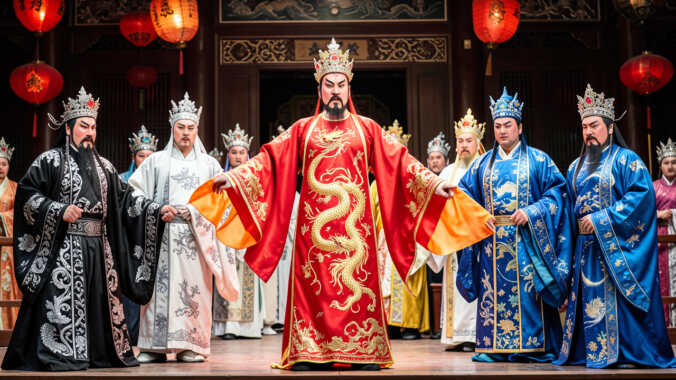
- Court robes and headwear: Emperors wore purple robes during official ceremonies, and specific shades indicated different levels of formality. Dark purple was reserved for the most solemn occasions.
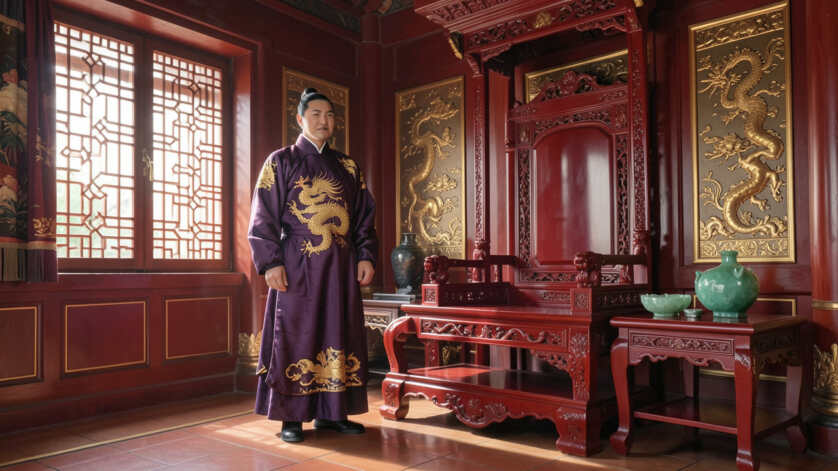
- Palace interiors: Bedrooms, throne rooms, and private studies featured purple silk hangings, cushions, and curtains throughout the Tang, Song, and Ming dynasties.
- Ceremonial objects: Purple jade, purple lacquerware, and purple enamel items were produced exclusively for imperial use.
- Seals and documents: The emperor’s personal seal was often housed in a purple silk pouch, and the most confidential imperial edicts were written on purple-bordered paper.
- Gifts and rewards: A purple robe was among the highest honors a ruler could bestow on a loyal official, known as “granting purple and goldfish” (赐紫金鱼袋).
This daily immersion in purple reinforced the visual message that the emperor existed on a different plane from ordinary people. Every glance at the ruler confirmed his otherworldly status.
Important: The practice of “granting purple” as an official honor was most prominent during the Tang Dynasty (618-907 AD), when receiving a purple robe signified the emperor’s personal trust and favor.
What Are the Key Uses of Purple in Chinese Imperial Architecture?
Architecture was one of the most visible arenas where purple symbolism played out. The most famous example is the Forbidden City, but purple appeared across imperial building projects throughout Chinese history. Architects used the color to encode meaning into the very walls and roofs of power.
| Location | Purple Usage | Symbolic Meaning |
|---|---|---|
| Forbidden City (Beijing) | Purple-tinted roof tiles, purple interior walls | Earthly mirror of the Purple Star (North Star) |
| Weiyang Palace (Han Dynasty) | Purple silk banners and purple-lacquered pillars | Imperial authority over all under heaven |
| Daming Palace (Tang Dynasty) | Purple-painted beams in throne hall | Connection between emperor and the cosmos |
| Imperial Gardens | Purple flowers cultivated exclusively | Natural world submits to imperial order |
The layout of the Forbidden City itself was designed to mirror the celestial realm. The emperor’s throne was positioned to align with the North Star, and the purple color scheme reinforced this astronomical symbolism at every turn.
Architects also used purple-glazed tiles on specific buildings within palace complexes to designate their function. Throne halls received the deepest purple, while residential quarters used lighter shades. This gradient created a visual map of power that any visitor could immediately read.
How Did Purple Influence Chinese Art and Ceramics?
Beyond architecture and clothing, purple left a deep mark on Chinese artistic traditions. Painters, ceramicists, and textile artists all developed techniques to capture and display the imperial color. Purple became a benchmark of artistic excellence, and pieces featuring the color were considered inherently more valuable.
In Chinese painting, purple pigments were ground from minerals and rare organic sources. Artists reserved purple for depicting sacred landscapes, immortal figures, and court scenes. The difficulty of producing stable purple paint meant that every use was intentional and symbolic.
Ceramics tell a particularly vivid story. During the Song Dynasty, potters at the famous kilns developed purple-glazed wares that were reserved for imperial use. These pieces featured:
- Deep violet glazes achieved through complex firing techniques
- Combinations of purple and gold for maximum visual impact
- Geometric patterns that echoed celestial maps and star charts
- Purple dragon motifs symbolizing imperial power
- Purple enameled bowls used exclusively for tea ceremonies at court
- Inscriptions in gold on purple backgrounds marking imperial ownership
- Small figurines and decorative objects glazed in purple for the emperor’s private collection
Textile arts also flourished under the influence of purple symbolism. Silk weavers developed techniques to produce fabrics in dozens of purple shades, each with a specific ceremonial purpose. The most prized textiles combined purple silk with gold thread, creating fabrics that shimmered like the night sky.
Why Did Purple Lose Its Exclusive Status in Later Dynasties?
Despite centuries of strict control, the exclusive association between purple and imperial power eventually weakened. This shift did not happen suddenly but rather evolved over several centuries as political, economic, and cultural forces converged to democratize the color.
Several major factors contributed to this change:
- Trade expansion: As the Silk Road and maritime trade routes expanded, purple dyes became more widely available, reducing their cost and exclusivity.
- Dynasty transitions: New ruling houses sometimes deliberately rejected the color associations of their predecessors, loosening purple restrictions to signal change.
- Technological advances: Improvements in dyeing techniques, particularly after contact with Middle Eastern and Indian dyeing traditions, made purple production more efficient.
- Mongol influence: The Yuan Dynasty (1271-1368), ruled by Mongol conquerors, brought different color preferences that disrupted traditional Chinese color hierarchies.
- Merchant class growth: A rising merchant class began wearing purple despite legal prohibitions, and enforcement gradually became impractical.
- Qing Dynasty reforms: The Manchu rulers of the Qing Dynasty (1644-1912) introduced their own color systems that coexisted with older Chinese traditions.
Warning: Despite loosening restrictions, wearing unauthorized purple clothing could still result in imprisonment or worse during the Ming Dynasty. Laws were only gradually relaxed, not formally repealed.
By the late Qing Dynasty, purple had become more broadly accessible, though it never fully lost its association with luxury and prestige. The color’s journey from absolute imperial monopoly to wider cultural adoption mirrors the broader social transformations that shaped modern China.
How Does Purple Symbolism in Imperial China Compare to Western Cultures?
Purple held powerful symbolism in both Eastern and Western civilizations, but the reasons and expressions differed in important ways. Comparing these traditions reveals how cultural context shapes color meaning across the world.
| Aspect | Imperial China | Western Civilizations |
|---|---|---|
| Primary source | Murex sea snails and rare minerals | Murex snails (Tyrian purple) |
| Main association | Cosmic order and the emperor’s divine mandate | Royal authority and later religious devotion |
| Legal enforcement | Strict sumptuary laws for over 1,000 years | Sumptuary laws varied by region and era |
| Astronomical link | Direct connection to the North Star (Ziwei) | Limited astronomical symbolism |
| Religious dimension | Daoist associations with immortality | Christian associations with penance and suffering |
| Decline | Gradual during late Qing Dynasty | After fall of Byzantine Empire and Roman authority |
Both civilizations arrived at the same conclusion – purple equals power – through remarkably similar economic logic. The dye was rare, expensive, and difficult to produce, which automatically made it a marker of wealth and status. However, the Chinese added a uniquely cosmic dimension by linking purple to the North Star and the structure of the heavens.
The Western tradition, particularly through the Roman Empire and the Byzantine Empire, treated purple primarily as a symbol of political and military dominance. Chinese tradition layered additional meaning through Daoism, astronomy, and Confucian hierarchy, creating a more complex web of associations.
What Idioms and Phrases Reflect Purple’s Power in Chinese Culture?
The importance of purple in Imperial China left deep traces in the Chinese language. Several idioms and expressions still in use today carry the legacy of purple’s royal associations. Understanding these phrases provides insight into how deeply the color penetrated Chinese thought.
- 紫气东来 (zǐ qì dōng lái): “Purple air comes from the east” – an idiom meaning auspicious fortune or the arrival of something sacred. It originates from a legend about Laozi passing through a mountain gate, where a guardian saw purple mist approaching from the east.
- 姹紫嫣红 (chà zǐ yān hóng): “Beautiful purple and radiant red” – describes a scene of lush beauty, often used to describe flourishing flowers or a vibrant landscape.
- 万紫千红 (wàn zǐ qiān hóng): “Ten thousand purples and a thousand reds” – means a brilliant variety or a flourishing scene, famously used in a poem by Mao Zedong.
- 青紫拾芥 (qīng zǐ shí jiè): “Pick up purple and blue like mustard seeds” – means obtaining high office is easy, referencing the purple and blue robes of officials.
- 金章紫绶 (jīn zhāng zǐ shòu): “Golden seal and purple ribbon” – refers to the highest ranks of officialdom, directly referencing the purple sashes worn by top officials.
- 佩紫怀黄 (pèi zǐ huái huáng): “Wearing purple and carrying yellow” – describes someone of great official rank and honor.
These idioms demonstrate that purple’s symbolism was not just visual but deeply embedded in how Chinese people described success, fortune, and authority. Even today, purple retains connotations of luxury and prestige in Chinese marketing and branding.
How Is Purple Symbolism Preserved in Modern Chinese Culture?
Although the imperial system ended over a century ago, the symbolism of purple in Imperial China has not vanished. Modern Chinese culture continues to reference and reinterpret purple’s historical associations in ways that bridge tradition and contemporary life.
Several key areas show this continued influence:
- Film and television: Historical dramas about the imperial court pay careful attention to purple costume design, using it to signal character status and power dynamics.
- Modern fashion: Chinese luxury brands frequently incorporate purple into product lines, drawing on its imperial associations to convey exclusivity.
- Lunar New Year celebrations: Purple decorations appear during holiday festivities, carrying echoes of the “purple air from the east” idiom and its promise of good fortune.
- Academic study: Chinese universities and museums continue to research and exhibit purple textiles, ceramics, and artifacts from imperial collections.
- Corporate branding: Banks, tech companies, and luxury goods manufacturers in China use purple in logos and packaging to signal prestige and reliability.
- Tourism: The Forbidden City’s formal name, “Purple Forbidden City,” is a major draw for domestic and international visitors interested in imperial history.
- Contemporary art: Modern Chinese artists sometimes use purple as a commentary on power, tradition, and the relationship between past and present.
- Language and education: Children in China learn purple-related idioms in school, ensuring the cultural knowledge passes to each new generation.
Tip: When visiting the Forbidden City, pay attention to the purple-glazed tiles on the Hall of Supreme Harmony. They are the deepest shade in the complex, marking it as the most important building in the entire palace.
What Can We Learn From Purple Symbolism in Imperial China?
The story of purple in Imperial China offers lessons that extend far beyond color theory or ancient history. It shows how societies construct meaning around seemingly arbitrary symbols, and how those meanings can endure for thousands of years.
At its core, the Chinese approach to purple reveals three important principles:
- Scarcity creates meaning: Purple’s rarity gave it power. When something is difficult to obtain, societies assign it higher value, whether that something is a color, a material, or an experience.
- Color communicates hierarchy: The Chinese system used color as a visual language of social order. Understanding this helps us recognize how color still shapes perceptions in modern life.
- Traditions compound over time: What began as an astronomical observation grew into a legal system, an artistic tradition, and a cultural identity. Layer upon layer of meaning accumulated over centuries.
- Cosmic thinking shapes politics: By linking the emperor to the purple star, Chinese rulers grounded their authority in the natural order, making opposition to their rule feel like opposition to the universe itself.
- Cultural symbols transcend their origins: Purple’s meaning has evolved but never disappeared, proving that truly powerful symbols adapt to new contexts while retaining their core significance.
The study of purple symbolism in Imperial China reminds us that colors are never just colors. They carry the weight of history, belief, and power in every thread, brushstroke, and glazed tile.
Frequently Asked Questions
What does purple symbolize in Imperial China?
Purple symbolized the emperor’s divine authority, cosmic order, and supreme political power. It was directly linked to the North Star (Ziwei), which the Chinese saw as the center of the heavens. The emperor, as the “Son of Heaven,” used purple to visually represent his cosmic connection.
Why was the Forbidden City called the Purple Forbidden City?
The Forbidden City was called the “Purple Forbidden City” (Zijin Cheng) because purple represented the North Star, around which all other stars revolved. The palace was designed as an earthly mirror of the celestial realm, and its purple associations reinforced the emperor’s position at the center of all power.
Were commoners forbidden from wearing purple in ancient China?
Yes. Sumptuary laws from the Han Dynasty onward prohibited commoners from wearing purple. Violations could result in severe punishment, including imprisonment or confiscation of property.
These laws were designed to maintain clear visual distinctions between social classes.
How was purple dye made in ancient China?
Purple dye in ancient China was produced from rare mollusks, particularly murex sea snails, and from certain mineral sources. The process required thousands of specimens and considerable labor, which made purple one of the most expensive dyes available. This rarity directly contributed to its exclusive status.
Does purple still hold special meaning in Chinese culture today?
Purple retains strong associations with luxury, prestige, and good fortune in modern Chinese culture. The idiom “purple air from the east” is still commonly used, and purple features prominently in branding, fashion, holiday decorations, and historical entertainment.
Final Thoughts
The symbolism of purple in Imperial China represents one of the most powerful and enduring color associations in human history. From the courts of the Han Dynasty to the walls of the Forbidden City, purple defined power, divinity, and cosmic order for over two millennia. Its legacy lives on in Chinese language, art, and culture, reminding us that a single color can carry the weight of an entire civilization’s beliefs about authority and the universe.