Wu, Min, and Hakka Dialects: Key Differences Explained
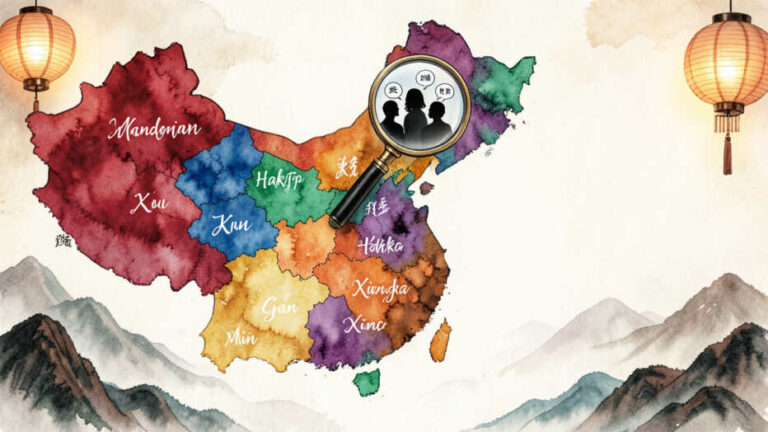
Understanding Wu, Min, and Hakka dialects is key to appreciating the vast linguistic landscape of Chinese languages. These three major dialect groups are spoken by hundreds of millions of people, each with a rich history and unique characteristics that set them apart from Mandarin and from each other.
This post breaks down their core differences in pronunciation, vocabulary, grammar, and geographic spread. You’ll learn what truly distinguishes a Wu speaker from a Min or Hakka speaker and why these differences matter.
Simply put, the primary difference lies in their geographic origins and phonological systems. Wu dialects, like Shanghainese, are tonal but with softer, more flowing sounds. Min dialects, including Hokkien and Teochew, are famous for preserving ancient Chinese pronunciations. Hakka is distinct for its consistent consonant endings and historical roots tied to migratory populations.
Key Takeaways
- The Wu, Min, and Hakka dialects are not mutually intelligible and represent distinct branches of Chinese.
- Geographic distribution is a primary separator: Wu is in the Yangtze Delta, Min is in Southeast China/Taiwan, and Hakka is spread across southern provinces.
- A major phonological difference is the retention of the /p/, /t/, /k/ endings in Min and Hakka, which are largely lost in Wu.
- Vocabulary and grammar show significant variation, with Hakka grammar often noted for its closer alignment to Classical Chinese.
- Understanding these differences is crucial for linguists, historians, and anyone exploring cultural identity in the Chinese-speaking world.

What is a Chinese Dialect Group?
Before diving into the specifics, it’s important to clarify terminology. Linguists often refer to these groups as “Chinese dialects,” but many scholars argue they should be classified as separate languages. The key point is that the term “dialect” here implies a large, self-contained linguistic system.
These groups are defined by major phonological and lexical differences. A speaker from one group typically cannot understand a speaker from another without prior study. They represent the primary linguistic divisions within the Sinitic language family.
The three groups in focus are the Wu, Min, and Hakka. Each originated in different historical regions and was shaped by distinct migration patterns and local influences.
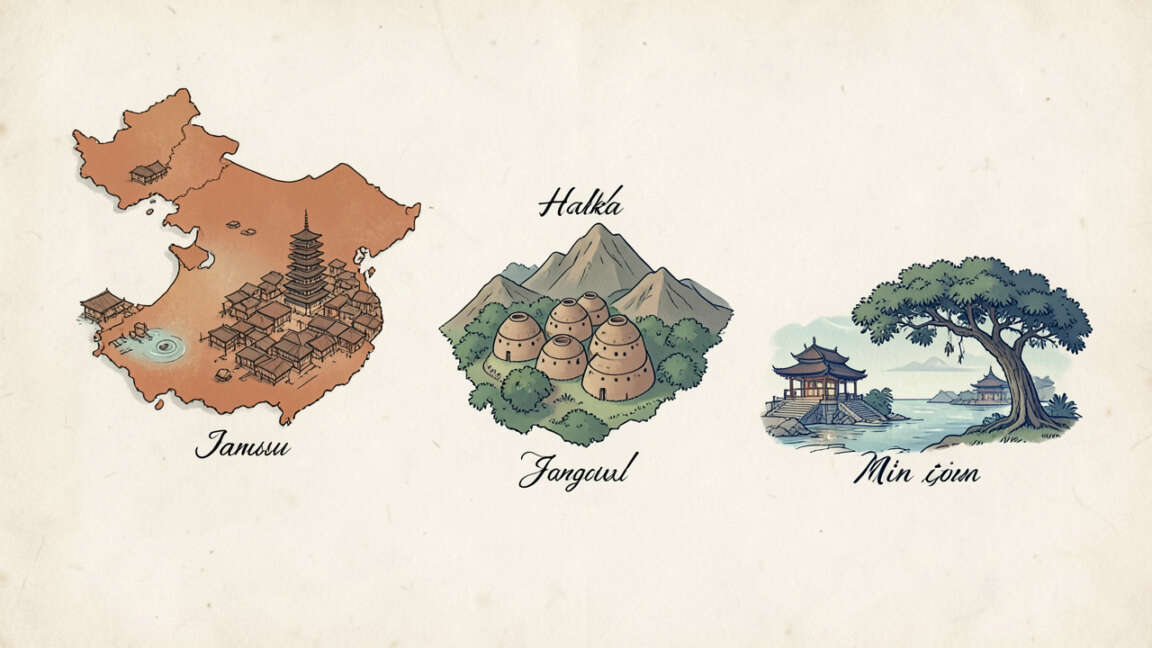
- Wu (吴语): Spoken in Shanghai, most of Zhejiang province, and southern Jiangsu. The largest city is Shanghai.
- Min (闽语): Spoken in Fujian province, eastern Guangdong, Hainan, Taiwan, and by diaspora in Southeast Asia. Sub-groups include Hokkien (Southern Min) and Fuzhounese.
- Hakka (客家话): Not confined to one province. Spoken in “language islands” across Guangdong, Jiangxi, Fujian, Guangxi, Sichuan, and Taiwan.

How are Wu, Min, and Hakka Pronunciations Different?
Pronunciation is the most immediate and obvious difference. Each group has a distinct tonal system and inventory of sounds. This variation is why communication between speakers of different groups is so challenging.
Tonal systems vary significantly. Wu dialects like Shanghainese typically have 5 tones, which are more fluid and less contoured than Mandarin’s. Min dialects can have between 7 and 9 tones, often with complex tone sandhi rules.
Hakka usually has 6 tones.
Consonant endings are a major phonological marker. Wu dialects have lost the ancient /p/, /t/, /k/ final stops. In contrast, both Min and Hakka preserve these endings, making them sound more “archaic” to linguists.
| Feature | Wu Dialects (e.g., Shanghainese) | Min Dialects (e.g., Hokkien) | Hakka Dialects |
|---|---|---|---|
| Number of Tones | Typically 5, more flowing | 7-9, with complex sandhi | Typically 6 |
| Final Stop Consonants (-p, -t, -k) | Lost in most varieties | Preserved | Preserved |
| Nasal Finals (-m, -n, -ng) | Merged or lost in some | Distinct -m, -n, -ng | Distinct -m, -n, -ng |
| Key Sound | Voiced initials (b, d, g as , , ) | Lack of retroflex sounds (zh, ch, sh) | Absence of initial /f/ in some words, use of /v/ or /h/ |
This table highlights the stark contrast in their sound systems, with Min and Hakka sharing the preservation of ancient endings that Wu has lost.
Tip: If you hear a Chinese language with clear “p”, “t”, or “k” endings at the end of words (like “cap” or “bat”), it’s likely Min or Hakka, not Wu.
What Vocabulary and Grammar Set Them Apart?
Beyond sound, vocabulary and sentence structure provide clear dividing lines. The core words for everyday items often differ completely. A “person” might be called “nen” in Wu, “lang” in Min, and “ngin” in Hakka.
Grammar rules also diverge. The placement of negation words and aspect particles can vary. For example, the word for “not” and how it interacts with verbs is a useful diagnostic feature.
Min dialects are noted for preserving some very old vocabulary items not found in other modern Chinese varieties. Hakka grammar is frequently cited as being relatively conservative and closer to Classical Chinese patterns.
- Basic Pronouns: The first-person singular “I” is often “ngu” (Wu), “goa/wa” (Min), and “ngai” (Hakka).
- Negation: Wu often uses “veq” or “meh,” Min uses “bue” or “m,” while Hakka uses “ng” or “bou.”
- Question Words: The word for “what” is “sa” (Wu), “sim-mi” or “mih” (Min), and “me-ton” (Hakka).
- Classical Residue: Hakka retains the double negative construction for emphasis, similar to Classical Chinese.
Warning: Assuming vocabulary similarity with Mandarin can lead to miscommunication. For instance, the Mandarin word for “house” (家, jiā) becomes “ka” in Hakka, “ou” in Min, and “ga” or “hou” in Wu.
How Did These Regional Variations Develop Historically?
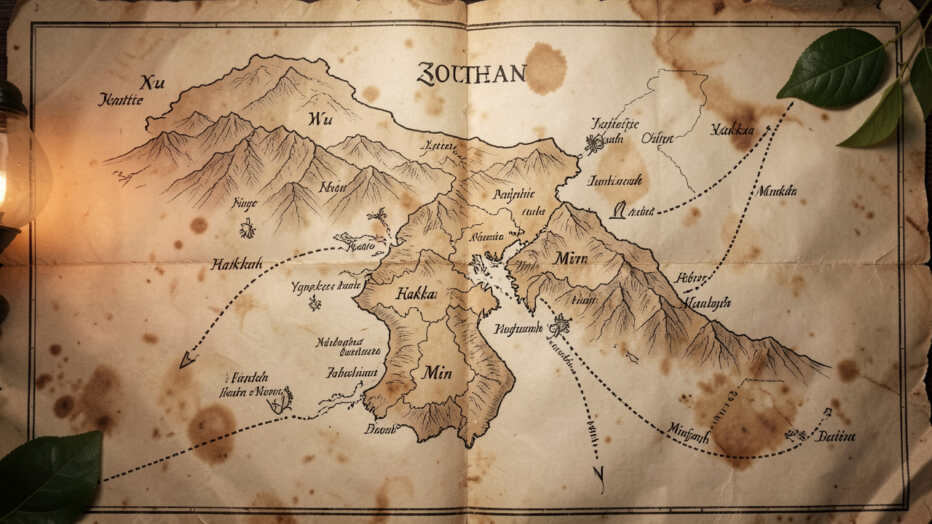
The differences are rooted in history, geography, and migration. China’s southeastern mountains and rivers acted as natural barriers, isolating populations for centuries. This isolation allowed dialects to evolve independently.
The Min dialect group is considered one of the oldest, having split off early due to the mountainous terrain of Fujian. Its speakers preserved features of Middle Chinese that were later lost in the north.
Hakka people, meaning “guest families,” are historically migrants from northern China who moved south over centuries, often settling in remote, hilly areas. Their dialect reflects a mix of ancient northern and southern influences.
Wu dialects developed in the relatively flat, water-rich Yangtze Delta. This area was a major cultural and economic hub, leading to influence from both the north and other southern dialects, creating a unique hybrid system.
- Min’s Isolation: Fujian’s mountains limited north-south movement, preserving ancient pronunciations.
- Hakka’s Migration: Waves of migration from the Yellow River region created a dialect with layered influences.
- Wu’s Prosperity: The Jiangnan region’s wealth and connectivity fostered a dialect that was innovative yet distinct.

Who Speaks These Dialects and Why Does It Matter?
The distribution of speakers tells a story of culture and identity. Wu is strongly associated with the cosmopolitan Yangtze Delta, particularly Shanghai. Min is the language of Fujian, Taiwan, and the vast Chinese diaspora in Southeast Asia.
Hakka is unique because it has no single geographic heartland. It’s spoken in communities across several provinces, creating a shared identity that transcends provincial borders.
For linguists, these groups provide crucial data on language evolution. For economists, they represent distinct consumer markets. For millions of people, they are the language of home, family, and local culture.
| Dialect Group | Primary Regions | Major Diaspora | Approx. Speakers |
|---|---|---|---|
| Wu | Shanghai, Zhejiang, Southern Jiangsu | Limited | ~80 million |
| Min | Fujian, Eastern Guangdong, Hainan, Taiwan | Southeast Asia (Singapore, Malaysia, Philippines) | ~70 million |
| Hakka | Guangdong, Jiangxi, Fujian, Guangxi, Taiwan | Southeast Asia, Taiwan | ~45 million |
The speaker numbers highlight that these are not minor variations but major languages in their own right, each with a population larger than many countries.
How Do Wu, Min, and Hakka Relate to Mandarin and Cantonese?
Placing these dialects in context with Mandarin (Putonghua) and Cantonese helps clarify their positions. Mandarin is the official standard and is tonally simpler than the others. Cantonese, another major southern dialect, has its own distinct system but shares some features with both Wu and Min.
A key distinction is intelligibility. A Mandarin speaker cannot understand Wu, Min, or Hakka without study. The same is true for speakers of Wu listening to Min or Hakka.
They are like separate languages sharing a common written form.
- Versus Mandarin: Wu, Min, and Hakka retain more ancient phonological features and have far less mutual intelligibility with Mandarin than Cantonese does.
- Versus Cantonese: Cantonese also preserves final stops (-p, -t, -k), like Min and Hakka. However, its tonal system and vocabulary differ from all three.
- Written Form: All use Chinese characters, but local characters (especially in Min and Hakka) are often used for words unique to the dialect.
Important: While Mandarin is the language of education and government, Wu, Min, and Hakka remain the languages of the home, local media, and daily conversation in their respective regions.

What are Common Misconceptions About These Dialects?
Several myths obscure the true nature of these linguistic groups. Addressing them is key to a proper understanding.
One major misconception is that they are just “accented” Mandarin. This is false; they are separate linguistic systems with different phonologies, vocabularies, and sometimes grammars. An analogy would be comparing Spanish to Italian and Portuguese – related, but not interchangeable.
Another misconception is that Wu is “soft” and “feminine” while Hakka is “harsh.” These are subjective stereotypes not supported by linguistic analysis. All dialects have a full range of sounds and tones.
- Myth: “They are all basically the same.”
- Reality: Mutual intelligibility between groups is near zero.
- Myth: “Only old people speak them.”
- Reality: They remain vital languages of daily life, especially at home and locally.
- Myth: “They have no written form.”
- Reality: While Standard Written Chinese is used formally, extensive written colloquial forms exist, especially online and in literature.

How is Modernity Affecting Wu, Min, and Hakka?
The spread of Mandarin through education and media is a powerful force of change. Younger generations in Wu and Min regions often grow up bilingual. In Hakka areas, the situation can be more precarious due to smaller, dispersed communities.
Urbanization is another factor. As people move to major cities like Shanghai (Wu) or Xiamen (Min), they may shift to Mandarin for wider communication. This can accelerate language shift.
However, there are also revitalization efforts. Local governments and cultural groups are producing media, developing teaching materials, and advocating for the use of these dialects in public spaces and education.
- Mandarin Dominance: Education and official business are conducted in Mandarin, reducing intergenerational transmission.
- Digital Revival: Social media and messaging apps allow speakers to use their dialect in writing, using phonetic adaptations of Chinese characters.
- Cultural Pride: Folk songs, movies, and online content in dialect are fostering a renewed sense of identity.
Frequently Asked Questions
Are Wu, Min, and Hakka considered languages or dialects?
This is a linguistic and political debate. In China, they are officially called “dialects” of the Chinese language for political unity. However, linguistically, the differences in phonology, vocabulary, and grammar between them are as large as the differences between separate European languages like Spanish and Portuguese.
Many scholars argue they should be classified as distinct Sinitic languages.
Which dialect is the hardest for Mandarin speakers to learn?
Generally, Min dialects like Hokkien are considered the most challenging due to their complex tonal system, preservation of ancient sounds, and significant vocabulary differences. Hakka is also difficult, while Wu might be slightly more accessible due to some lexical similarities with Mandarin in modern urban forms like Shanghainese.
Is there a written form for Wu, Min, or Hakka?
Yes, but it’s not standardized like Standard Written Chinese. Speakers use Chinese characters, sometimes special local characters, and increasingly use phonetic adaptations to write colloquially online. For example, Min Nan has a well-developed literary tradition and a Romanization system called Pe̍h-ōe-jī.
Can speakers of these dialects understand each other?
Generally, no. A Wu speaker cannot understand a Min or Hakka speaker. However, intelligibility can exist between closely related sub-dialects within a group, such as between different varieties of Wu or different varieties of Min.
What is the best way to preserve these dialects?
Preservation efforts focus on intergenerational transmission (teaching children at home), integrating dialect into local education, creating entertainment and media content, and documenting the languages through dictionaries and audio archives. Community engagement and pride are essential for long-term survival.
Final Thoughts
The differences between Wu, Min, and Hakka go far beyond accents. They are distinct linguistic worlds shaped by unique geography and history, each with its own sounds, words, and grammatical patterns. Recognizing these differences is the first step to appreciating the true diversity within Chinese.
As Mandarin continues to spread, the vitality of Wu, Min, and Hakka reflects the ongoing tension between national standardization and local identity. Their future will depend on both organic use in daily life and conscious efforts to document and celebrate them.