How Many Spialects Exist in China: Official Count
How many spoken dialects exist in China is a complex question without a single, simple number. The country is a vast linguistic tapestry where regional speech varies dramatically, often making neighboring communities mutually unintelligible. Understanding this diversity is key to appreciating the cultural and social fabric of modern China.
This post breaks down the official classifications, the main dialect groups, and the practical reasons why pinpointing an exact count is challenging. We will explore the linguistic landscape, from Mandarin to Min, and cover the factors influencing this rich oral heritage.
Simply put, there is no single official number for the total spoken dialects in China because definitions of “dialect” versus “language” are fluid. China officially recognizes 55 minority languages, but the dominant Han Chinese population speaks a huge spectrum of mutually unintelligible varieties typically grouped into 7 to 10 major dialect families. The precise count within those families runs into the hundreds.
Key Takeaways
- The Chinese government officially recognizes 55 ethnic minority languages in addition to the dominant Han varieties.
- Linguists commonly group the main Han Chinese speech into 7 to 10 major dialect families, such as Mandarin, Wu, and Cantonese.
- Within these major families, there are hundreds of distinct regional dialects, many of which are not mutually intelligible.
- The total number of spoken varieties in China is estimated to be well over 300 when all minority and Han dialects are counted.
- Standard Mandarin (Putonghua) is the official national language, but regional dialects remain vital for local identity and daily communication.
What Is Considered a Dialect in the Chinese Context?
Defining a “dialect” in China is notoriously difficult. The political and cultural concept of “Chinese” as a single language often clashes with linguistic reality. Many varieties classified as dialects of Chinese are as different from each other as separate European languages like French and Spanish.
The key factor linguists use is mutual intelligibility. If speakers of two varieties cannot understand each other without prior study, they are often considered separate languages. However, the Chinese government promotes the idea of one unified “Chinese language” (Hanyu) with many local forms, which influences the official count.
Consider the difference between Mandarin and Cantonese. A speaker from Beijing and a speaker from Guangzhou cannot hold a conversation in their native tongues without using Standard Mandarin. This stark difference illustrates why a simple count is elusive.
- Political vs. Linguistic Definition: Official reports often count dialects under the umbrella of “Chinese,” while linguists may classify them separately.
- The “Dialect Continuum” Problem: In many regions, speech changes gradually over distance, creating a chain where adjacent villages understand each other, but endpoints do not.
- Written vs. Spoken: Historically, a unified written classical Chinese aided communication, masking vast spoken differences. This legacy fuels the “one language” narrative.
How Many Official Dialect Groups Does China Recognize?
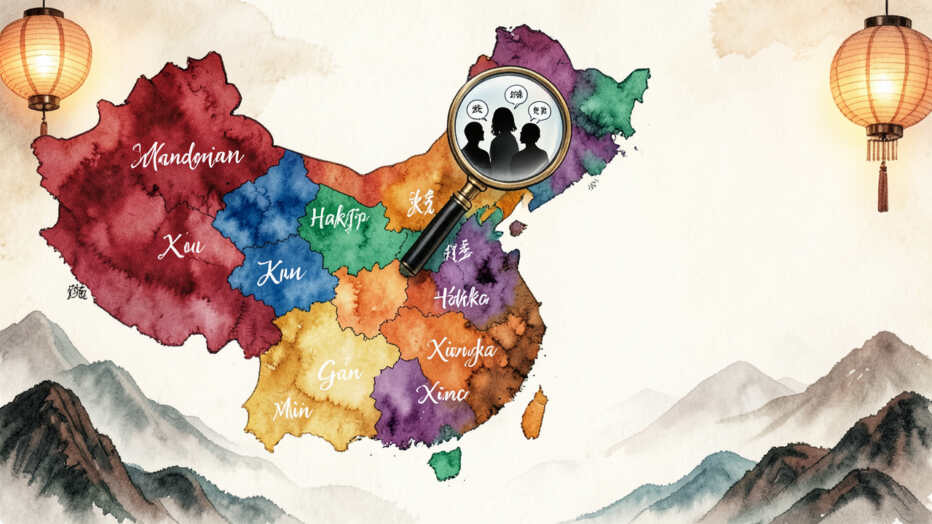
The most widely cited academic classification divides the speech of the Han Chinese (the majority ethnic group) into seven major dialect groups. Some linguists expand this to eight, nine, or even ten, depending on how certain transitional varieties are categorized.
These groups are massive linguistic territories. The Mandarin group alone covers the vast majority of northern, central, and southwestern China. The others are concentrated in specific coastal and southern provinces, contributing to the country’s incredible linguistic diversity.
| Dialect Group | Primary Region(s) | Estimated Speakers | Key Characteristic |
|---|---|---|---|
| Mandarin (Beifang) | North, Southwest, Central | ~920 million | Basis for Standard Mandarin (Putonghua) |
| Wu | Shanghai, Zhejiang, southern Jiangsu | ~80 million | Includes Shanghainese; known for voiced initials |
| Cantonese (Yue) | Guangdong, Guangxi, Hong Kong, Macau | ~85 million | Preserves many final consonants lost in Mandarin |
| Min | Fujian, Taiwan, Hainan, parts of Guangdong | ~75 million | Sub-groups like Hokkien and Teochew are distinct |
| Hakka | Scattered in Guangdong, Fujian, Jiangxi, Taiwan | ~45 million | “Guest people” dialect; conservative features |
| Gan | Jiangxi | ~22 million | Transitional features between Mandarin and Hakka |
| Xiang (Hunanese) | Hunan | ~38 million | Includes the famous Changsha dialect |
This table summarizes the major Han dialect groups. Each group contains numerous sub-dialects. For example, within the Min group, the speech of Xiamen (Amoy) is different from that of Fuzhou.
This layering is why the total count quickly rises into the hundreds.
What Are the Major Han Dialect Families in Detail?
Looking closer at the primary families reveals the sheer scale of diversity within each category. These are not just accents; they are distinct linguistic systems with their own phonology, grammar, and vocabulary.
Mandarin: The Dominant and Diverse Group
Mandarin is by far the largest group in terms of speakers and geographic spread. It is divided into numerous sub-dialects. Beijing dialect is the phonetic base for Standard Mandarin, but dialects from Sichuan, Yunnan, and the Northeast sound quite different.
The key to Mandarin’s dominance is its status as the official language. The government’s promotion of Putonghua has led to widespread bilingualism, but in homes and local markets, regional Mandarin variants flourish.
- Northeastern Mandarin (Dongbei): Known for its distinctive tone and vocabulary, often heard in Chinese comedy.
- Southwestern Mandarin: Spoken in Sichuan, Chongqing, and Yunnan, it has unique tonal patterns.
- Ji-Lu Mandarin: Covers Hebei and Shandong provinces, with many sub-varieties.
- Jianghuai Mandarin: Spoken in parts of Anhui and Jiangsu, it is a transitional zone.
Wu: The Language of the Yangtze Delta
Wu is the second largest group, centered on the Shanghai-Zhejiang region. Shanghainese is the most famous Wu dialect. Wu is characterized by a complex tone system and voiced initials, features lost in Mandarin.
Historically, Wu was the language of trade and culture in the region.
Cantonese and Min: Linguistic Powerhouses
Cantonese, or Yue, has global recognition due to Hong Kong cinema, music, and large diaspora communities. It preserves a full set of final stop consonants (-p, -t, -k) from Middle Chinese. The Min group is incredibly diverse internally.
The Min Nan (Southern Min) dialect, also known as Hokkien, is spoken in Taiwan and is a major language of commerce in Southeast Asia. Min Dong (Eastern Min) centered in Fuzhou is mutually unintelligible with Min Nan.
Tip: When visiting southern China, assume that local dialects will be completely different from the Standard Mandarin taught in schools. Basic Mandarin phrases are essential for travel.
How Do China’s Minority Languages Fit into the Count?
China is a multi-ethnic state with 56 officially recognized ethnic groups. The Han majority speaks the various “Chinese dialects,” while the other 55 groups have their own distinct languages. These are not dialects of Chinese; they belong to entirely different language families.
The government recognizes and promotes these minority languages in education and media in their respective autonomous regions. Examples include Tibetan, Uyghur, Mongolian, and Zhuang. Each of these languages has its own set of regional dialects, adding further layers to the count.
- Tibetan: Has several major dialects like Amdo, Kham, and Lhasa (Ü-Tsang).
- Mongolian: Includes dialects like Chahar, Ordos, and Oirat.
- Zhuang: A Tai-Kadai language with many local varieties, spoken in Guangxi.
- Miao/Yao Languages: Several distinct languages within this designation, including Hmong and Mien.
According to Ethnologue, a comprehensive catalog of world languages, there are approximately 305 living languages in China. This number includes the major Chinese dialect groups counted separately, all minority languages, and sign languages like Chinese Sign Language.
| Ethnic Group | Language Family | Example Language | Primary Region |
|---|---|---|---|
| Zhuang | Tai-Kadai | Standard Zhuang | Guangxi |
| Uyghur | Turkic | Uyghur | Xinjiang |
| Miao (Hmong) | Hmong-Mien | Hmong Daw | Guizhou, Yunnan |
| Mongol | Mongolic | Southern Mongolian | Inner Mongolia |
| Tibetan | Sino-Tibetan | Lhasa Tibetan | Tibet, Qinghai |
Why Is an Exact Count of Chinese Dialects So Difficult?
Several factors make pinning down a precise number nearly impossible. The first is the dialect continuum. In many areas, speech changes gradually as you move from village to village.
There is no clear border where one dialect ends and another begins. Linguists must draw arbitrary lines.
The second factor is the lack of comprehensive, standardized surveys. Mapping every small-town dialect in a country the size of China is a monumental task. New dialects emerge and old ones fade with migration and urbanization.
The third issue is political. Acknowledging too many separate “languages” could be seen as undermining national unity, so official counts often lean toward consolidation.
Warning: Do not assume all Chinese dialects are related to Mandarin. Groups like Wu and Min diverged from the common ancestor over a thousand years ago. Linguistic diversity in China is as great as in all of Europe.
Consider the Jin dialect group. Previously lumped with Mandarin, it is now often classified separately, centered on Shanxi province. This single reclassification changes the total count from seven to eight major groups.
Such academic debates are ongoing.
How Is Language Policy Shaping the Linguistic Landscape?
The Chinese government has a strong policy of promoting Putonghua (Standard Mandarin) as the national common language. This initiative, started in the 1950s and intensified in recent decades, has had a profound impact on dialect use. Education, media, and official business are conducted in Standard Mandarin.
This policy aims to foster national cohesion and facilitate mobility in a vast country. However, it also leads to a decline in dialect proficiency among younger urban generations. Many children in major cities like Shanghai and Guangzhou are more comfortable speaking Putonghua than the local Wu or Cantonese dialect.
Efforts to preserve local dialects are increasing. Some cities have introduced dialect programs in schools or created local TV channels that broadcast in the regional dialect. Cultural production, like music and web dramas in Cantonese or Shanghainese, also plays a role in keeping these varieties alive.
- Benefits of Promotion: Easier internal migration, standardized administration, broader access to national media.
- Costs of Promotion: Potential loss of unique cultural heritage, erosion of local identity, and intergenerational communication gaps.
- Preservation Efforts: Dialect dictionaries, community radio stations, and digital apps focused on specific dialects are emerging.
What Does This Mean for Everyday Communication?
For most Chinese people, daily life involves a bilingual or diglossic situation. They use Putonghua for formal situations, with people from other regions, and in education. They switch to their local dialect at home, with family, and among neighbors for a sense of intimacy and local identity.
In practice, this means a business meeting in Shenzhen might be conducted in Putonghua, but the colleagues might chat over lunch in Cantonese or Hakka. Tourists will find Putonghua widely understood in cities, but may struggle in rural areas where the local dialect is dominant.
Understanding this dynamic is crucial for anyone working or traveling in China. Language is not just a tool for communication here; it is a powerful marker of regional identity, history, and social bonds.
Frequently Asked Questions
Are Cantonese and Mandarin the same language?
No. Cantonese (Yue) and Mandarin (Beifang) are two distinct major dialect groups of Chinese. They are not mutually intelligible in their native forms.
A Cantonese speaker from Guangzhou and a Mandarin speaker from Beijing cannot understand each other without learning the other’s language or using Standard Mandarin.
Is Shanghainese a dying language?
Shanghainese, a Wu dialect, is under significant pressure from Putonghua promotion and migration. Many young Shanghainese are more fluent in Mandarin. However, it is not yet endangered, as it remains widely used in households and local communities.
Active preservation efforts are underway.
How many people in China speak English?
Estimates vary widely. China has over 400 million English learners, but functional proficiency is lower. According to the EF English Proficiency Index, China ranks in the “moderate proficiency” band.
In major international business hubs, English use is common, but for most of the population, Putonghua and the local dialect are the primary means of communication.
Can different Chinese dialects use the same writing system?
Historically, yes. Classical Chinese provided a unified written standard across dialect regions. Modern Standard Chinese (written Mandarin) is now the dominant written form.
Some dialects have their own written traditions using Chinese characters phonetically, but this is not standard practice.
Is Wu Chinese a separate language?
Linguistically, Wu (which includes Shanghainese) is often classified as a separate language, not just a dialect, due to its lack of mutual intelligibility with Mandarin. The distinction is primarily political and cultural. Academically, it is one of the major Sinitic language groups.
Final Thoughts
The question of how many spoken dialects exist in China has no single answer because it depends on definitions and the level of detail considered. The reality is a rich spectrum of speech ranging from major, internationally recognized groups like Cantonese and Wu to countless localized village varieties.
While Standard Mandarin serves as the vital national common tongue, the regional dialects are fundamental to local culture and identity. The linguistic map of China is incredibly complex, reflecting thousands of years of history, migration, and regional development. This diversity is a testament to the country’s vast human tapestry.