The Meaning of Colors in Chinese Opera Costumes
Colors in traditional Chinese opera costumes are not just decorative; they are a vital visual language that instantly communicates a character’s personality, moral compass, and social standing to the audience. Understanding color symbolism in traditional Chinese opera costumes unlocks a deeper appreciation for this complex art form. This guide explores the meaning behind every hue and pattern you see on stage.
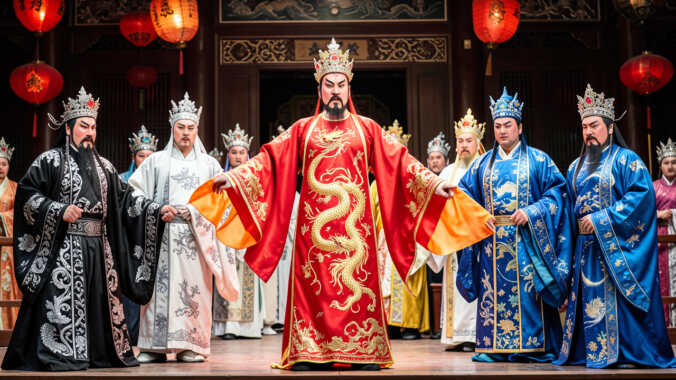
Simply put, colors in Chinese opera costumes are a code. Red signals loyalty and bravery, black represents integrity and impartiality, and white denotes treachery or purity depending on the role. Each costume color choice is deliberate, shaping the audience’s perception before a single line is sung.
Key Takeaways
- Color symbolism is a fundamental storytelling tool in Chinese opera, conveying character traits instantly.
- Red, yellow, blue, black, and white are the core colors, each with specific meanings tied to loyalty, power, and morality.
- Costume patterns and accessories work with color to define a character’s role type, such as martial, civil, or supernatural.
- The system is consistent across major opera forms like Peking Opera, making it a universal element of the art.
- For performers, correctly applying these colors is essential for authentic character portrayal.
What is Color Symbolism in Traditional Chinese Opera?
Color symbolism in traditional Chinese opera is a codified system where specific hues are assigned to represent character archetypes, moral qualities, and social status. It evolved from ancient Chinese philosophy, particularly the theory of the Five Elements (Wu Xing), which links colors to natural forces. This visual shorthand allows the audience to immediately grasp the role of a character.
This system is not arbitrary. It draws from historical sources, including imperial court dress codes and folk art traditions. The vibrant colors of the costumes were also designed to be visible and impactful in outdoor or candlelit theaters, ensuring the story was clear even from a distance.
The Philosophical and Historical Roots
The symbolism is deeply rooted in Confucian ideals of social harmony and moral behavior. Colors help reinforce these values by making virtues and vices visually prominent. For example, a loyal general’s red robe signifies his passion and righteousness, aligning with Confucian virtues.
- Five Elements Theory: Links colors to elements – Red (Fire), Yellow (Earth), White (Metal), Black (Water), Green/Blue (Wood).
- Imperial Influence: Certain colors, like bright yellow, were restricted to the emperor in historical periods, a rule reflected in opera.
- Buddhist and Taoist Imagery: Influences the use of colors for deities, immortals, and demonic characters.
| Philosophical Source | Primary Color Associations |
|---|---|
| Confucianism | Red (Loyalty), Black (Impartiality) |
| Five Elements (Wu Xing) | Five colors linked to natural forces |
| Taoism & Buddhism | Gold (Divinity), Purple (Nobility/Supernatural) |
This blend of philosophy created a rich visual lexicon. When you see a character in purple, you know they are likely a noble or a supernatural being, a meaning consistent across many plays.
How Does Color Symbolism Work in Chinese Opera?
The system works through immediate association. A veteran theatergoer or a trained performer knows that a character in a red face paint and red costume is a loyal warrior. A character in white face paint is a treacherous villain.
This is how color symbolism in traditional Chinese opera costumes functions as a non-verbal script.
The application extends beyond just the robe. Facial makeup (lianpu) is the most critical element. The base color of the face, combined with elaborate patterns, creates a unique identity for each character type.
The costume color then reinforces and amplifies this message.
The Language of Face and Fabric
An actor’s transformation begins with the face. The colors chosen here define their core nature. The costume then provides context about their rank, profession, and current situation.
- Base Face Color: Red (loyal), Black (integrity), White (villainous), Blue/Green (brave/rebellious).
- Pattern Complexity: Intricate patterns often indicate a more important or complex character.
- Costume Hue: Sets the overall tone – bright for heroes, muted for scholars, glittering for gods.
- Patterns and Embroidery: Dragons for emperors, birds for officials, simple waves for soldiers.
- Accessories: A long beard (rank), a specific headdress (profession), or flags on the back (a general in command).
Warning: The meaning of a color can invert based on the character type. White purity (a maiden) is completely different from white treachery (a treacherous official). Context is everything.
For example, the famous character Guan Yu is always depicted with a red face and often wears a green robe (representing his loyalty to the Han dynasty, which used green). His specific combination is instantly recognizable.
What are the Main Colors and Their Meanings?
The core palette of Chinese opera costumes is small but incredibly potent. Each major color carries a weight of meaning that has been refined over centuries. Here is a breakdown of the primary hues used in color symbolism in traditional Chinese opera costumes.
Red (Hong) – Loyalty and Bravery
Red is the most positive color, symbolizing loyalty, bravery, uprightness, and passion. It is the color of heroes and righteous warriors. Characters like the virtuous general Guan Yu or the faithful minister Guan Zhonghua are clad in red.
It is also used for festive occasions and happy endings.
- Represents: Loyalty, courage, justice, passion, celebration.
- Typical Characters: Faithful generals, loyal ministers, brave warriors.
- Facial Makeup: A full red face is the ultimate sign of loyalty.
Black (Hei) – Integrity and Impartiality
Black signifies integrity, impartiality, selflessness, and rough but righteous strength. It is the color of just judges and honest officials. The most iconic black-faced character is Bao Zheng (Judge Bao), known for his unwavering commitment to justice.
- Represents: Honesty, integrity, impartiality, steadfastness.
- Typical Characters: Just judges, honest officials, upright warriors.
- Facial Makeup: A black face often has white or silver patterns for emphasis.
White (Bai) – Treachery and Purity
White has a dual meaning, which depends entirely on the character type. For male civil roles (like officials), it often signifies treachery, cunning, and cruelty. The villain Cao Cao is famously portrayed with a white painted face.
However, for young female roles (dan), white can represent purity, innocence, and refinement.
- Represents (Male Villains): Treachery, cunning, cruelty, insidiousness.
- Represents (Young Women): Purity, innocence, youth, refinement.
- Facial Makeup: A white face with small red or black accents is the classic “clown villain” pattern.
Yellow (Huang) – Royalty and Supremacy
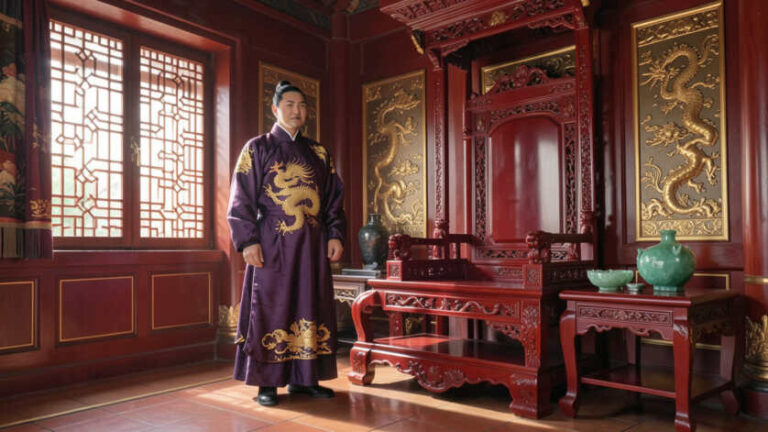
Bright yellow is almost exclusively reserved for the emperor and the highest nobility. It represents power, royalty, and the earth element. Its use is strictly controlled within the opera to reflect historical imperial monopolies on the color.
Darker yellows or golds are also used for gods and immortals.
- Represents: Royalty, supremacy, imperial power, divinity.
- Typical Characters: Emperors, high gods, supreme commanders.
- Patterns: Almost always embroidered with the five-clawed dragon.
Blue (Lan) and Green (Lv) – Rebellious and Wild
Blue often represents bravery, fierceness, and a somewhat rebellious or unyielding nature. It is common for heroes who are not part of the official system, like bandits or independent warriors. Green can signify impulsiveness, youth, or a connection to nature, but also sometimes demonic traits.
Both colors are associated with the wood element.
- Represents: Bravery, fierceness, impulsiveness, independence, the wild.
- Typical Characters: Brave rebels, young warriors, supernatural beings of the forest.
How Do Patterns and Accessories Complement Color?
Color is only the first layer of meaning. The patterns embroidered onto a costume and the accessories a character wears provide crucial secondary information about rank, profession, and personality. Together with color symbolism in traditional Chinese opera costumes, they create a complete visual profile.
For instance, an emperor wears yellow, but it’s the dragon pattern that confirms his supreme status. A general wears red, but the flags on his back denote his command of an army. A scholar wears blue, but his fan or book identifies his profession.
Decoding Common Patterns
Patterns are not mere decoration. They are symbols read by the informed audience. The type, size, and arrangement of motifs carry specific messages.
| Pattern | Meaning | Typical On |
|---|---|---|
| Five-Clawed Dragon | Supreme Imperial Authority | Emperor’s robe |
| Four-Clawed Dragon | Nobility or high official | Prince’s robe |
| Phoenix | Empress or high-ranking consort | Empress’s robe |
| Crane | Longevity, scholar-official | Minister’s robe |
| Simple Waves or Clouds | Military, lower rank | Soldier’s uniform |
Essential Accessories and Their Roles
Accessories further specify a character’s state and identity. A long, flowing beard isn’t just facial hair; its color and length indicate age and temperament. Headdresses are equally telling.
- Beards (Rankou): Long black = vigorous adult; long white = aged sage; short red = young warrior.
- Headdresses: The “phoenix coronet” for emperors/queens; the “hat with wings” for officials; the “silk band” for scholars.
- Weapons and Props: A spear versus a fan immediately distinguishes a general from a scholar.
- Flags on Back: Worn by generals, representing command of a troop or army.
Tip: When watching a performance, pay attention to the smallest details. The number of dragons on a robe, the specific pattern on a shoulder piece, or the style of a boot can all provide clues about a character’s exact rank and story.
Why is This Symbolism System So Important?
The importance of color symbolism in traditional Chinese opera costumes cannot be overstated. It is the foundational grammar of the art form’s visual storytelling. Without it, the nuanced relationships, moral judgments, and social hierarchies of the story would be lost on the audience, especially in the loud, stylized world of the stage.
This system allows for immediate recognition. In a play with dozens of characters, the audience doesn’t need lengthy introductions. A glance at a red-faced general or a white-faced villain tells them everything they need to know about that character’s role in the drama.
Preserving Cultural Heritage
This codified system is a living repository of Chinese cultural values. It transmits historical concepts of virtue, power, and social order from one generation to the next. For practitioners, learning this symbolism is a rite of passage, connecting them to centuries of tradition.
- Storytelling Efficiency: Condenses complex character exposition into a single visual cue.
- Audience Engagement: Allows viewers to actively “read” the stage and predict narrative elements.
- Cultural Education: Preserves and teaches philosophical ideals through performance.
- Artistic Integrity: Maintains the authenticity and discipline of the traditional art form.
For scholars and performers alike, mastering this symbolism is essential. It is the key to unlocking the full depth of a play’s meaning and historical context.
Who Needs to Understand This Symbolism?
While fascinating for any audience, understanding color symbolism in traditional Chinese opera costumes is particularly crucial for specific groups. This knowledge transforms passive viewing into an active, intellectually rewarding experience. It is a core part of theatrical literacy in the Chinese cultural sphere.
Performers must internalize these codes to embody their characters authentically. A wrong color or pattern is a fundamental error that breaks the illusion and disrespects the tradition. The symbolism guides their entire physical portrayal.
For Performers and Students
For actors, this is not optional knowledge; it is their job description. Every costume fitting, every application of makeup, is an exercise in this symbolic language. Students spend years learning the rules and their exceptions.
- Character Authenticity: Correctly applying color is the first step to becoming the character.
- Non-Verbal Communication: The costume must “speak” before the actor does.
- Respect for Tradition: Accurate portrayal honors the art form’s history and masters.
For Directors, Designers, and Educators
Directors use this symbolism to shape the visual narrative of a production. Costume designers must have expert knowledge to create authentic outfits. Educators use it as a primary tool to teach students about character and plot.
A director might choose to subtly subvert expectations by having a villain wear a slightly off-white, creating unease. A designer must know that a general’s flags must be a specific size and color to denote his rank correctly.
For Cultural Enthusiasts and Viewers
For the general audience, this knowledge greatly enhances enjoyment. Spotting the loyal hero by his red face or understanding the emperor’s authority through his yellow robe adds a layer of satisfaction. It turns a show into a decipherable spectacle.
| Audience Group | Key Benefit of Understanding Symbolism |
|---|---|
| Performers & Students | Authenticity and artistic mastery |
| Directors & Designers | Creating coherent and meaningful visual stories |
| Cultural Scholars | Decoding historical and philosophical texts |
| Theater Fans & Viewers | Deeper appreciation and engagement |
Ultimately, this knowledge connects you more deeply to one of the world’s oldest and most sophisticated theatrical traditions. It is the key to moving beyond seeing a performance to truly witnessing a story unfold in brilliant, meaningful color.
Frequently Asked Questions
What does the color red mean in Chinese opera?
Red in Chinese opera symbolizes loyalty, bravery, uprightness, and passion. It is used for heroic and virtuous characters, such as the famous general Guan Yu. A red face paint combined with a red costume is the ultimate indicator of a loyal and courageous hero.
Why are some opera characters painted white?
A white face in Chinese opera has a dual meaning. For male officials or older male roles, it typically signifies treachery, cunning, and cruelty, making it a hallmark of the villain. For young female roles, however, white can represent purity, innocence, and refinement.
How are emperors represented in Chinese opera costumes?
Emperors are instantly identifiable by their bright yellow robes, as yellow historically was the color of the imperial family. These costumes are elaborately embroidered with five-clawed dragons, the ultimate symbol of supreme authority in Chinese culture.
Does the symbolism change between different types of Chinese opera?
The core color symbolism is remarkably consistent across major forms like Peking Opera, Kunqu, and Cantonese Opera. While embroidery styles and costume cut may vary slightly, the fundamental meanings of red (loyalty), black (integrity), and white (treachery/purity) remain the same.
Can colors have negative meanings in Chinese opera?
Yes, absolutely. White, when used for male characters, is the most common color for villainy and treachery. Blue can sometimes indicate a fierce, untamed, or rebellious nature.
The meaning is always tied to the specific role type (sheng, dan, jing, chou) wearing the color.
Final Thoughts
The vibrant world of color symbolism in traditional Chinese opera costumes is a profound language of its own, turning the stage into a living canvas of moral and social commentary. From the loyal red of a hero to the treacherous white of a villain, every hue tells a story rooted in centuries of philosophy and tradition. This system is the heartbeat of Chinese opera’s visual drama, allowing audiences and performers alike to connect deeply with the narrative. Next time you watch a performance, look closely at the colors and patterns – they are speaking directly to you.