Common Radicals in Chinese Characters: Meanings & Examples
Common radicals in Chinese characters are the fundamental building blocks that reveal the meaning and structure of the language. Understanding these key components makes learning Chinese characters faster and more logical. This guide will walk you through the most frequent radicals, their meanings, and how to use them to decode unfamiliar characters.
Simply put, radicals are recurring components within Chinese characters that often hint at the character’s semantic category or original meaning. Mastering about 50 common radicals provides a powerful shortcut to understanding hundreds of characters, significantly accelerating your Chinese learning journey.
Key Takeaways
- Most Chinese characters are phono-semantic compounds, containing a radical that hints at meaning and a component that suggests pronunciation.
- The common radicals in Chinese include elements like water (氵), wood (木), heart (心), and person (亻), each linking characters to a thematic group.
- Learning radicals helps you guess meanings, organize vocabulary, and remember characters more effectively than rote memorization alone.
- A character’s radical is often (but not always) found in a consistent position, such as the left side or top, which aids in identification and dictionary lookup.
- The study of radicals is a core part of the Chinese writing system, connecting modern characters to their ancient pictographic origins.

What Is a Radical in Chinese Characters?
A radical, known as a “bushou” (部首) in Chinese, is a graphical component that forms part of a Chinese character. These components are used to categorize characters in traditional dictionaries and often provide a clue to the character’s original meaning. The concept dates back to the ancient Chinese scholar Xu Shen, who classified over 9,000 characters into 540 radicals in his seminal work, the Shuowen Jiezi.
Today, most modern Chinese dictionaries use a simplified system of 214 radicals. These are the essential keys to the Chinese writing system. When you recognize a radical, you can often make an educated guess about the character’s general meaning.
For example, the radical for “water” (氵) appears in characters related to liquids, rivers, or states of being wet.
| Radical Component | Meaning | Example Character | Meaning of Example |
|---|---|---|---|
| 口 (kǒu) | Mouth, opening | 吃 (chī) | To eat (action of the mouth) |
| 木 (mù) | Wood, tree | 林 (lín) | Forest (two trees) |
| 女 (nǚ) | Woman, female | 妈 (mā) | Mother (woman + horse phonetic) |
This table shows how radicals function as semantic indicators. The “mouth” radical in “eat,” the “wood” radical in “forest,” and the “woman” radical in “mother” all provide a direct link to the character’s core meaning.

How Do Radicals Indicate Meaning in Chinese?
Radicals provide a semantic anchor for a character. In the majority of Chinese characters, known as phono-semantic compounds, the radical forms the semantic part while another component provides a hint to pronunciation. This system is what allows a learner to encounter a new character and have a framework for understanding it.
The connection isn’t always literal in modern Chinese. Over thousands of years, meanings have evolved and characters have been simplified. However, the foundational link often remains.
Recognizing this link moves you from memorizing arbitrary strokes to understanding a logical system.
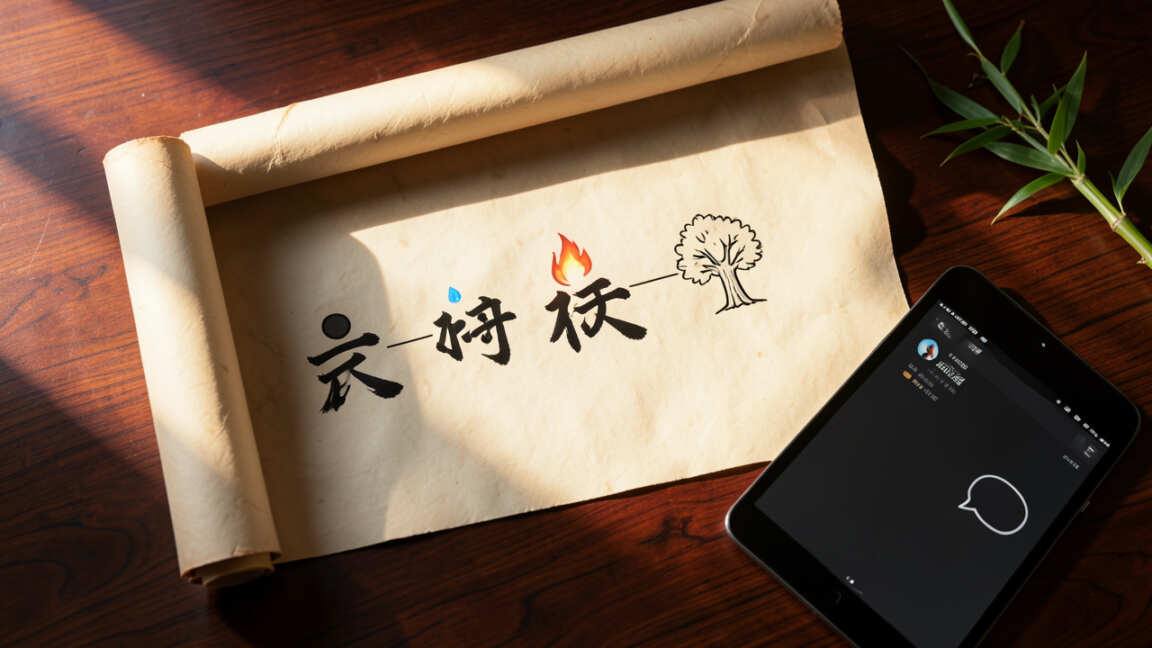
Consider the radical for “fire” (火). It appears in characters like:
- 灯 (dēng) – lamp (fire-related light source)
- 烧 (shāo) – to burn (involving fire)
- 烤 (kǎo) – to roast (cooking with fire)
- 烟 (yān) – smoke, cigarette (byproduct of fire)
- 灰 (huī) – ash (what remains after fire)
The common thread of “fire” or its effects is clear. This thematic grouping is a powerful mnemonic device. Instead of learning five entirely unrelated characters, you learn one concept (fire) and see its applications.
Common Radicals in Chinese Characters and Their Meanings
While there are 214 traditional radicals, a core set of about 30-50 appear with very high frequency. Focusing on these first will give you the most significant return on your study time. Here is a detailed look at some of the most common ones, their meanings, and examples.
| Radical | Pinyin | Meaning | Example Characters | Thematic Connection |
|---|---|---|---|---|
| 氵 | shuǐ | Water | 河 (river), 洗 (to wash), 海 (sea) | Liquids, bodies of water, cleansing |
| 心/忄 | xīn | Heart, mind | 想 (to think), 忙 (busy), 情 (feeling) | Emotions, thoughts, mental states |
| 亻 | rén | Person | 你 (you), 他 (he), 住 (to live) | People, human actions, occupations |
| 日 | rì | Sun, day | 时 (time), 晴 (sunny), 早 (early) | Time, daylight, brightness |
| 月 | yuè | Moon, month | 期 (period), 脚 (foot – body part) | Time (months), also used for body parts |
| 手/扌 | shǒu | Hand | 打 (to hit), 抓 (to grab), 拿 (to hold) | Hand actions, manipulation |
| 土 | tǔ | Earth, soil | 地 (ground), 坐 (to sit), 城 (city) | Land, geography, places |
This table is an excellent starting point for your study. Notice how each radical creates a semantic field. The “heart” radical (心/忄) is particularly interesting because it often relates to emotions and internal states, even when the modern translation isn’t immediately obvious.
Tip: Pay attention to the radical’s form. Some, like “heart” (心) and “hand” (手), have a simplified form (忄, 扌) when they appear on the left side of a character. Recognizing both forms is crucial.
Why Learning Radicals Matters for Beginners
For anyone starting their Chinese journey, radicals are not just an academic curiosity; they are a practical survival tool. Relying solely on pinyin and stroke-by-stroke memorization leads to frustration and a fragile foundation. Radicals provide the essential scaffolding.
First, they dramatically improve character recall. When you learn the character for “mother” (妈), knowing it’s composed of the “woman” radical (女) and a phonetic component (马) makes it logical and sticky in your memory. It’s not a random drawing; it’s a “woman” + a sound-alike.
Second, radicals help you navigate the dictionary, whether physical or digital. Most Chinese dictionaries are organized by radical, followed by stroke count. Knowing you can find “river” (河) under the “water” radical (氵) is a fundamental skill.
- Reduces Cognitive Load: You learn one radical (like 木 for wood) and can apply that knowledge to dozens of characters (tree, forest, chair, bed, table).
- Enables Intelligent Guessing: See a character with the “food” radical (饣) next to a restaurant? You can safely assume it’s a menu item or food-related word.
- Provides Cultural Insight: Radicals reveal ancient Chinese worldview. The “woman” radical appears in characters for peace (安), good (好), and slander (妒), reflecting historical social roles.
- Builds a Systematic Approach: It shifts your mindset from seeing Chinese as art to be copied to a system to be decoded.
The Role of Radicals in Character Composition
Understanding the position of a radical is as important as knowing its meaning. While the left side is the most common placement for semantic radicals, others appear at the top, bottom, or surround the character. This positional knowledge helps with quick identification.
Common radical positions include:
- Left Side (most common for semantic radicals): 亻(person), 氵(water), 忄(heart), 扌(hand), 口(mouth)
- Top Side: 艹(grass/plant), 宀(roof), 竹(bamboo)
- Bottom Side: 灬(fire), 皿(container)
- Enclosure: 囗(enclosure), 门(door)
Consider the character for “study” or “learn” (学). The top component is not a traditional radical but is derived from two “child” (子) characters under a “roof” (宀), symbolizing children in a school building. The bottom part is “child” (子) again.
This pictographic origin is preserved in the structure. While modern dictionaries might file it under the “child” radical, understanding its composite nature is key.
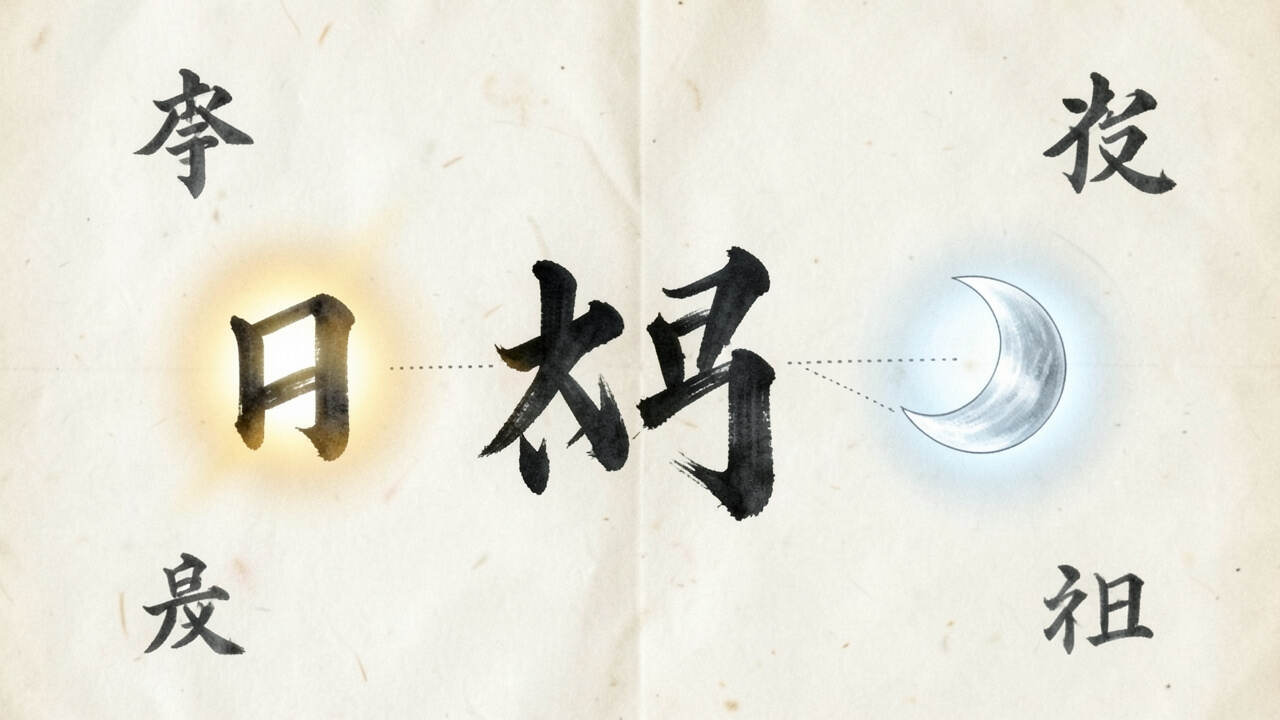
This leads to an important point: not every character neatly separates into a semantic radical and a phonetic component. Some are pictographs (like 山 for mountain), and others are ideographs (like 明, bright, made of sun 日 and moon 月). Radicals help categorize all of these, but the phono-semantic logic applies to the majority—over 80% of common characters.
How to Identify and Learn Radicals Effectively
A structured approach makes learning radicals efficient. Don’t just scan a list; engage with them actively. Here is a step-by-step process:
- Start with the Core 20-30: Focus on the radicals listed in the table above. Master their forms, meanings, and positions first.
- Use a Radical Chart: Find a clear visual chart showing each radical, its meaning, and stroke count. Pin it where you study.
- Practice Radical Decomposition: Take a character you know and break it down. For “good” (好), identify the “woman” (女) and “child” (子) radicals.
- Learn Through Context: When you learn a new character, immediately identify its radical. Say, “This character has the water radical (氵), so it’s probably related to liquid.”
- Group Vocabulary Thematically: Create lists of characters sharing a radical. Make a “food” list with radicals like 饣, 米, and 口.
- Use Flashcards with Components: Design flashcards that show the radical, its meaning, and example characters. This builds neural pathways between form and function.
Warning: Do not assume every character with a given radical has a direct modern meaning connection to it. For example, the radical for “money/shell” (贝) appears in characters for “buy” (买), “sell” (卖), and “store” (贮), but its connection to “store” is historical (a storage of value). The link is often historical or conceptual, not always literal.
Common Mistakes When Learning Chinese Radicals
Avoiding pitfalls will save you time and confusion. Here are frequent errors to sidestep:
- Ignoring Radical Variants: Not recognizing that 心 (heart), 忄 (heart radical on left), and 灬 (fire at bottom, but historically heart-related) are distinct forms in context.
- Over-Literal Interpretation: Thinking every character with the “woman” radical (女) must be about women. It often indicates a category, not a specific subject. The character “good” (好) combines “woman” and “child,” symbolizing a positive concept.
- Confusing Similar Radicals: Mixing up radicals that look alike, such as 日 (sun) and 曰 (to say), or 土 (earth) and 士 (scholar).
- Neglecting Position Rules: Trying to find a radical in the wrong place. If you can’t find it on the left, check the top, bottom, or enclosure.
- Rote Memorization Without Context: Memorizing the list of radicals in isolation without immediately applying them to real characters.
Resources for Mastering Chinese Radicals
The right tools can accelerate your learning. Beyond a good dictionary, seek out specialized resources. Many modern language apps include radical breakdowns within their character learning modules.
This is a highly effective method as it integrates radical knowledge with vocabulary acquisition.
For deeper study, look for books dedicated to character composition or “character etymology.” These often tell the fascinating stories behind the radicals. Online databases and flashcard systems like Anki allow you to create custom decks focused on radicals and their examples. Consistent, daily practice with these tools will solidify your understanding.
Frequently Asked Questions
How many radicals do I really need to learn?
You don’t need to memorize all 214 radicals at once. Start with the 30-50 most common ones, which cover a vast majority of everyday characters. Focus on radicals like 氵(water), 木 (wood), 忄 (heart), 亻 (person), and 口 (mouth) first.
These will give you the most immediate benefit.
Can a Chinese character have more than one radical?
Technically, each character is classified under a single primary radical in the dictionary. However, a character can be composed of multiple components that are themselves radicals. For example, the character for “mud” (泥) has the water radical (氵) and the component 尼, which contains the radical for “dagger” (匕).
The primary radical for lookup is 氵.
Are radicals the same as strokes?
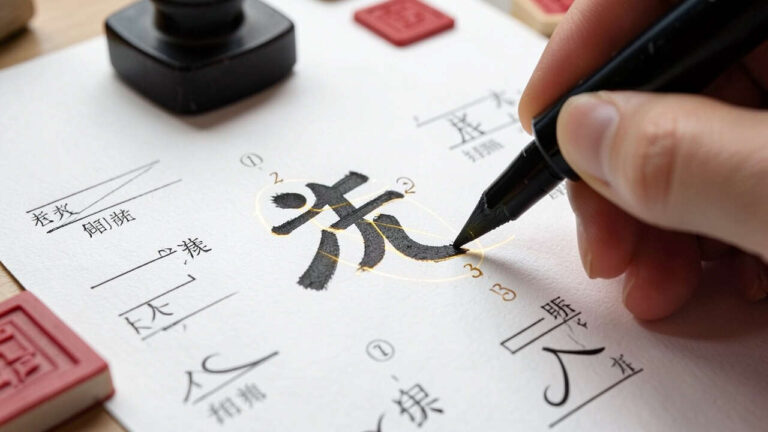
No, they are different concepts. A stroke is a single, continuous brushstroke (like a dot, line, or curve). A radical is a larger component made up of multiple strokes that carries a meaning.
For example, the radical 木 (wood) consists of four individual strokes.
Do all modern Chinese dictionaries use radicals?
Yes, virtually all Chinese dictionaries, including digital ones, are organized by radical. This traditional system remains the standard for looking up unfamiliar characters. When you don’t know how to pronounce a character, you identify its radical, then count the remaining strokes to find it in the dictionary.
Does learning radicals help with Chinese handwriting?
Absolutely. When you understand a character as a combination of meaningful parts rather than a random set of lines, you can write it more accurately and with better proportion. Knowing that a character has a “hand” radical (扌) on the left tells you to give that component specific space and structure.
This understanding improves both legibility and writing speed.
Final Thoughts
The common radicals in Chinese characters are your most reliable guideposts in the world of Hanzi. By learning their meanings and patterns, you transform character study from a daunting task into a logical puzzle. Start with a core set, apply them consistently, and you will unlock a deeper, more intuitive understanding of the Chinese written language.