How Social Class Worked During Imperial China
Social class during Imperial China was a rigid, hierarchical system that shaped every aspect of life for over two millennia. It determined your occupation, your rights, your clothing, and even where you could live. Understanding this system is key to grasping Chinese history, philosophy, and modern cultural values.
This guide breaks down how the system functioned, who belonged to each group, and why its structure remained so influential for centuries.
Simply put, Imperial Chinese society was organized into a strict four-tier pyramid—scholars, farmers, artisans, and merchants—based on the Confucian ideal of contributing to social harmony. While most people were born into their class, the imperial examination system provided a challenging but theoretical path for social mobility.
Key Takeaways
- The core of Imperial Chinese society was the four-class system, officially promoted by Confucian ideology to maintain order and harmony.
- Scholar-officials sat at the top of the hierarchy, ruling through a merit-based civil service exam, while merchants were placed at the very bottom.
- The system was not entirely fluid; social mobility was rare but possible almost exclusively through the grueling imperial examination.
- Social status dictated daily life, from the color of clothing and housing materials to legal rights and marriage prospects.
- This class structure created a society that valued education and agriculture above commerce and trade, impacting China’s economic development for centuries.
What Was the Core Social Hierarchy of Imperial China?
The fundamental structure of Imperial Chinese society was the four-class system, a clear social pyramid that assigned status based on a group’s perceived contribution to social good. At the apex were the scholar-officials, followed by farmers, artisans, and finally, merchants. This order was not just a social custom but was codified in law and reinforced by state policy from the Han Dynasty onwards, reaching its peak during the Ming and Qing Dynasties.
The hierarchy was explicitly rooted in Confucian philosophy. Confucians believed that the scholars’ role in governing and educating was the most noble, farmers’ labor produced essential sustenance, artisans created necessary goods, and merchants were seen as parasitic since they produced nothing tangible, merely profiting from exchange. This ideology justified the official treatment and privileges of each group.
- Scholar-Officials (士, Shì): The ruling elite who administered the state, interpreted laws, and upheld moral standards. Their status was theoretically based on merit, not birth.
- Farmers (农, Nóng): The revered “backbone of the nation.” They worked the land to feed everyone and paid taxes that funded the government. They were respected for their productive contribution.
- Artisans (工, Gōng): Craftsmen who manufactured tools, textiles, and other goods. They possessed valuable skills but were considered less essential than the farmers who provided raw materials and sustenance.
- Merchants (商, Shāng): The lowest-ranked group in the official hierarchy. They were often restricted from wearing certain colors, owning large estates, or taking the civil service exam in some dynasties.
It is important to note that this “official” system coexisted with a more complex reality. Within these four broad categories were vast differences in wealth and local power. A wealthy merchant family in a bustling port town might live more luxuriously than a poor scholar, but their social prestige and political influence remained capped by their official classification.
How Did the Scholar-Official Class Maintain Its Elite Status?
The scholar-officials held their position at the top of the social order primarily through control of knowledge, governance, and the state’s most powerful institution: the civil service examination system. This system, known as the keju, was a series of rigorous exams based on Confucian classics that select candidates for government positions. Mastering these texts required years of dedicated study, often from a young age.
Success in the exams was the ultimate goal for many families. Passing even the lowest level of examination conferred a basic degree that granted a degree of social prestige and minor legal privileges. The higher levels—provincial, metropolitan, and palace exams—could lead to prestigious posts as magistrates, governors, or even ministers in the central court.
This path created a self-perpetuating elite where education and bureaucratic service were the only respected avenues to power.
| Exam Level | Description | Resulting Privilege |
|---|---|---|
| County (Xiucai) | Entry-level exam testing basic Confucian knowledge. | Exemption from corvée labor, minor legal immunities. |
| Provincial (Juren) | Highly competitive exam held triennially in provincial capitals. | Eligibility for minor official posts, significant social status. |
| Metropolitan (Jinshi) | National-level exam held in the capital, open to provincial degree holders. | Fast track to high-ranking central government positions. |
| Palace (Dianshi) | The final, most prestigious exam, presided over by the emperor himself. | Appointment to elite posts, direct access to the imperial court. |
This system, while offering a theoretical meritocracy, favored those who could afford years of full-time study. In practice, most successful candidates came from families of existing scholar-officials or wealthy farmers who could support a son’s education. The scholar class reinforced its status through strict dress codes (dark robes and specific hats), exclusive housing, and intricate social rituals that visually and behaviorally separated them from commoners.
Important: The term “scholar-official” is key. These individuals were not just academics; they were the governing administrators. Their authority came from the state, backed by the emperor’s mandate and Confucian moral authority.
Why Were Farmers Held in Such High Esteem?
Farmers occupied the second tier of the official hierarchy, a position of great honor and vital importance. The reasoning was straightforward and deeply practical: agriculture was the foundation of the empire’s wealth and stability. The state depended on farmers to produce food, which sustained the entire population and generated tax revenue through grain levies and labor obligations.
A bountiful harvest meant stability; famine could lead to rebellion.
The government actively promoted the dignity of farming through rituals, tax policies, and propaganda. The emperor himself performed annual sacrificial ceremonies at the Temple of Heaven to pray for good harvests, a public act that underscored the celestial importance of agricultural work. Policies often aimed to protect smallholder farmers from exploitation by large landowners, as a healthy peasant class was seen as essential for social order.
- Tax Policy: The primary tax burden was on agricultural output, directly acknowledging the farm’s role as the economic engine.
- Corvée Labor: While a burden, farmers’ labor obligations for public works like canals and walls were framed as a necessary duty to the state.
- Moral Value: Confucian texts praised the honest, hardworking farmer as morally superior to the scheming merchant.
- Population Control: Farmers were rooted to the land through the household registration system, ensuring a stable labor force for agriculture and taxation.
However, this high esteem did not translate into high wealth or political power for the average farmer. Most were tenant farmers or smallholders living on the edge of subsistence, vulnerable to natural disasters and heavy taxation. Their “high status” was relative within the rigid system—more honorable than artisans and merchants, but still far below the ruling scholar elite who administered and taxed their labor.
What Was the Role and Reality of Artisans and Merchants?
Artisans and merchants formed the lower tiers of the official social hierarchy, with merchants at the very bottom. Artisans (craftsmen) were respected for their technical skills and the goods they produced. They worked in workshops, often organized into guilds, creating everything from silk textiles and porcelain to metal tools and furniture.
While necessary, their work was seen as less fundamental than farming since they transformed raw materials rather than producing sustenance from the earth.
Merchants, on the other hand, faced official disdain and legal restrictions. Confucian ideology viewed commerce as an inherently selfish activity—profiting from the labor of others without creating new value. Despite their low status, merchants could amass enormous wealth, especially during periods of economic growth like the Song Dynasty.
This created a major tension: wealthy merchants with no social prestige and poor scholars with high status but no money.
| Group | Typical Occupations | Official Restrictions (Varied by Dynasty) |
|---|---|---|
| Artisans | Potters, weavers, carpenters, blacksmiths, jade carvers. | Generally fewer legal restrictions; could organize into powerful guilds. |
| Merchants | Traders, shopkeepers, financiers, salt traders. | Forced to wear black or brown clothes, couldn’t ride horses or carry umbrellas, barred from exams (in some dynasties), higher taxes. |
Over time, especially in later dynasties like the Ming and Qing, the system blurred. Successful merchants would often use their wealth to educate their sons for the imperial exams, effectively “buying” a path into the scholar class. Some merchants even purchased honorary degrees or official titles, a practice that undermined the system’s Confucian purity but demonstrated the inescapable pull of financial power.
A wealthy salt merchant might live in a grand compound, but his family would still aspire to have a son become a scholar to gain true social respect.
Warning: Do not confuse official low status with actual poverty. A “low-status” merchant could be vastly wealthier than a “high-status” poor scholar. The system ranked societal contribution and prestige, not individual wealth.
How Did Social Class Influence Daily Life and Material Culture?
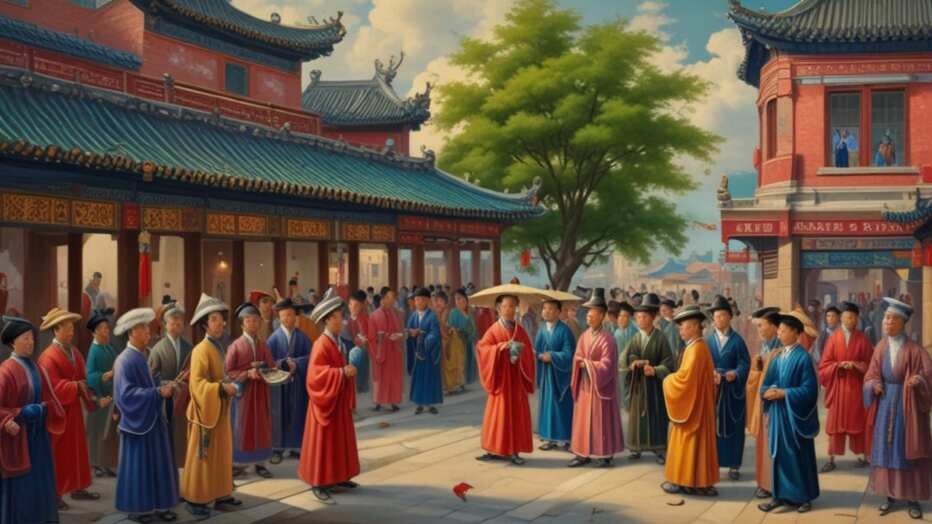
Social class in Imperial China was not an abstract concept; it was a visible, tangible reality embedded in every facet of daily life. The government enforced sumptuary laws—regulations that dictated what people could wear, eat, own, and build based on their official rank. This created a society where you could identify a person’s status at a glance through their clothing, housing, and even the mode of transportation they used.
- Clothing: Colors were strictly regulated. Yellow was reserved for the emperor, while dark blue and black were for officials. Farmers and commoners wore undyed linen or simple cotton in muted tones. The number of claws on a dragon motif on clothing indicated rank.
- Housing: Architecture followed strict rules. The number of courtyard rooms, the height of the main hall, the style of the roof, and even the color of the door frames signified status. Only officials could build with certain types of stone or wood.
- Transportation: The type of chair (sedan) or animal one could ride was regulated. Merchants might be wealthy, but they could not hire a six-bearer sedan chair reserved for higher-ranking officials.
- Rites of Passage: Funeral ceremonies, weddings, and ancestral rites varied greatly by class, involving different rituals, offerings, and amounts of expenditure.
This system of visible distinction served a crucial social function: it constantly reinforced the hierarchy and made any violation of the social order immediately apparent and punishable. It created a visual language of power and deference that structured public space and social interactions. The rare occasions when a commoner or merchant adopted the dress of a higher class were considered serious crimes of pretension.
What Was the Path to Social Mobility?
Despite its rigidity, Imperial China’s social system contained a theoretically open door for social mobility: the imperial examinations. This path was arduous, uncertain, and inaccessible to many, but it offered the only sanctioned way for a family to rise dramatically in status across generations. The process required immense investment, sacrifice, and a bit of luck.
- Early Education: A boy’s preparation often began in childhood at a village school or with a private tutor. Families would pool resources or seek sponsorship to fund years of study.
- Candidate Stage: Years of memorizing Confucian classics, practicing essay writing, and mastering calligraphy. The candidate lived a life of study, often delaying marriage and family.
- Passing an Examination: Gaining even the lowest degree (Xiucai) was a major achievement that lifted a family’s status. Each higher level offered exponentially greater rewards.
- Appointment and Office: Upon passing the highest exams, candidates entered the bureaucracy as officials, transforming their family’s social standing permanently.
The reality was that true mobility was rare. Statistics suggest that over 50% of successful candidates in later dynasties came from families that already held scholar-official positions. Nevertheless, the existence of this path was a powerful ideological tool.
It created the belief that talent and hard work could triumph over birth, a notion that promoted social stability by giving ambitious individuals a non-rebellious outlet for their aspirations. For the vast majority of the population, however, life was determined by birth, and social mobility remained a distant dream.
How Did Religion and Folk Beliefs Interact with Social Class?
The formal social hierarchy was primarily a Confucian construct. However, China’s rich religious landscape—comprising Daoism, Buddhism, and folk traditions—offered both reinforcement and a subtle counter-narrative to the official class system. These beliefs influenced how people understood their place in the world and provided spaces where the rigid Confucian order could be partially set aside.
- Daoism: Often appealed to scholars disillusioned with court politics, as well as to the general populace. Its emphasis on harmony with nature and detachment from worldly status could be seen as a critique of the striving inherent in the Confucian meritocracy. Hermit scholars and Daoist priests existed outside the official hierarchy.
- Buddhism: The concept of karma offered a transcendent explanation for one’s social position—you were reborn into a class based on your actions in past lives. This could be seen as justifying the hierarchy, but monasteries also provided an alternative social space where class distinctions among the monastic community were minimized.
- Folk Religion: Local temples and community festivals were gatherings where all classes mingled. Shared rituals for deities and ancestors created bonds that cut across the official hierarchy, fostering a sense of local community identity that sometimes superseded class divides.
In essence, while Confucianism provided the official operating system for social order, Daoism, Buddhism, and folk beliefs offered psychological coping mechanisms, alternative value systems, and social spaces that softened the absolute edges of the class structure for many ordinary people.
Frequently Asked Questions
Very rarely and not directly. A woman’s status was almost entirely defined by the men in her life—her father, husband, and sons. The primary path for a woman of lower birth to improve her family’s standing was through her son’s success in the imperial examinations.
A woman could also marry into a slightly higher class, but such upward mobility was limited and unusual.
What was the “outcast” class below the four-class system?
Beneath the four official classes existed a class of “mean people” or outcasts. This included executioners, grave diggers, sex workers, and certain entertainers. Their jobs were considered polluting according to Confucian and Buddhist beliefs.
They lived in segregated communities and faced severe social discrimination, often unable to marry into the common classes.
The Manchu rulers imposed a new ethnic hierarchy on top of the existing Chinese class system. Manchus, Mongols, and Han Chinese were categorized into separate banners, with Manchus holding the highest privileges. The civil service exams were continued, but top positions were increasingly filled by Manchus.
This added a layer of ethnic stratification over the traditional occupational classes.
Did merchants ever gain higher official status over time?
Yes, particularly in the late Ming and Qing dynasties. As commerce grew, wealthy merchant families successfully lobbied for relaxed restrictions. They could purchase honorary degrees or official titles, and their sons were educated to pass the exams.
While merchants never reached the top of the official hierarchy, their economic power forced a pragmatic, if not ideological, accommodation by the state.
The abdication of the last emperor in 1912 and the rise of the Republic of China legally abolished the imperial class system and its privileges. Land reform, revolution, and modernization further dismantled the old structures. However, some cultural values associated with it—like respect for education and bureaucratic service—persisted in modern Chinese society.
Final Thoughts
The social class system of Imperial China was a complex framework that blended Confucian ideology with legal enforcement and cultural practice. It created a remarkably stable social order that lasted for centuries by defining everyone’s role and rewarding education and agricultural productivity above all. While it contained a theoretical meritocratic path through the exams, true mobility was the exception, not the rule.
Its legacy endures in the deep cultural value placed on education and in the historical memory of a once clear-cut social world.