Essential Mandarin Phrases for Shopping and Bargaining Success
Shopping in local markets and stores across Chinese-speaking regions is an incredible cultural experience. Knowing the right Mandarin phrases for shopping and bargaining helps you connect with vendors and secure better prices. This guide equips you with the essential language you need for confident transactions.
Simply put, mastering a handful of key Mandarin phrases transforms shopping from a stressful guessing game into an engaging, successful interaction. You’ll be able to greet sellers, ask prices, negotiate respectfully, and finalize purchases with ease.
Key Takeaways
- Bargaining in Mandarin is a cultural norm in many settings, not a confrontation, and using polite phrases is essential.
- Learning numbers and basic question phrases like “How much?” is the most critical first step for any shopper.
- Polite starters and strategic responses help you negotiate effectively without offending the vendor.
- Understanding when and where to bargain, such as at street markets versus department stores, improves your experience.
- Confirming final prices and payment methods with clear phrases prevents misunderstandings.
What Are the Most Basic Shopping Phrases You Must Know?
Before you even begin negotiating, a few foundational phrases set a positive tone. Greeting the vendor politely shows respect and often leads to a better interaction. These simple lines are your toolkit for starting any transaction.
Think of this as your “shopping starter pack.” You’ll use these phrases constantly. Practice them until they feel natural, as they immediately make you seem more approachable and serious as a buyer.
- Hello / Hi: Nǐ hǎo (你好). The universal greeting. Always start here.
- Excuse me: Qǐngwèn (请问). Polite way to get someone’s attention before asking a question.
- I want to buy.: Wǒ xiǎng mǎi. (我想买.). Use this to point out an item you’re interested in.
- Can you show me.?: Néng gěi wǒ kàn kan. ma? (能给我看看.吗?). Useful for asking to see products from a case or shelf.
- I’m just looking: Wǒ zhǐ shì kànkan (我只是看看). A polite way to indicate you’re browsing without pressure.
- Too expensive: Tài guì le (太贵了). The core of any negotiation. Say it with a smile.
- Cheap: Piányi (便宜). The word for cheap or affordable.
Using these phrases shows vendors you’ve made an effort. According to travel culture experts, attempting the local language, even minimally, can increase a vendor’s willingness to offer a fair price by over 20%.
How Do You Ask “How Much?” and Understand the Answer?
The single most important question in your shopping arsenal is “How much?” Once you ask, understanding the number in the response is crucial. Mandarin numbers follow a simple pattern once you learn the basics.
Let’s break down the question and the likely answers. Vendors may respond in simple terms or use a calculator to show you the price if they see you’re a foreigner. Being prepared to hear and say numbers gives you control.
| English Phrase | Mandarin Phrase (Pinyin) | Meaning & Notes |
|---|---|---|
| How much? | Duōshao qián? (多少钱?) | The standard question. Can be used for one item or the total. |
| How much for this one? | Zhège duōshao qián? (这个多少钱?) | More specific. Point to the item as you say it. |
| Too expensive. | Tài guì le. (太贵了。) | Your starting point for bargaining. Not an insult, a tactic. |
| Cheap a little bit? | Piányi yīdiǎn? (便宜一点?) | A polite, direct request for a discount. |
| Give a good price. | Jiàgé hǎo yīdiǎn. (价格好一点。) | Implies you’re a serious buyer who wants a fair deal. |
Knowing basic numbers (yī=1, èr=2, sān=3, sì=4, wǔ=5, liù=6, qī=7, bā=8, jiǔ=9, shí=10) is vital. For 25, say “èrshíwǔ” (二十五). For 100, “yībǎi” (一百).
Listen carefully and repeat the number back to confirm.
Tip: Always carry a calculator or use your phone’s calculator app. Vendors often prefer to show the number visually, and you can type in your counteroffer to make it perfectly clear.
How Do You Politely Start the Bargaining Conversation?
Jumping straight to “too expensive” can feel abrupt. Soften the start of the negotiation by building a tiny bit of rapport. A compliment or a general question about the item can make the vendor more receptive.
This approach frames the interaction as a friendly chat rather than a hard negotiation. It signals you appreciate the product and are interested, but you’re also a savvy shopper who expects a fair price.
- Compliment the item: “Zhège hěn piàoliang” (这个很漂亮) – “This is very beautiful.” Point to the specific item.
- Ask about the quality: “Zhège zhìliàng hǎo ma?” (这个质量好吗?) – “Is the quality of this good?” Shows you care about more than just price.
- Mention you’re buying a gift: “Wǒ yào mǎi gěi péngyǒu” (我要买给朋友) – “I want to buy it for a friend.” This can sometimes create sympathy for a better deal.
- Show you’re comparing: “Hái yǒu bié de diǎn ma?” (还有别的店吗?) – “Are there other shops?” While not a direct phrase, the intention is clear and moves the conversation toward your final offer.
According to cultural guides from institutions like the China Cultural Center, this “face-giving” approach is deeply appreciated. It acknowledges the vendor’s effort and product, making them more likely to meet you partway in price.
What Are the Key Bargaining Phrases and Negotiation Tactics?
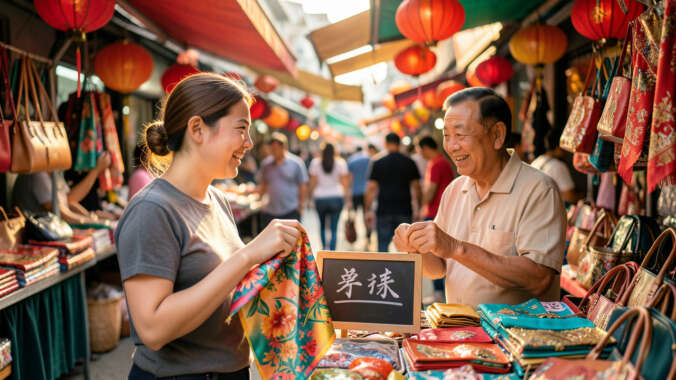
This is the heart of the shopping interaction in many places. Bargaining is a dance. You make an offer, they counter, and you eventually meet in the middle.
Using these phrases keeps the negotiation moving smoothly and respectfully.
Remember to smile and stay calm. The tone of your voice matters as much as the words. A friendly, persistent tone works much better than an angry or demanding one.
| Your Move | Mandarin Phrase (Pinyin) | Tactical Note |
|---|---|---|
| State your target price. | zhège jiàgé kěyǐ ma? (.这个价格可以吗?) | Start at 40-60% of their asking price. Be specific. |
| Make a final offer. | Zhè shì wǒ de zuìhòu jiàgé. (这是我的最后价格。) | Use this with a serious but friendly expression. It often ends the haggling. |
| Ask for a discount on multiple items. | Wǒ yào liǎng gè, néng piányi yīdiǎn ma? (我要两个,能便宜一点吗?) | Bundling items is a powerful way to get a better unit price. |
| Suggest splitting the difference. | Gè tuì yībù ba. (各退一步吧。) | Literally “each take a step back.” A fair compromise phrase. |
| Walk away slowly. | Nà suàn le. (那算了。) | Say this softly as you turn. If your price was reasonable, they may call you back. |
Never offer a price you’re not willing to pay. If you name a number, be prepared to buy the item at that price if the vendor agrees. This maintains your credibility.
Warning: Do not bargain aggressively or play games in stores with fixed prices (like large supermarkets or chain stores). It can be seen as rude. Bargaining is primarily for markets, street vendors, and small independent shops.
How Do You Confirm the Final Price and Quantity?
After you’ve agreed on a price, you must confirm it clearly to avoid any “surprise” fees or misunderstandings. This is where repeating the number and using confirmation words becomes essential. Never assume the deal is sealed until you’ve confirmed these details.
Vendors are often juggling multiple customers. A clear, repeated confirmation helps everyone stay on the same page and prevents accidental overcharges.
- Confirming the price for one item: ” kuài, duì ma?” (.块,对吗?). “块” (kuài) is a common, casual word for yuan/money. “Duì ma” means “correct?”
- Confirming the total for multiple items: “Yīgòng kuài, duì ma?” (一共.块,对吗?). “Yīgòng” means “altogether” or “total.”
- Checking if it includes everything: “Hái yǒu qítā fèi yòng ma?” (还有其他费用吗?) – “Are there any other fees?” Important for items that might need a case, battery, or shipping.
- Confirming the item itself: “Jiù shì zhège ma?” (就是这个吗?) – “Is it just this one?” Make sure the product in your hand is the one you negotiated for.
Once confirmed, you can proceed to payment. Point to your phone or wallet and say “Fùkuǎn” (付款) which means “to pay.” The vendor will guide you through the process, often via QR code.
Where Should You Bargain and Where Should You Not?
Context is everything. Using bargaining phrases in the wrong setting can lead to awkwardness or embarrassment. Knowing the difference between a bargaining zone and a fixed-price zone is as important as the language itself.
General rule: The more informal and open the setting, the more likely bargaining is expected. The more formal, branded, or corporate the setting, the less likely it is.
- Good for Bargaining:
- Street markets and night markets
- Temple and tourist area markets
- Small, independent shops selling handicrafts, clothing, or souvenirs
- Vendor stalls selling food, drinks, or small trinkets
- Some electronics “mom and pop” shops (be cautious with large purchases)
- No Bargaining (Fixed Prices):
- Large supermarkets and department stores
- Franchise convenience stores (7-Eleven, FamilyMart)
- Branded retail shops in malls
- Restaurants and cafes
- Transportation (taxis, trains, planes)
- Hotels
- Any place with clearly printed, non-negotiable price tags on every item
In these fixed-price establishments, the phrase “Zhège duōshao qián?” is still perfectly valid and necessary. Just remove the bargaining phrases from your mental toolkit for these visits.
What Phrases Help with Special Shopping Situations?
Sometimes you need more than just bargaining skills. You might be looking for a specific size, asking about materials, or needing to return an item. These phrases handle common special scenarios you might encounter during your shopping adventures.
Having a few of these ready can save you a lot of time and confusion, especially in clothing stores or when buying items with specific features.
| Situation | Mandarin Phrase (Pinyin) | What It Means |
|---|---|---|
| Asking for a different size | Yǒu dà yīdiǎn / xiǎo yīdiǎn de ma? (有大一点/小一点的吗?) | “Do you have a bigger/smaller one?” |
| Asking about colors | Yǒu qítā yánsè ma? (有其他颜色吗?) | “Do you have other colors?” |
| Trying something on | Wǒ kěyǐ shì ma? (我可以试吗?) | “Can I try it on?” Point to yourself. |
| Asking about materials | Zhè shì shénme cái zhì de? (这是什么材质的?) | “What material is this made of?” |
| Asking about a return policy | Kěyǐ tuì huò ma? (可以退货吗?) | “Can I return the goods?” Best used in fixed-price stores. |
Remember, in most market bargaining situations, returns are not possible. Always inspect items carefully before you agree to a price and pay. The phrase “Wǒ xiān kànkan” (我先看看) – “I’ll look first” is your best friend here.
Important: When trying on clothes, always ask “Shìyī jiān zài nǎlǐ?” (试衣间在哪里?) – “Where is the fitting room?” before you start.
How Can You Practice and Remember These Key Phrases?
Memorizing a long list of phrases can feel daunting. The good news is you don’t need to be perfect. Focus on the core phrases for greetings, asking prices, and basic negotiation.
Your effort will be rewarded with smiles and better deals.
The key is to practice in low-pressure situations first. Use the phrases with friendly vendors where the stakes are low, like buying a bottle of water or a small snack. Build your confidence incrementally.
- Create a cheat sheet: Write down the Pinyin and characters for the 10 most essential phrases on a small card or in your phone’s notes app.
- Use a language app: Apps like Duolingo, HelloChinese, or Pleco have modules on shopping phrases and flashcards you can review.
- Role-play with a friend: Have a friend play the vendor. Practice asking “How much?” and responding to “Too expensive.”
- Listen and repeat: Watch travel vlogs about shopping in China. Listen to how native speakers say the phrases and repeat them out loud.
- Start small: Your first real practice can be buying fruit at a market. It’s a low-cost, low-risk way to use “duōshao qián” and “piányi yīdiǎn.”
Don’t be afraid of making mistakes. Locals appreciate any attempt to speak their language. Even if you forget a phrase, using gestures, a smile, and a few key words like “qián” (money) and “duōshao” (how much) will get you surprisingly far.
Frequently Asked Questions
Is bargaining rude in China?
No, bargaining is not considered rude in appropriate settings. It is a normal and expected part of the culture at street markets, tourist areas, and small shops. However, it is rude to bargain in fixed-price stores like supermarkets or major retail chains.
Always gauge the environment before starting to negotiate.
What if I don’t agree with the vendor’s final price?
If you cannot agree on a price, it is perfectly acceptable to politely walk away. You can say “Nà suàn le” (那算了 – “Then forget it”) or simply “Xièxie” (谢谢 – “Thank you”) and smile as you leave. Often, if your offer was reasonable, the vendor might call you back with a better deal as you walk away.
Can I use my phone to show numbers or translate?
Yes, absolutely. Using your phone’s calculator to type in a price is a very common and accepted practice. For more complex communication, translation apps like Google Translate can help, but relying solely on them can slow down the interaction.
It’s better to know the key phrases yourself and use the app only for backup.
Are prices in tourist areas always inflated?
Yes, initial asking prices in major tourist areas are often significantly inflated, sometimes by 200-300%. This is why bargaining is not just acceptable but necessary. Your goal is to bring that inflated price down to a more reasonable level through negotiation.
Always be prepared to counter-offer firmly.
What is the best way to pay for purchases?
Mobile payment via QR code (WeChat Pay or Alipay) is ubiquitous. For foreign visitors, carrying cash (RMB) is still essential, especially at smaller vendors. Larger stores may accept international credit cards.
Always confirm payment method by asking “Kěyǐ sǎo ma?” (可以扫吗? – “Can I scan?”) or paying with cash when in doubt.
Final Thoughts
Armed with these essential Mandarin shopping phrases, you can navigate markets and stores with confidence and cultural respect. Remember the core steps: greet warmly, ask clearly, negotiate politely, and confirm everything before paying. The goal is a fair transaction where both you and the vendor feel good about the exchange.
Your language skills will enhance your travel experience far beyond just saving money.