Symbolism of Bamboo in Chinese Art and Life
Bamboo symbolism runs deep in the cultural fabric of China, representing a powerful blend of virtues that have shaped art, philosophy, and daily life for millennia. More than just a plant, bamboo is a character in China’s grand story, a silent teacher of resilience and grace.
This post explores the rich meanings behind this iconic plant. You will discover how its qualities translate into visual art, poetry, and personal ethics. We will break down its core symbolic attributes and see how they appear in different contexts.
Simply put, bamboo symbolizes integrity, resilience, humility, and flexibility in Chinese culture. Its hollow interior represents an open mind, while its evergreen nature signifies eternal youth. Artists and scholars have used it for centuries to convey these profound virtues.
Key Takeaways
- Bamboo symbolism centers on the virtues of integrity, resilience, humility, and flexibility.
- In art, bamboo is a primary subject of the “Four Gentlemen,” representing moral character through painting and calligraphy.
- The plant’s physical traits, like hollow stems and evergreen leaves, are directly linked to philosophical ideals.
- Bamboo appears in countless idioms, poems, and architectural designs, influencing daily Chinese life.
- Understanding this symbolism provides deep insight into traditional Chinese values and aesthetics.
The imagery of bamboo is a cornerstone of traditional Chinese aesthetics. Its presence in art is not merely decorative; it is a language of its own, communicating complex ideas about human character through simple, elegant forms.
Here, we delve into the historical and philosophical roots of this enduring symbol. You will learn to identify bamboo in art and understand the specific virtues it is meant to represent.
What is Bamboo Symbolism in Chinese Culture?
At its core, bamboo symbolism in Chinese culture is the practice of attributing human virtues to the plant’s natural characteristics. It is a form of personification deeply embedded in Confucian, Taoist, and Buddhist thought. The plant’s behavior becomes a metaphor for how a person should conduct themselves.
This symbolism is ancient, dating back over 3,000 years. Early texts like the “Classic of Poetry” already used bamboo as a poetic device. Over time, it evolved into one of the most recognized and potent symbols in East Asian art.
Several key attributes make bamboo a perfect vessel for these ideas. Its physical form provides clear, direct parallels to philosophical concepts. Artists and thinkers chose bamboo because its story is told through its very structure.
- Hollow Stem: Represents an open, humble heart and mind, free from prejudice and ego.
- Segmented Nodes: Symbolize integrity and a steady progression in life or learning, with each node marking a stage of growth.
- Evergreen Foliage: Stands for constancy, perseverance, and eternal youth, staying vibrant through harsh winters.
- Flexibility: The stalk bends in strong winds without breaking, embodying resilience, adaptability, and the strength of yielding.
- Growth Speed: Some species grow incredibly fast, symbolizing rapid progress, potential, and vitality.
| Bamboo Trait | Symbolic Meaning | Cultural Context |
|---|---|---|
| Hollow Center | Openness, Humility | Confucian self-cultivation |
| Firm Nodes | Integrity, Resolution | Scholarly determination |
| Bends but Doesn’t Break | Flexibility, Resilience | Taoist wu wei (effortless action) |
| Evergreen Leaves | Perseverance, Loyalty | Enduring friendship |
This table summarizes the direct link between the plant’s biology and the cultural messages it conveys. Each physical trait serves as a visual shorthand for a complex virtue.
How Does Bamboo Symbolism Function in Chinese Art?
In Chinese art, bamboo functions as more than a subject; it is a direct portrait of a scholar’s or artist’s inner character. The “Scholarly Art” tradition is built on this premise. Painting bamboo is an exercise in expressing one’s own moral standing through brushwork.
The technique itself is symbolic. The artist must capture the bamboo’s spirit in few, confident strokes. This requires the same clarity of mind and sincerity that the bamboo represents.
A sloppy or hesitant brushstroke reveals a lack of discipline.
Tip: When viewing a Chinese bamboo painting, look at the brushwork. Strong, vertical strokes for the stalk suggest firmness and uprightness. Quick, pointed strokes for the leaves convey a sharp, keen mind.
The most famous association is the “Four Gentlemen” (四君子), a group of plants each symbolizing a virtue. Bamboo is one of the four, along with the plum blossom, orchid, and chrysanthemum. Together, they represent the full year and the complete spectrum of noble qualities.
- Bamboo (Summer): Represents integrity, modesty, and resilience.
- Orchid (Spring): Symbolizes refinement, modesty, and friendship.
- Chrysanthemum (Autumn): Stands for fortitude, optimism, and endurance.
- Plum Blossom (Winter): Embodies perseverance, hope, and purity.
Within the Four Gentlemen, bamboo’s summer association links it to vitality and growth. Artists often depicted it in groves or with birds to add layers of meaning. A bamboo grove with a magpie might symbolize a happy event approaching.
What Are the Core Virtues Represented by Bamboo?
Bamboo’s symbolism crystallizes into four primary virtues that are universally recognized. These virtues form the bedrock of its meaning and are the lens through which its presence is interpreted in all forms of culture.
Understanding these core traits allows you to decode the message in a painting, a poem, or even a garden design. Each virtue is interconnected, painting a picture of an ideal person.
- Integrity and Strength of Character (节 – Jié): This is perhaps the most valued virtue. The segmented nodes are seen as markers of moral uprightness and a steadfast character that does not waver under pressure. The phrase “bamboo character” is used to describe someone of unwavering principle.
- Humility and Openness (虚 – Xū): The hollow stem signifies an empty mind ready to receive knowledge and a heart free from arrogance. This aligns with both Confucian humility in learning and Taoist emptiness as a source of potential.
- Resilience and Flexibility (韧 – Rèn): The ability to bend in the storm and spring back unharmed is a powerful metaphor for enduring hardship. It represents the wisdom to yield without breaking, a crucial skill in navigating life’s challenges.
- Modesty and Unpretentiousness (朴 – Pǔ): Bamboo grows in simple, unassuming clusters. It doesn’t show off flashy flowers but maintains its clean, elegant lines throughout the year. This reflects the ideal of quiet worth over superficial display.
Warning: In some contexts, bamboo can also imply stubbornness or inflexibility if its upright nature is taken to an extreme. A truly balanced interpretation appreciates both its firmness and its ability to bend.
These virtues are not isolated. The hollow, open heart (humility) allows one to learn and grow strong nodes (integrity). This inner strength provides the resilience to bend without breaking.
The entire structure works together as a holistic model for personal development.
How is Bamboo Symbolism Used in Architecture and Daily Life?
Beyond high art, bamboo’s symbolism permeates the practical and spiritual spaces of Chinese life. In architecture, the plant is both a building material and a philosophical statement. Bamboo groves are essential features in classical scholar gardens, creating a meditative atmosphere that encourages contemplation of the virtues they represent.
Walking through a bamboo grove was considered an exercise in self-reflection. The sound of wind through the leaves, the filtered light, and the straight, towering stalks all worked together to inspire feelings of tranquility, resilience, and mental clarity.
In daily life, the symbolism appears in language and customs. Numerous Chinese idioms (chengyu) incorporate bamboo to make a point about character or situations.
- 胸有成竹 (xiōng yǒu chéng zhú): “To have a fully formed bamboo in one’s mind.” This means to have a well-thought-out plan before taking action.
- 势如破竹 (shì rú pò zhú): “Like splitting bamboo.” This describes an irresistible momentum or an easy victory after breaking through the first resistance.
- 竹报平安 (zhú bào píng’ān): “Bamboo reports peace.” Historically, firecrackers were made from bamboo; the explosive sound was said to ward off evil and announce safety.
| Area of Life | Expression of Bamboo Symbolism |
|---|---|
| Garden Design | Planted to create a microcosm for contemplation; its sound and form induce calm and reflection on resilience. |
| Language & Idioms | Used in over 30 common idioms to describe planning, victory, integrity, and family news. |
| Festivals | Firecrackers (originally bamboo) used to scare away evil spirits; symbolizes protection and peace. |
| Material Culture | Used for everything from writing brushes to furniture, representing practicality, strength, and a connection to nature. |
This table shows how the abstract virtues of bamboo are translated into tangible aspects of life, from the spaces people inhabit to the language they use.
Why Does Bamboo Remain a Powerful Symbol Today?
In contemporary China and across the global Chinese diaspora, bamboo symbolism has not faded. Instead, it has adapted to new contexts. In a fast-paced modern world, its message of resilience and inner peace resonates even more strongly.
The “bamboo mindset” is sometimes invoked in business psychology as a model for adaptive leadership.
Modern artists continue to explore bamboo themes, often blending traditional techniques with new media. Its image appears in modern graphic design, tattoos, and home decor, serving as a cultural anchor for those seeking connection to traditional values.
Important: The universality of bamboo’s virtues is key to its enduring power. The need for integrity, humility, and resilience transcends specific historical periods, making the symbol perpetually relevant.
Furthermore, as an eco-friendly and rapidly renewable resource, bamboo aligns with modern sustainability values, adding a new layer to its symbolic meaning of harmony with nature. It represents a bridge between ancient wisdom and contemporary challenges.
The symbol’s adaptability ensures its continued use. It can convey traditional respect in a formal setting or offer a message of personal fortitude on a social media post. Its visual language is instantly recognizable and carries a weight of meaning that requires no explanation within the culture.
How Do You Interpret Bamboo in a Painting?
Interpreting bamboo in a Chinese painting involves looking at its presentation, composition, and accompanying elements. The artist’s choices add specific nuances to the broad symbolic base. A single, upright stalk speaks differently than a swaying grove.
Consider the following elements when viewing bamboo artwork. They provide clues to the intended message and the artist’s state of mind.
- Brushwork Quality: Strong, confident lines indicate resolve and clarity. Softer, wetter ink might suggest a more lyrical or emotional approach.
- Composition: Is the bamboo solitary or in a group? A solitary bamboo emphasizes individual integrity. A grove may symbolize community, family, or a scholarly gathering.
- Season and Weather: Bamboo in rain or snow highlights resilience in adversity. Bamboo in a gentle breeze might symbolize flexibility and ease.
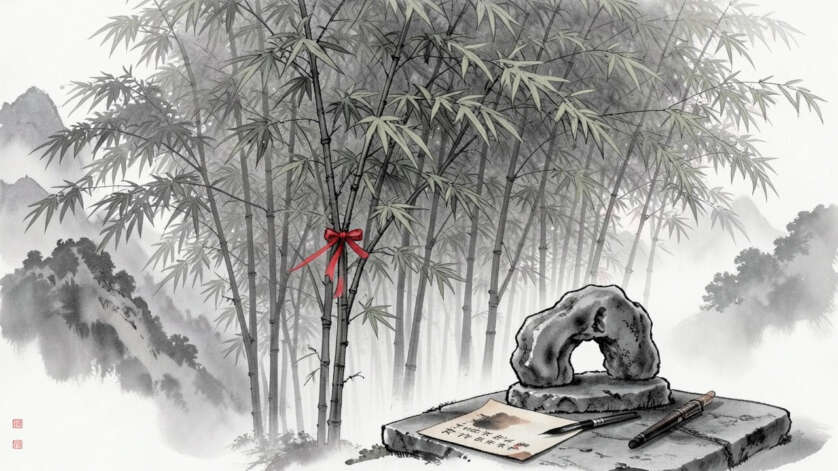
- Accompanying Elements: Pairings are crucial. With a rock, it suggests steadfastness. With a bird, it adds a narrative or auspicious meaning. With the moon, it evokes solitude and contemplation.
- Space and Emptiness: The blank paper (white space) around the bamboo is as important as the inked lines. It represents the Tao, the void, and the potential from which all things arise.
Frequently Asked Questions
What are the “Four Gentlemen” in Chinese art?
The “Four Gentlemen” are four plants that symbolize core virtues in Chinese culture. They are bamboo (integrity), plum blossom (perseverance), orchid (refinement), and chrysanthemum (optimism). Each is associated with a season and is a staple subject in the “scholarly painting” tradition.
Why is bamboo associated with scholars and intellectuals?
Bamboo’s hollow stem symbolizes an open mind ready to learn, and its upright growth represents integrity. For scholars, who valued moral character as much as intellectual pursuit, bamboo was the perfect emblem. Painting it was a way to demonstrate their own refined spirit and adherence to Confucian ideals.
Can bamboo symbolize negative traits?
While overwhelmingly positive, in some contexts bamboo can imply inflexibility or stubbornness if its uprightness is taken to an extreme without the balancing virtue of yielding (bending). However, the most common interpretation emphasizes the balance between firmness and flexibility.
How is bamboo used in Feng Shui?
In Feng Shui, bamboo is considered a powerful symbol of growth, protection, and positive energy (Qi). Lucky bamboo plants are often arranged in specific numbers of stalks to invite different blessings like wealth, health, or love. It is believed to attract prosperity and shield a home from negative energy.
What is the difference between bamboo and plum blossom symbolism?
Both are virtues, but they are expressed differently. Bamboo symbolizes integrity and resilience through its physical form in everyday life. The plum blossom, which blooms in winter snow, symbolizes perseverance, hope, and the ability to flourish in harsh, unlikely conditions.
One is about steadfast character, the other about hopeful renewal.
Final Thoughts
The symbolism of bamboo in Chinese art and life is a profound testament to the human desire to find moral guidance in nature. Its virtues of integrity, humility, and resilience offer a timeless blueprint for character. From an ink painting on a scroll to a grove in a modern garden, bamboo continues to whisper these ancient lessons.
By understanding this symbol, you gain a key to unlock deeper appreciation in Chinese aesthetics and philosophy. The silent bamboo stands as an enduring guide, teaching that true strength lies in flexible uprightness and an open, ever-growing heart.