Why Bats Are Considered Lucky Symbols in Chinese Culture
Why bats are a symbol of luck in China is a question that reveals a fascinating blend of language, art, and cultural beliefs. Many Western cultures view bats with fear, but in Chinese tradition, they represent profound good fortune. This post explores the linguistic roots, historical significance, and modern presence of this powerful auspicious symbol.
Simply put, bats are considered lucky in China because the Chinese word for bat, “fu,” sounds identical to the word for good fortune or blessing. This homophonic link transformed the creature into a beloved emblem of joy, prosperity, and positive wishes, making its image a common feature in art, textiles, and decor.
Key Takeaways
- The primary reason for the bat’s lucky status is linguistic: the Chinese character for bat (蝠, fú) is a homophone for the character for fortune (福, fú).
- This auspicious meaning is reinforced by the bat’s association with longevity and its perceived positive qualities in some folk beliefs.
- You will find stylized bat motifs everywhere, from ancient royal robes and porcelain to modern Lunar New Year decorations and jewelry.
- A common design is a cluster of five bats, representing the “Five Blessings” or “Five Fortunes”: longevity, wealth, health, love of virtue, and a natural death.
- This symbolic tradition is a perfect example of how cultural context, rather than inherent traits, determines an animal’s symbolic meaning.
What is the Cultural Origin of the Bat Symbol in China?
The bat’s role as a lucky charm in China is rooted deeply in the Chinese language itself. It is a classic example of how wordplay shapes cultural iconography. The connection is not based on the animal’s behavior or appearance, but purely on sound.
This symbolic association began centuries ago, likely during the Ming and Qing dynasties when decorative arts flourished. Artisans and scholars embraced homophones to create visual rebuses—pictures that represent words or phrases. The bat became a convenient and elegant way to depict a wish for good fortune without writing it out directly.
- Linguistic Foundation: The character 蝠 (fú) for bat is pronounced identically to 福 (fú), meaning “good fortune” or “blessing.”
- Visual Rebus: Showing a bat in a painting or pattern was a subtle and artistic way to express a wish for luck for the viewer.
- Scholarly Adoption: This clever wordplay was appreciated by the educated class, helping to elevate the bat from a common creature to a refined symbol.
- Folk Transmission: The meaning was easily understood and passed down through generations, embedding itself in popular culture.
- Contrast with West: This highlights how symbolism is culturally constructed; the same animal holds opposite meanings in different societies.
The power of this homophone is so strong that it overrides any negative physical associations. The bat’s nocturnal habits and eerie appearance are simply irrelevant when its very name sounds like “happiness” and “fortune.”
How Does Bat Symbolism Connect to Other Auspicious Concepts?
Beyond the basic “bat = fortune” link, the symbol’s meaning expands when combined with other elements. Chinese symbolic art is rarely about a single image; it’s about creating layers of meaning. The bat often partners with other auspicious symbols to form complex, positive messages.
| Combination Element | Resulting Symbolic Meaning |
|---|---|
| Bat with Peony | Wealth and honor (blessing + the “king of flowers”). |
| Bat with Peach | Blessing of longevity (fortune + symbol of immortality). |
| Bat with Coin | Blessing of wealth (fortune + symbol of money). |
| Bat with Ruyi Scepter | May all your wishes be granted (fortune + the “as-you-wish” object). |
| Bat Entering a Door | “Fortune has arrived at your home” (a direct visual pun). |
This practice of symbolic combination allows for highly personalized and context-specific blessings. A gift for a new business might feature bats and coins, while a wedding present could combine bats with peonies.
Why Are Five Bats a Particularly Powerful Motif?
While a single bat represents good fortune, a group of five bats creates one of the most significant and concentrated symbols of blessing in Chinese culture. This motif, known as the “Five Blessings” (Wufu 五福), directly ties the bat to a complete system of Confucian ideals for a perfect life.
The “Five Blessings” are traditionally defined as: longevity (shou 寿), wealth (fu 贵), health and peace (kang ning 康宁), love of virtue (xiu hao de 修好德), and a natural, peaceful death (zhong ming zhong 考终命). This comprehensive list covers the full span of a well-lived life.
- Longevity (寿): The wish for a long and full life. This is often represented by the peach or the character 寿 itself.
- Wealth (贵): Not just money, but also status, honor, and noble standing in society. Coins and the ruyi scepter can symbolize this.
- Health and Peace (康宁): The blessing of good health and a tranquil, worry-free existence. This is a foundation for enjoying life.
- Love of Virtue (修好德): The aspiration to cultivate moral character and be a person of integrity and goodness.
- Natural Death (考终命): The blessing of a peaceful end to life, without accident or prolonged suffering. This completes the cycle.
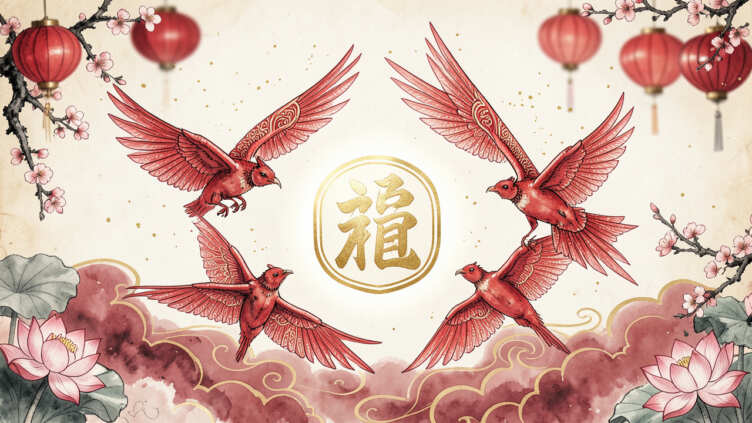
Depicting five bats together, often in a circular or symmetrical pattern, is a powerful visual prayer that encompasses every key aspect of human aspiration. It’s a holistic blessing for a complete and happy destiny.
Where Can You Find Bat Symbols in Chinese Art and Objects?
The lucky bat motif is not hidden; it is proudly displayed across centuries of Chinese material culture. Its presence serves both a decorative and a talismanic purpose, wishing good fortune upon the owner or viewer. You will encounter it in both grand imperial settings and humble folk crafts.
| Object/Setting | How Bat Symbols Are Used |
|---|---|
| Textiles & Robes | Embroidered in gold thread on court robes, signifying imperial favor and blessing. Often in symmetrical patterns on hems and collars. |
| Ceramics & Porcelain | Painted on vases, plates, and bowls. Commonly in red (the color of joy) or as underglaze blue motifs. |
| Architectural Details | Carved into wooden beams, painted on ceiling panels, or shaped as roof tiles, especially in temples and palaces. |
| Folk Arts | A central motif in paper-cutting (jianzhi), New Year prints, and shadow puppets, making the blessing accessible to all. |
| Jewelry & Accessories | Carved from jade, made into pendants, or crafted as hairpins, worn as personal amulets for luck. |
| Modern Decor | Featured in Lunar New Year decorations, window clings, and home decor items like pillows and wall hangings. |
The sheer variety of its application demonstrates how deeply the symbol is woven into the fabric of Chinese visual tradition.
Tip: When viewing traditional Chinese art, look closely at borders, corners, and background patterns. Bats are often subtly included as a background element, creating a field of hidden blessings.
What is the Modern Significance and Perception of Bat Symbols?
In contemporary China, the bat symbol remains a vibrant and actively used emblem of good fortune. Its ancient meaning is not a relic; it is a living tradition that adapts to modern life. During festivals, especially Lunar New Year, bat imagery experiences a major resurgence.
You will see festive red banners (fai chun) featuring bats alongside characters for prosperity. It’s common in the design of red envelopes (hongbao), greeting cards, and festive clothing. The symbol has also been embraced by modern designers, appearing in everything from trendy fashion prints to contemporary home decor, often in a stylized or abstract form.
- Festival Use: Central to Lunar New Year and Mid-Autumn Festival decorations, renewing wishes for the coming year.
- Gift-Giving: Items featuring bats are given as gifts for weddings, housewarmings, and birthdays to bestow blessings.
- Commercial Branding: Some Chinese brands use bat motifs in their logos or product designs to evoke tradition and good luck.
- Cultural Identity: The symbol serves as a point of cultural recognition and pride, connecting modern Chinese people to their heritage.
- Global Influence: As Chinese culture gains global popularity, bat lucky symbols appear in international fashion and art, carrying their positive meaning outward.
The symbol’s endurance proves its emotional resonance. It succinctly packages a profound and positive cultural sentiment into a single, recognizable image.
How Does Bat Symbolism Compare to Other Cultures?
Understanding the lucky bat in China becomes even clearer when contrasted with its symbolism elsewhere. Cultural interpretation is subjective, and the bat is a prime example of how the same creature can embody opposing values.
| Culture/Tradition | Symbolism of Bats | Key Reason |
|---|---|---|
| Traditional China | Extreme good luck, blessing, fortune | Homophone (fú = fortune) |
| Western Cultures | Often fear, darkness, vampires, Halloween | Nocturnal nature, association with caves/abandoned places |
| Ancient Greece | Association with the underworld and the soul | Nocturnal flight seen as a journey to Hades |
| Some Native American Tribes | Communication with spirits, rebirth, intuition | Ability to navigate in darkness; connection to night world |
| Modern Pop Culture | Mixed: superhero (Batman), still spooky (horror) | Largely influenced by Western cinematic tropes |
This stark contrast underscores that symbolic meaning is never inherent. It is assigned by human culture, language, and narrative. The Chinese bat’s luck is a product of linguistic ingenuity, not zoology.
Why Does This Ancient Symbol Remain Relevant Today?
The staying power of the lucky bat symbol in a rapidly modernizing China speaks to a deep human need for continuity and positive psychological anchoring. In a world of constant change, traditional symbols offer a sense of stable identity and inherited wisdom.
The bat motif provides a direct, visual connection to ancestral hopes and values. Using it in modern life is a way of saying, “We carry forward the blessings and wisdom of our past.” Furthermore, its aesthetic appeal—the elegant curves and the joyous red color it’s often paired with—ensures it remains pleasing and desirable in contemporary design.
- Psychological Comfort: Displaying a luck symbol can create a positive mindset and a sense of agency over one’s fortune.
- Cultural Continuity: It acts as a thread linking today’s celebrations to centuries of tradition.
- Aesthetic Versatility: The stylized form of the bat lends itself well to both classic and minimalist modern designs.
- Universal Aspiration: The “Five Blessings” represent goals (health, wealth, virtue) that are timeless and cross-cultural.
- Brand of Chineseness: Internationally, it has become a recognizable icon of Chinese cultural heritage.
Important: To fully appreciate the symbol, one must suspend Western perceptions. Judging the Chinese lucky bat through a Western lens of fear or darkness misses its entire cultural logic and profound positive meaning.
What Are Common Misconceptions About Chinese Bat Symbols?
For those unfamiliar with the cultural context, several misunderstandings can arise regarding the bat’s lucky status. Clarifying these points is key to accurate cultural appreciation.
- Misconception: The meaning is universal.
Reality: The positive symbolism is culturally specific to China and countries influenced by its culture. In other regions, bats hold different or negative connotations.
- Misconception: Chinese people are not afraid of real bats.
Reality: Cultural symbolism is separate from personal experience. A person can appreciate the symbolic “lucky bat” on a vase while still being cautious of a real bat in their attic. The symbol is an artistic and linguistic abstraction.
- Misconception: It’s an old, dead tradition.
Reality: As shown, the symbol is actively used in contemporary festivals, gifts, and design, constantly being reinterpreted by new generations.
- Misconception: The symbol is only about money.
Reality: While wealth is one blessing, the “Five Blessings” encompass a much broader definition of a successful life, including health, virtue, and a peaceful end.
- Misconception: Every image of a bat is meant to be lucky.
Reality: Context matters. A bat in a traditional auspicious pattern is a blessing. A bat used in a horror movie poster is leveraging its Western spooky connotation for a different audience.
Frequently Asked Questions
Why is the bat a symbol of good luck in China and not elsewhere?
The primary reason is linguistic. In Mandarin Chinese, the word for bat (fú 蝠) is a perfect homophone for the word for good fortune (fú 福). This sound connection transformed the animal into a visual rebus for blessing.
This specific linguistic link does not exist in other languages, so the symbol did not develop.
What do the “Five Blessings” represented by five bats actually mean?
The Five Blessings (Wufu) are a comprehensive Confucian ideal for a perfect life. They are: longevity (a long life), wealth (status and means), health and peace (physical and mental well-being), love of virtue (moral character), and a natural, peaceful death. Together, they signify a complete and auspicious destiny.
Are there any animals considered unlucky in Chinese symbolism?
Yes, some animals carry negative connotations, often due to homophones or perceived traits. For example, the number four (sì) sounds like “death” (sǐ), so anything associated with four can be avoided. White cats are sometimes seen as unlucky because “cat” (māo) can imply “trouble” (māo), though this varies by region.
Generally, symbolism is complex and context-dependent.
How has the meaning of the bat symbol changed over time in China?
The core homophonic link has remained strong for centuries. What has changed is its application. Historically prominent in imperial and scholarly art, it democratized over time to become a staple of folk art and festive decoration.
Today, it is both a cherished traditional motif and a graphic element in modern commercial design, maintaining its auspicious core meaning throughout.
Can I use a bat symbol in my own decor if I’m not Chinese?
Absolutely, as long as you do so with cultural awareness and respect. Understanding that it represents profound good fortune in Chinese culture allows you to appreciate it beyond a mere “spooky” or “exotic” design element. Using it as a thoughtful nod to Chinese aesthetics or as a personal charm for luck is perfectly fine when approached with appreciation rather than appropriation.
Final Thoughts
The journey of the bat from a nocturnal creature to a revered symbol of luck in China is a testament to the power of language and cultural perspective. Its meaning is woven from the clever twist of a homophone, creating a visual language of blessing that has adorned everything from imperial robes to modern greeting cards. Recognizing the bat as a carrier of the “Five Blessings” offers a window into a holistic and aspirational view of a good life.
So the next time you see this elegant motif, you’ll understand it not as a creature of the night, but as a flying wish for enduring fortune.