The Meaning Behind the Double Happiness Symbol Explained
The double happiness symbol is one of the most recognizable icons in Chinese culture, instantly evoking images of joy, celebration, and marital bliss. This ancient character, known as “shuang xi” (囍), is a powerful emblem used primarily in weddings and romantic unions. It represents a deep-seated cultural belief that the union of two people creates a multiplier effect of happiness, not just for the couple but for both families involved.
Understanding its origins and proper use offers a fascinating glimpse into traditions that have shaped celebrations for centuries.
Simply put, the double happiness symbol (囍) is a traditional Chinese character representing profound joy and is overwhelmingly associated with weddings. It is formed by two “joy” (喜) characters side-by-side, symbolizing the doubled fortune that comes from the union of two people and their families.
Key Takeaways
- The double happiness symbol is a ligature of two “joy” characters, representing the amplification of happiness through marriage.
- It is a cornerstone of Chinese wedding traditions, used decoratively on invitations, gifts, and venue decor.
- The symbol’s use is governed by traditional etiquette, emphasizing correct placement and context.
- Modern interpretations have expanded its use to broader celebrations of partnership and shared success.
- Understanding this symbol provides insight into collectivist values where family and communal joy are paramount.
What is the Double Happiness Symbol and Its Origin Story
The symbol’s origin is often tied to a popular folk tale from the Tang Dynasty. The story tells of a scholar who, while traveling to the capital for his imperial examinations, stopped at an inn owned by an elderly couple with a beautiful, intelligent daughter. The scholar and the daughter fell in love. Before leaving to take his exams, the scholar wrote two lines of a poem, each containing the character for joy (喜). The first line read: “The moon is bright in the sky.” The daughter, understanding the hidden meaning, replied with the second line: “A scholar at the door.”
When the scholar returned a year later, having passed the highest exam, he found the daughter had cleverly combined the two “joy” characters from their exchanged poems into the single, symmetrical character 囍. This reunion, celebrating both academic success and romantic union, gave the symbol its powerful association with double joy and a happy marriage.
The symbol itself is not a standard character found in classical dictionaries but is a creative combination. Its perfect symmetry and balanced structure are visually pleasing and reflect core philosophical concepts.
- Structural Components: Two identical “xi” (喜) characters are joined, often with the vertical strokes overlapping or sharing a common center.
- Cultural Meaning: The duality represents the bride and groom, two families joining, and the balance of yin and yang energies.
- Historical Context: Its use became widespread during the Ming and Qing dynasties as wedding customs became more elaborate and codified.
Tip: The traditional color for the double happiness symbol is red, which itself symbolizes luck, joy, and vitality in Chinese culture. Using other colors like gold or black can change its connotation.
How is the Double Happiness Symbol Used in Modern Weddings?
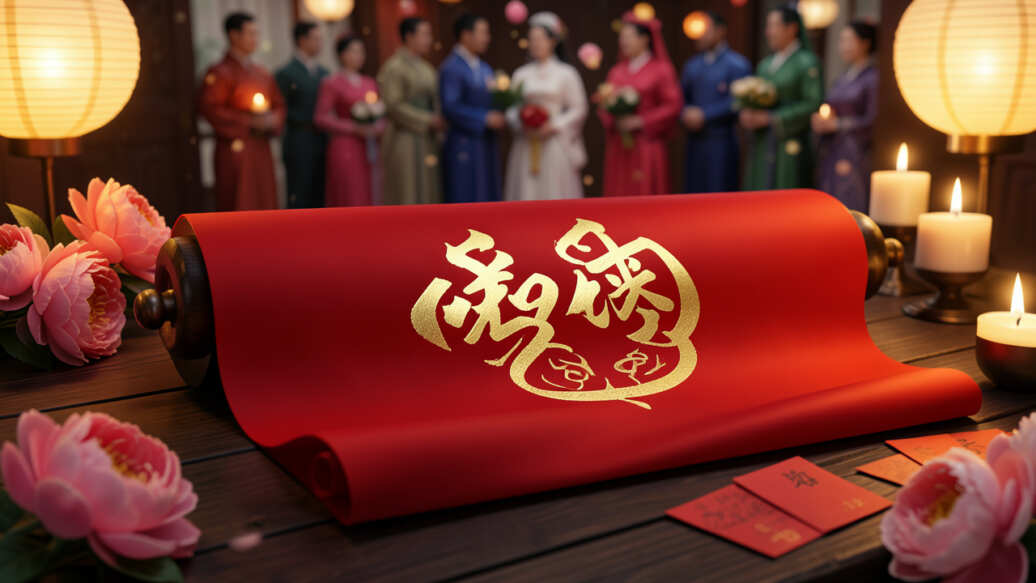
Today, the symbol remains ubiquitous in Chinese wedding ceremonies, blending ancient tradition with contemporary style. Its application is multifaceted and serves both decorative and symbolic purposes. According to cultural guides from China Highlights, its presence is considered essential for a “proper” Chinese-style wedding.
The most common applications include:
- Wedding Invitations (请柬): Often printed prominently in red ink at the top or center of the invitation card.
- Door Decorations: Large paper-cut symbols are affixed to the doors of the couple’s new home, sometimes upside-down to symbolize “happiness has arrived” (福倒了 sounds like 福到了).
- Wedding Venue: Draped on walls, hung from ceilings, or incorporated into stage backdrops and table centerpieces.
- Red Envelopes (红包): Gift money from guests is often placed in red envelopes stamped with the symbol.
- Bridal Attire: The character is frequently embroidered on the traditional Chinese wedding dress, the qipao, or the groom’s changshan.
- Wedding Cakes & Favors: Modern bakers and hosts incorporate the symbol into cake toppers, cookies, or small guest gifts.
It is crucial to observe proper etiquette. The symbol should never be used inauspiciously—for example, it is never used on funereal items or in contexts unrelated to joyous unions. Its association is strictly with legitimate, celebrated partnerships.
| Traditional Usage | Modern Adaptation |
|---|---|
| Paper-cuts pasted on doors and windows | Acrylic or wooden laser-cut signs for venue decor |
| Embroidered on bridal quilts and dowry items | Custom stamps for wedding photo albums or Instagram hashtags |
| Painted on ceramic plates given as gifts | Minimalist line-art version on modern wedding stationery |
| Carved into wooden bedposts of the nuptial bed | Huge illuminated installation art at the ceremony entrance |
This table illustrates how the core symbol has been reimagined for contemporary aesthetics while maintaining its traditional significance.
Why Does the Double Happiness Symbol Hold Such Cultural Weight?
The enduring power of the double happiness symbol stems from its alignment with fundamental Chinese philosophical and social values. It is more than decoration; it is a visual affirmation of core beliefs.
- Communal Harmony over Individualism: The symbol emphasizes that the marriage unit is a joining of families, not just two individuals. The “double” joy extends to parents, grandparents, and the wider community.
- Balance and Symmetry: Chinese aesthetics and philosophy deeply value balance, akin to the yin-yang principle. The perfectly mirrored halves of the symbol represent harmony, equality, and the complementary nature of a marital partnership.
- Auspiciousness and Hope: Displaying the symbol is an active invocation of good fortune. It is believed to attract positive energy (qi) and bless the couple’s future with prosperity and many offspring.
- Visual Language: In a culture where such symbols are rich with meaning, the character acts as a powerful, non-verbal communicator of the event’s significance and the community’s well-wishes.
Important: The symbol’s importance is so ingrained that omitting it from a traditional Chinese wedding could be seen as an oversight or even an inauspicious sign. It fulfills a symbolic checklist for a complete ceremony.
What Are the Common Mistakes to Avoid When Using the Symbol?
While the symbol’s use is widespread, there are specific traditional guidelines that, if ignored, can be considered disrespectful or unlucky. Awareness of these nuances shows cultural sensitivity.
The primary mistake is using it in the wrong context. The double happiness symbol has a very specific semantic field: celebratory, romantic, marital unions.
- Incorrect Color: Using it in white, black, or blue for decor. Red is the traditional and most appropriate color.
- Inappropriate Placement: Placing it on footwear, cleaning supplies, or other items that could be considered degrading. It should be displayed with respect in clean, elevated spaces.
- Using for Non-Marital Events: It is not for birthday parties, business openings, or graduation celebrations, even though they are happy occasions. Its “double joy” is specific to the joy of partnership.
- Distortion or Disrespectful Alteration: While modern adaptations exist, dramatically altering the core structure into an unrecognizable form strips it of meaning. Similarly, using it in a disrespectful or humorous context is taboo.
- Improper Orientation: Unlike the character “fu” (福), the double happiness symbol is not typically displayed upside-down for meaning. It is usually shown right-side up and symmetrical.
How Does the Double Happiness Symbol Compare to Other Wedding Emblems?
Globally, wedding symbols often focus on unity or love. The double happiness symbol is distinct in its emphasis on amplified communal joy and its specific phonetic-visual construction.
| Symbol/Emblem | Primary Culture | Core Meaning |
|---|---|---|
| Double Happiness (囍) | Chinese | Doubled joy from union of two people/families |
| Interlocking Rings | Western/Global | Eternal, unbroken bond and commitment |
| Mangalsutra | Hindu (Indian) | Sacred thread symbolizing marital status and protection |
| Meganei (目抜) | Japanese (via China) | “Seeing each other” – a commitment to mutual understanding |
This comparison highlights how the Chinese symbol is uniquely character-based and focuses on the quantitative concept of “doubling” positive emotion, rather than just the qualitative aspect of the bond itself.
Who Actually Uses This Symbol Today, and Beyond China?
The symbol’s use is not confined to mainland China. Its reach extends across the Chinese diaspora and has been adopted in other East Asian cultures influenced by Chinese traditions.
- The Chinese Diaspora: Communities in Taiwan, Singapore, Malaysia, and Western countries use it to maintain cultural connections during weddings.
- Vietnamese Culture: Known as “song hỷ” (double joy), it is used similarly in Vietnamese weddings (đám cưới).
- Korean Culture: Borrowed as “ssanghui” (쌍희), it appears in some traditional Korean wedding contexts.
- Global Events: It has made appearances in multicultural weddings and by designers seeking to incorporate East Asian aesthetic elements.
Warning: When using the symbol in a cross-cultural context, it is best to research and respect its traditional roots. Using it purely as a “pretty design” without acknowledging its meaning can be seen as cultural appropriation.
Frequently Asked Questions
Is the double happiness symbol only for weddings?
Primarily, yes. Its deep association with the “double joy” of marital union makes it overwhelmingly a wedding symbol. While its components represent general happiness, the specific 囍 ligature is reserved for celebrating the formal partnership of two people.
Can non-Chinese people use the double happiness symbol?
Absolutely, especially in multicultural ceremonies. The key is to use it with understanding and respect for its meaning. It’s a beautiful way to honor Chinese heritage or to simply celebrate the universal concept of shared joy in a unique way.
What is the correct way to write or draw the double happiness symbol?
The correct form is two “joy” (喜) characters placed side-by-side, often with the central vertical strokes connected or overlapping to form a single, symmetrical character. Many calligraphers and designers create stylized versions, but the fundamental two-character structure should remain clear.
Why is red the traditional color for the double happiness symbol?
In Chinese culture, red (红, hóng) is the color of good fortune, joy, vitality, and celebration. It is believed to ward off evil and bring prosperity. Therefore, the double happiness symbol, as an emblem of ultimate joy, is most powerfully expressed in this auspicious color.
Does the double happiness symbol have any religious significance?
It is not tied to a specific religion like Buddhism or Taoism but is deeply rooted in Chinese folk beliefs, Confucian values of family harmony, and cultural superstitions. It represents a secular, philosophical ideal of communal happiness rather than a religious doctrine.
Final Thoughts
The double happiness symbol is far more than a wedding decoration; it is a condensed narrative of Chinese values, emphasizing family, balance, and the multiplicative power of shared joy. Its elegant structure and profound meaning have allowed it to transcend centuries and borders. Whether seen on a wedding invitation in Toronto or a lantern festival in Beijing, it continues to communicate a universal hope: that the union of two hearts creates a wellspring of happiness for everyone around them. Understanding its roots enriches our appreciation of this beautiful tradition.