Lotus Flower Symbolism in Chinese Culture Explained
Lotus flower symbolism in Chinese culture runs deep, representing purity, resilience, and spiritual awakening. This ancient motif appears everywhere from temple art to modern poetry. Understanding its layers of meaning offers a window into core Chinese values and beliefs.
This guide breaks down the lotus’s journey from muddy pond to revered symbol. We explore its philosophical roots, religious significance, and everyday uses. You’ll discover why this flower remains a powerful icon across millennia.
Simply put, the lotus flower in Chinese culture is a potent symbol of purity rising from adversity, moral integrity, and spiritual enlightenment. Its life cycle—growing in mud yet blooming immaculately—mirrors the human journey toward virtue and wisdom in Taoist and Buddhist thought.
Key Takeaways
- The lotus flower primarily symbolizes purity, rebirth, and rising above difficulties in Chinese culture.
- Its meaning is deeply intertwined with both Buddhist and Taoist philosophies, representing enlightenment and harmony.
- Different colors of the lotus carry distinct meanings, from pink for the Buddha to white for mental purity.
- You’ll find the lotus motif everywhere in Chinese art, architecture, jewelry, and idiomatic expressions.
- The concept of “出淤泥而不染” (chū yūní ér bù rǎn) is the core philosophical phrase explaining its symbolism.
What Does the Lotus Represent in Core Chinese Philosophy?
The lotus serves as a living metaphor for foundational philosophical ideas. Its growth pattern directly illustrates key concepts without needing words. Scholars and sages have used it for centuries to teach complex virtues.
The most famous association is with the phrase “出淤泥而不染” (chū yūní ér bù rǎn), meaning “emerging from the mud unsullied.” This idea from the Song dynasty text “Ai Lian Shuo” (爱莲说) by Zhou Dunyi became a cornerstone of Chinese moral philosophy. It teaches that one can live in a corrupt world while maintaining personal integrity.
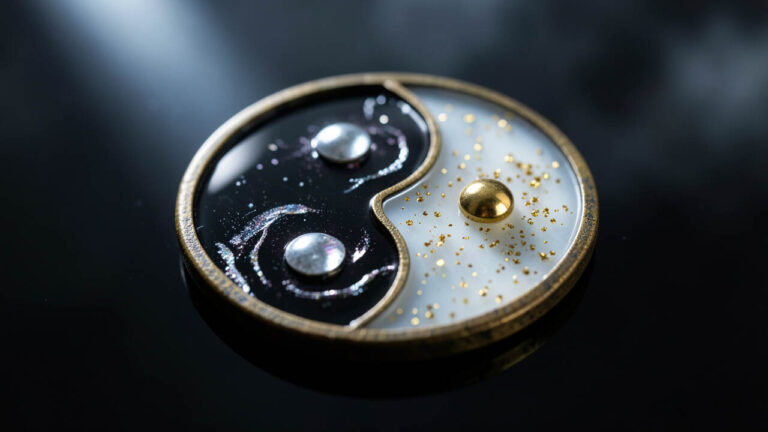
The lotus is also a primary symbol in both Buddhism and Taoism, representing different but complementary paths to wisdom. In Buddhism, it signifies the journey from ignorance to enlightenment. In Taoism, it represents harmony, natural beauty, and the balance of yin and yang.
- Purity & Integrity: Rising above murky conditions without being stained.
- Rebirth & Renewal: The daily cycle of opening at dawn and closing at dusk symbolizes continuous renewal.
- Spiritual Enlightenment: The unfolding petals represent the expansion of the soul and mind.
- Harmony & Balance: Its perfect symmetry reflects Taoist ideals of natural order and equilibrium.
- Noble Character: It became an emblem for the Confucian gentleman (junzi) striving for moral perfection.
Tip: When discussing the lotus in a cultural context, always reference the “Ai Lian Shuo.” It is the foundational text that cemented its philosophical status beyond just a religious symbol.
How Does the Lotus Symbolism Differ Between Buddhism and Taoism?
While both traditions revere the lotus, their interpretations highlight different facets of its meaning. The flower acts as a bridge between these two major belief systems in Chinese culture, often coexisting in the same temples and artworks.
In Buddhism, the lotus is inseparable from the narrative of the Buddha’s birth and enlightenment. It is said that lotuses sprang from the ground where the infant Buddha took his first seven steps. Statues of the Buddha and Bodhisattvas almost universally sit or stand upon a lotus throne, signifying their elevated, enlightened state above the mundane world.
In Taoism, the emphasis is less on transcendent enlightenment and more on natural harmony and virtue. The lotus represents the Taoist sage who moves through life with effortless grace (wu wei), maintaining purity and balance. The flower’s daily opening and closing also mirrors the Taoist concept of cyclical change and the interplay of yin (passive, dark, feminine) and yang (active, bright, masculine).
| Aspect | Buddhist Symbolism | Taoist Symbolism |
|---|---|---|
| Primary Focus | Spiritual enlightenment, purity of mind. | Natural harmony, moral virtue, balance. |
| Core Image | Throne for deities, symbol of Buddha’s teachings. | Embodiment of the ideal gentleman (junzi) in nature. |
| Key Connection | Lotus Sutra, Amitabha Buddha’s Western Pure Land. | Philosophical treatise “Ai Lian Shuo” (爱莲说). |
| Associated Goal | Achieving Nirvana, being reborn in paradise. | Living in accord with the Tao, effortless virtue. |
This table clarifies the nuanced differences. In practice, for most people, these meanings blend into a unified symbol of profound goodness and aspiration.
What Are the Meanings of Different Lotus Colors in Chinese Art?
The color of a lotus in Chinese paintings, ceramics, and textiles is never accidental. Each hue carries a specific symbolic weight that adds another layer to the artwork’s message. Artists use this color code to communicate complex ideas to their audience.
The most common colors are pink, white, red, and blue. Each corresponds to a different aspect of the lotus’s meaning or is associated with a specific deity or concept. Recognizing these color associations deepens your appreciation of traditional Chinese art.
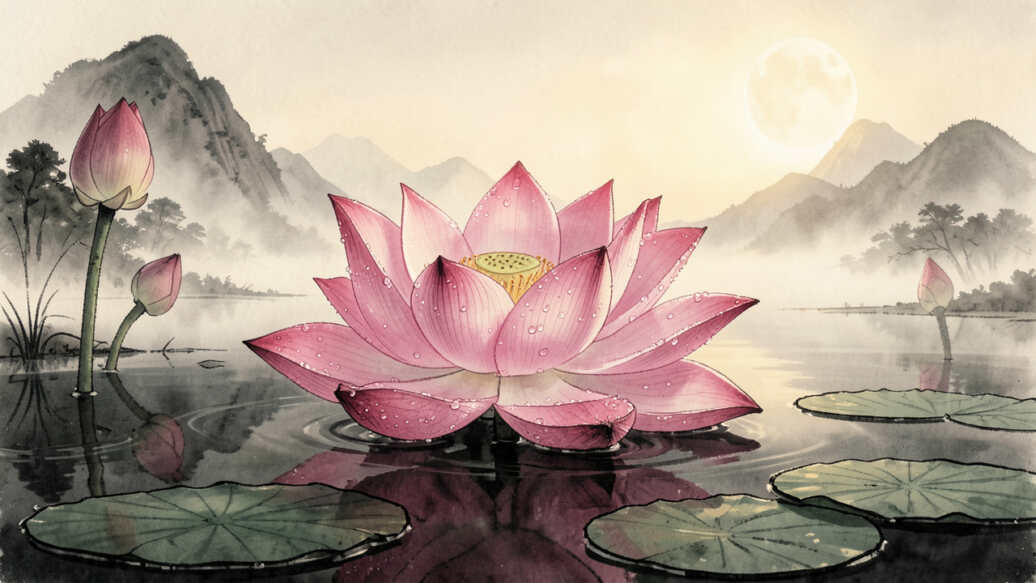
- Pink Lotus: This is the most sacred and common color, directly associated with the historical Buddha, Sakyamuni. It represents the highest deity and the supreme source of wisdom. Statues of the Buddha are almost always depicted on a pink lotus.
- White Lotus: Symbolizes mental purity, spiritual perfection, and the pacification of one’s nature. It is often linked with the Peaceful manifestation of deities and the perfection of the spirit.
- Red Lotus: Represents the heart, love, and compassion. It is often associated with Avalokiteshvara (Guanyin in Chinese), the Bodhisattva of compassion. This color speaks to emotional engagement and heart-centered virtues.
- Blue Lotus: Signifies wisdom, knowledge, and victory over the senses. It is a symbol of the victory of the spirit over the senses and is often shown partially closed, with the center not visible. It is associated with the wisdom of Manjushri.
- Gold Lotus: Represents complete enlightenment and the achievement of spiritual perfection. It is the symbol of the highest form of spiritual attainment.
Important: In many artworks, you may see a lotus depicted with both a seedpod and a blossom. This combination symbolizes cause and effect, past and future, or the connection between wisdom and method.
Why Does the Lotus Appear So Frequently in Chinese Architecture and Design?
The lotus motif’s prevalence in physical spaces is a direct translation of its symbolic importance into the built environment. Its presence serves as a constant visual reminder of cultural and spiritual values. You can spot it in locations ranging from imperial palaces to humble homes.
In architecture, the lotus is used as both a decorative element and a structural one. It appears carved into stone railings of bridges and temples, painted on ceilings of palaces, and molded into the brackets of traditional roofs. Its repeated form creates patterns that are both aesthetically pleasing and rich with meaning.
- Temples and Monasteries: Found on Buddha statues, altars, columns, and roof tiles. It reinforces the sacred atmosphere and Buddhist teachings.
- Imperial Palaces: The Forbidden City contains numerous lotus carvings and motifs, symbolizing the emperor’s purity, virtue, and heavenly mandate to rule.
- Gardens and Ponds: Planting actual lotuses in scholar’s gardens provides a living symbol for contemplation. The garden pond itself can represent the muddy world from which virtue arises.
- Household Items: The motif graces ceramics, furniture, textiles, and wallpaper. It brings the auspicious symbolism of purity and harmony into daily life.
- Coinage and Jewelry: Ancient coins sometimes featured lotus designs, associating wealth with integrity. Jade lotus pendants are worn for protection and moral encouragement.
This ubiquitous presence ensures that the philosophy behind the lotus is woven into the very fabric of traditional Chinese life and landscape.
How Is the Lotus Used in Modern Chinese Culture and Expressions?
The lotus has not remained an ancient relic; its symbolism continues to evolve and thrive in contemporary life. It maintains relevance in language, modern art, celebrations, and even business. This adaptability proves the enduring power of its core message.
In modern usage, the lotus appears in corporate logos for brands wanting to project purity, clarity, or Asian heritage. It is a popular subject for contemporary Chinese ink wash painters who blend traditional themes with new styles. During festivals, particularly the Buddha’s Birthday, artificial lotuses are carried in parades and floated in water.
The most persistent modern use is in language. Several common idioms and phrases derive from the lotus and are heard in everyday conversation.
- “莲莲有鱼” (lián lián yǒu yú): A pun where “lotus” (莲) sounds like “continuous” (连) and “fish” (鱼) sounds like “surplus” (余). This phrase means “may you have abundance year after year,” often said during New Year.
- “并蒂莲” (bìng dì lián): Refers to two lotus flowers growing on one stalk. It is a metaphor for a devoted, harmonious couple or siblings.
- “舌灿莲花” (shé càn liánhuā): Literally “to speak with blossoming lotuses,” describing someone who is eloquent and persuasive, like a monk giving a brilliant sermon.
These expressions keep the ancient symbolism alive in the dynamic flow of modern Mandarin.
What Are the Most Famous Artworks Featuring Lotus Symbolism?
Certain masterworks have immortalized the lotus in Chinese art history. These pieces are not just beautiful; they are philosophical texts painted in color and form. Studying them offers a masterclass in visual symbolism.
The single most important work is Zhou Dunyi’s prose-poem “Ai Lian Shuo” (爱莲说) – “On the Love of the Lotus.” This short text, from the Northern Song Dynasty, is memorized by schoolchildren across China. It explicitly contrasts the lotus with other plants, elevating it as the sole emblem of the noble person’s character. Its opening lines are profoundly famous.
In painting, the lotus has been a staple for centuries. During the Ming and Qing dynasties, court painters like Yun Shouping created exquisitely detailed botanical studies of lotuses. Later, in the 20th century, modern masters like Qi Baishi and Chang Dai-chien incorporated the lotus into their ink wash paintings, using bold, expressive strokes to capture its spirit rather than just its form.
Warning: Be mindful that in some historical contexts, particularly for the common people, the lotus (莲, lián) was a homophone for “link” (连, lián), leading to some folk associations with continuous misfortune. However, the dominant cultural narrative is overwhelmingly positive.
How Does the Lotus Connect to Chinese Literature and Poetry?
Chinese literature is rich with botanical metaphors, and the lotus holds a premier position among them. Poets have used it for over two millennia to explore themes of love, longing, virtue, and sorrow. Its image is both concrete and deeply abstract.
The “Book of Songs” (Shijing), the oldest collection of Chinese poetry from the 11th to 7th centuries BCE, contains one of the earliest poetic references to the lotus. It is used in the context of courtship and longing. Later, during the Tang Dynasty—the golden age of Chinese poetry—the lotus became a more complex symbol.
Poets like Li Bai and Bai Juyi referenced it. Li Bai once wrote of a beautiful woman, comparing her grace to a lotus swaying in the wind. Bai Juyi used the lotus in his famous “Song of Everlasting Regret” to symbolize the pure, untouchable beauty of the imperial consort Yang Guifei.
- Symbol of Feminine Beauty: Often used to describe a woman’s graceful bearing and pure heart.
- Metaphor for Sorrow: The shedding of lotus petals could mirror the shedding of tears or the passing of time.
- Image of Solitude: A single lotus in a vast pond could represent the poet’s own isolated integrity.
- Reminder of Transience: The fleeting bloom of the lotus often prompted reflections on the impermanence of life and beauty.
The literary lotus is as multifaceted as the flower itself, offering poets a versatile tool to express the depths of human emotion.
Frequently Asked Questions
What is the most famous Chinese saying about the lotus?
The most famous saying is “出淤泥而不染” (chū yūní ér bù rǎn), which means “emerging from the mud unsullied.” It comes from Zhou Dunyi’s “Ai Lian Shuo” and encapsulates the core symbolism of maintaining purity and integrity despite a corrupt environment.
Is the lotus only a Buddhist symbol in China?
No. While it is a paramount Buddhist symbol, the lotus is equally important in Taoism and secular Chinese philosophy. It represents natural harmony in Taoism and moral virtue in Confucian thought.
Its symbolism transcends any single religion, embodying broader cultural ideals.
Why is the lotus associated with purity when it grows in mud?
This is precisely the source of its powerful symbolism. The lotus demonstrates that something of exquisite beauty and perfection can arise from murky, dirty conditions. It serves as a metaphor for the human potential to transcend difficult circumstances and achieve a state of grace and virtue.
Where can I see lotus symbolism in China today?
You can see it everywhere. Visit any Buddhist temple for architectural motifs and statues. Look for it in traditional gardens, on jewelry in antique markets, in the patterns of silk fabrics, and even in modern logos and graphic design.
It remains a living symbol.
Does the lotus have any practical uses besides symbolism?
Yes, the lotus is highly practical. Its seeds and root (lotus root) are staple foods in Chinese cuisine. Lotus seedpaste is a popular filling for mooncakes and pastries.
The leaves are used to wrap foods for steaming, imparting a subtle fragrance. The plant has also been used in traditional medicine.
Final Thoughts
The lotus flower stands as one of the most eloquent symbols in Chinese culture. Its meaning, rooted in philosophy, religion, and art, continues to inspire and instruct. From the muddy pond to the gilded temple, it tells a timeless story of purity, resilience, and enlightenment.
By understanding the lotus flower symbolism, you gain insight into the values that have shaped Chinese civilization. Its image serves as a gentle, constant reminder of the highest aspirations of the human spirit.