
The Difference Between Feng Shui Schools: Form vs Compass
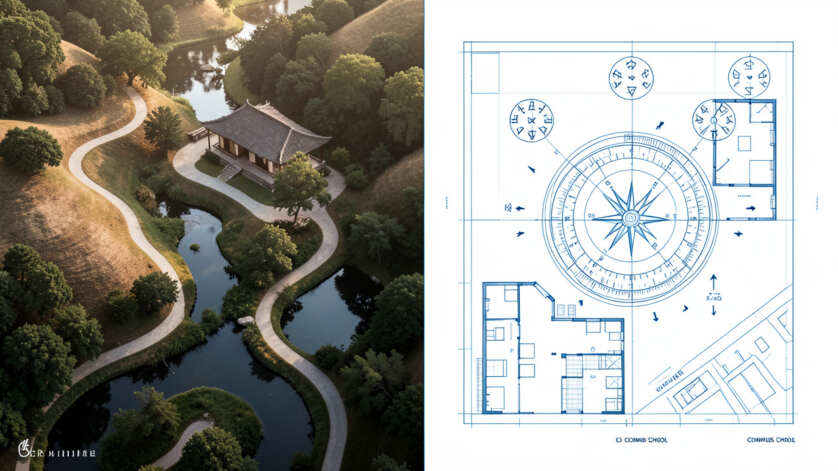
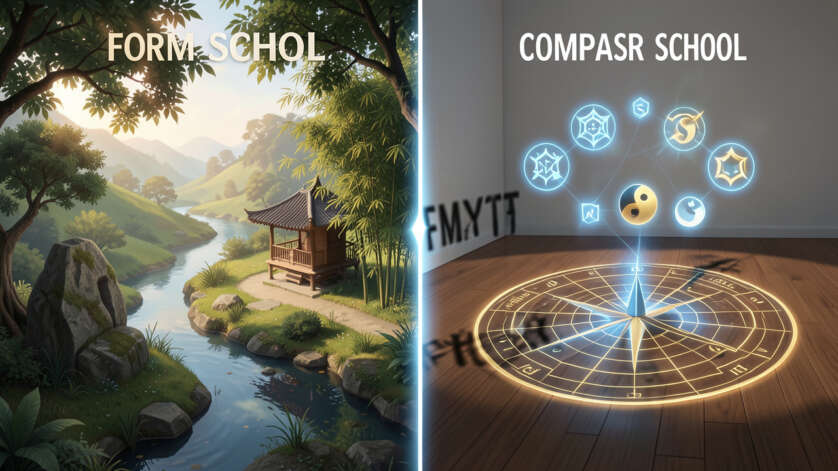
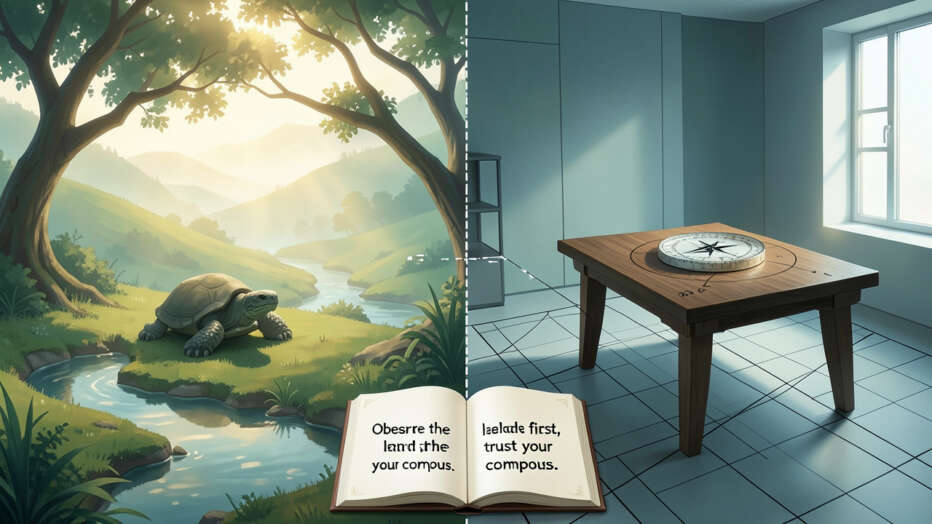
The two main schools of feng shui, Form (Xing Fa) and Compass (Li Qi), differ fundamentally in methodology: Form School assesses physical land shapes and surrounding structures to evaluate Qi, while Compass School relies on precise cardinal direction measurements from a Luo Pan compass and time-based formulas like Flying Stars. Form School provides an intuitive, observational foundation rooted in ancient burial practices, whereas Compass School offers a systematic, mathematical approach incorporating time and space. Recognizing the distinction allows practitioners to correctly interpret environmental energies and choose suitable techniques for specific spaces.
Feng Shui is not a single, unified practice. Two very different paths lead to the same goal of creating harmony in your space. This guide examines the difference between Feng Shui schools: Form vs Compass so you can understand and apply these traditions correctly.
Quick Verdict: The Form School visually analyzes the landscape and physical shapes around a building to assess Qi energy. The Compass School uses the Luo Pan compass to measure precise cardinal directions and applies time-based calculations like Flying Stars. Form School is observational and intuitive. Compass School is mathematical and systematic. Both aim to create harmony.
Key Takeaways
- The Form School focuses on the physical shapes, contours, and features of the land and surrounding structures to determine Qi flow.
- The Compass School relies on the Luo Pan compass for precise direction readings and uses complex formulas like the Flying Stars system.
- Form School is considered the older, more intuitive foundation of Feng Shui, with roots dating back thousands of years to ancient Chinese burial practices.
- Compass School incorporates space and time calculations, making it a more dynamic and mathematically rigorous system for modern environments.
- Most serious modern practitioners combine both schools to get a complete understanding of a property’s energy blueprint.

What Is Feng Shui
Feng Shui translates to “wind and water.” It is an ancient Chinese practice that aims to harmonize individuals with their surrounding environment. According to, the flow of Qi (vital energy) through a space directly impacts your health, wealth, and relationships.
Classical Feng Shui breaks down into two dominant branches. Understanding the difference between Feng Shui schools: Form vs Compass is your first step toward mastering either path. The Form School originated first. The Compass School developed later as technology advanced.

What Is the Form School (Xing Fa)
The Form School is the original Feng Shui. It relies entirely on observation of the physical environment. You do not need a compass. You need your eyes and an understanding of natural archetypes.
The foundational text of Form School is the Zang Shu (Book of Burial), attributed to the scholar Guo Pu in the 4th century. Guo Pu described how the shape of mountains and the flow of water determine the quality of Qi in a location. The core teaching revolves around the Four Celestial Animals.
The Four Celestial Animals
This system describes the ideal land formation for a home or grave. The practitioner imagines the site as a throne protected by symbolic animals.
| Animal | Direction | Physical Form | Purpose |
|---|---|---|---|
| Black Turtle | Behind (North) | High mountain or tall building | Support and protection |
| Azure Dragon | Left (East) | Rolling hills or adjacent building | Strength and stability |
| White Tiger | Right (West) | Lower hill or shorter building | Control and safety |
| Red Phoenix | Front (South) | Open space or low lying area | Opportunity and clarity |
Form School also evaluates the specific shapes of mountains and structures. Peaks are categorized into the Five Stars based on the Five Elements (Wu Xing). A sharp, pointed peak is Fire element. A flat, squarish peak is Earth element. Each shape creates a different type of Qi influence on the occupants.
Tip: Start your Feng Shui studies with the Form School. Go for a walk in your neighborhood. Notice which buildings have a tall structure behind them and an open field in front. This is the armchair formation. It is the most basic and powerful protection pattern.

What Is the Compass School (Li Qi)
The Compass School is the mathematical branch of Feng Shui. It emerged prominently during the Song Dynasty. This school uses the to determine the exact orientation of a building. It then applies complex formulas to calculate how energy moves through that space over time.
Unlike Form School, Compass School is invisible. You cannot see the energy patterns it describes. You must calculate them. This makes it a very technical practice that rewards precision and study.
Core Methods of the Compass School
The Compass School contains several powerful subsystems. Understanding the difference between Feng Shui schools: Form vs Compass means recognizing that Compass methods rely heavily on direction and time.
- Eight Mansions (Ba Zhai): This method divides people into East Group and West Group based on their Kua number. It also divides the home into eight sectors. Specific doors, beds, and stoves must be placed in favorable directions for the occupants.
- Flying Stars (Xuan Kong Fei Xing): This is the most advanced Compass method. It creates a chart based on the construction period of the building and its facing direction. The stars move through the chart annually and monthly. This system tracks the rise and fall of different energies in a house.
- The Trigrams (Ba Gua): The Compass School uses the Later Heaven (Postnatal) Ba Gua sequence. This sequence maps the eight trigrams around the compass. Each trigram represents a family member and a life aspect. A practitioner measures the direction of the main door to determine which trigram energy dominates the home.
Warning: Do not use a standard smartphone compass for Flying Stars readings. The magnetic interference inside modern buildings and the metal in your phone distort the reading. You need a traditional Luo Pan or a professional quality compass calibrated for Feng Shui.
Quick Comparison Table: Form vs Compass
| Feature | Form School | Compass School |
|---|---|---|
| Primary Tool | Eyes and observation | Luo Pan compass |
| Focus | External landscape and shapes | Internal energy distribution and time |
| Methodology | Intuitive and archetypal | Mathematical and systematic |
| Time Element | Static (landscape is fixed) | Dynamic (energies shift yearly) |
| Origin Date | 4th century (Guo Pu) | Song Dynasty (960-1279 AD) |
| Best For | Rural properties, house hunting | Apartments, urban planning, timing |
Key Differences Between Form and Compass School
The difference between Feng Shui schools: Form vs Compass goes deeper than just tools. They represent two different philosophies about how energy operates in the world.
Methodology: Intuition vs Mathematics
Form School is an art of perception. You train your eye to recognize shapes. You feel the Qi by looking at the balance of Yin and Yang in the landscape. A winding river path is auspicious. A straight road pointing at the door is a poison arrow. You learn to see these patterns instantly.
Compass School is a science of calculation. You must measure the exact degrees of your front door. You memorize the sequence of stars. You calculate the monthly movements. According to the International Feng Shui Guild, over 70% of professional consultants use a combination of both methods to provide accurate advice. Intuition alone is not enough for Compass work.
The Role of Time
Form School treats the environment as a static object. The mountain behind your house stays there for generations. The Qi cycle is slow and stable.
Compass School introduces dynamic time. The Flying Stars chart for a house built in Period 8 is different from a house built in Period 9. The energy of the front door changes every year. This allows a Compass practitioner to predict good and bad fortune cycles with incredible specificity.
Handling Modern Urban Environments
In a dense modern city, Form School can struggle. You cannot see a mountain if you live on the 20th floor of a steel and glass tower. The landscape is man-made. A Form School practitioner must interpret roads as rivers and skyscrapers as mountains.
Compass School thrives in this environment. The practitioner ignores the shapes and focuses entirely on the directional coordinates of the apartment. They calculate the Flying Stars chart for the specific floor plan. This gives them a pure energetic map of the space, regardless of the external chaos.
Important: A Compass chart without Form School context can be dangerous. If you place a wealth cure in the living room based on a Flying Stars chart, but the external environment has a hospital or cemetery facing that window, the cure may not work. Context matters.
Common Myths vs Facts
Myth: Compass School is more accurate than Form School
Fact: Accuracy depends on context. Form School provides the macro-level health of a site. Compass School provides the micro-level details of the floor plan. A site with poor Form (like a house at a T-junction) will have bad Qi, regardless of what the Compass chart says. Form comes first.
Myth: You can use any compass for Feng Shui
Fact: A standard hiking compass only shows magnetic north. A contains multiple concentric rings. These rings display the 24 Mountains of the compass, the Trigrams, and the Heavenly Stems. A regular compass lacks the data needed for the Eight Mansions and Flying Stars calculations.
Myth: Form and Compass schools are incompatible
Fact: Most classical Feng Shui masters use a synthesized approach. You check the external landscape using Form principles. Then you verify the facing direction and internal layout using Compass principles. They work together like the hardware and software of a computer.
Pro Tips for Beginners
- Learn the Four Celestial Animals perfectly before touching a Luo Pan. Walk through different neighborhoods. Identify the Black Turtle behind houses and the Red Phoenix in front. This builds your intuitive foundation.
- Buy a proper Luo Pan compass. Do not rely on a phone app for accuracy. A basic 10-inch Luo Pan is sufficient for learning the rings and taking reliable readings.
- Practice Form School everywhere. Look at the shapes of windows, roofs, and doors. Notice how a square window feels different from a pointed arch. This is Form School in action.
- Keep a journal of your Flying Stars observations. Track how the energy shifts in your home over the course of a year. You will see patterns emerge that match the classic texts.
- Study the Five Elements until they become second nature. The generating and controlling cycles are the grammar of all Feng Shui formulas.
Tip: When taking a compass reading, stand outside the main door. Face the direction the building is facing. Hold the Luo Pan at waist level. Ensure no large metal objects are nearby. Take the reading three times to confirm you have a consistent number.
Frequently Asked Questions
Can I use both Form and Compass schools at the same time?
Yes. Most experienced practitioners use a combined method. Form School evaluates the external environment. Compass School calculates the internal energy blueprints. According to Master Derek Walters, author of The Feng Shui Handbook, this provides a complete 360-degree view of a property’s energy system.
Which school is older, Form or Compass?
Form School is significantly older. Its principles were recorded in the Zang Shu by Guo Pu in the 4th century. Compass School became prominent during the Song Dynasty with the refinement of the Luo Pan compass. Form School is the mother of all Feng Shui.
Does the Compass School require me to know the exact birthdates of the occupants?
Some branches require it. The Eight Mansions method uses your birth year to calculate your personal Kua number. The Flying Stars method primarily uses the construction date of the building. Both systems rely on structured calculations derived from the compass and time.
Is Form School just about common sense?
Not exactly. Some principles align with intuitive design. Protecting your back with a wall makes you feel safe. However, Form School has a specific vocabulary and set of archetypes that require formal study. The Five Stars landforms (Wood, Fire, Earth, Metal, Water peaks) are not obvious at first glance.
Which school is better for a small apartment?
Both are useful. Form School helps analyze the building’s external shapes and the interior layout. Compass School determines the auspicious sectors for the main door, kitchen, and bedroom within the specific floor plan. A combination gives you the best results.
Final Thoughts
Form School and Compass School offer two distinct paths to the same goal. Form School roots you in the immediate, physical world of shapes and landscapes. Compass School connects you to the invisible forces of direction and time. The best path combines the wisdom of both traditions for a complete practice.