How Shanghainese Differs From Standard Mandarin
Shanghainese and Standard Mandarin are both Chinese languages, but they belong to distinct dialect groups and differ profoundly. While Mandarin is the official national language, Shanghainese is a major dialect of the Wu Chinese family, spoken by millions in Shanghai and its surrounding regions. Understanding these differences is crucial for linguists, language learners, and anyone interacting with the rich cultural tapestry of China.
This post breaks down the core distinctions between Shanghainese and Standard Mandarin. We will explore their unique phonetic systems, tonal structures, vocabulary, and grammatical rules. You will learn why mutual intelligibility is low and what makes Shanghainese a fascinating linguistic system in its own right.
Simply put, Shanghainese and Standard Mandarin are not mutually intelligible. They are distinct languages with different sound systems, tones, and grammar. A Mandarin speaker cannot understand Shanghainese without specific training, just as an English speaker cannot understand Japanese.
Key Takeaways
- Shanghainese belongs to the Wu Chinese dialect group, while Standard Mandarin is based on the Northern Mandarin dialect.
- The phonetic inventory of Shanghainese includes voiced consonants (like ‘b’, ‘d’, ‘g’) and a glottal stop, features absent in Standard Mandarin.
- Tonal systems differ dramatically: Mandarin uses four main tones, while Shanghainese has five tonal categories that interact to create complex sandhi rules.
- Vocabulary and common expressions are often completely different, requiring speakers of one language to learn the other from scratch.
- Grammar shows subtle but important variations in word order and the use of certain particles, affecting sentence construction.
What is Shanghainese? A Wu Chinese Dialect
Shanghainese, or Shanghainese Wu, is the primary language of the Shanghai metropolitan area. It is a representative dialect of the Wu Chinese group, one of the major language groups in China. With over 14 million native speakers in the region, it is one of the most widely spoken Chinese dialects after Mandarin.
Its classification places it in the Taihu cluster of Wu Chinese, sharing similarities with dialects in Suzhou, Wuxi, and Hangzhou.
The language’s development is deeply tied to Shanghai’s history as a trading port and cultural hub. It absorbed influences from neighboring dialects and even foreign languages during the international settlement period. This history gives Shanghainese a unique character distinct from both ancient Chinese and modern Mandarin.
Core Linguistic Features of Shanghainese
- Phonology: Features voiced initial consonants (b, d, g) and a glottal stop (ʔ) that cuts off syllables sharply.
- Tones: Possesses five fundamental tone categories which combine through “tone sandhi” rules, changing tones based on adjacent syllables.
- Vocabulary: Retains many archaic Chinese words not used in modern Mandarin and has its own colloquialisms.
- Writing: Is written using Chinese characters, but pronunciation is entirely different from the Mandarin reading of those characters.
- Social Status: Historically prestigious locally, but now faces pressure from the nationwide promotion of Standard Mandarin.
Tip: When writing Shanghainese, speakers often use a system of Romanized characters (Shanghainese Romanization) to approximate pronunciation for learners, as standard Pinyin is designed for Mandarin.
What is Standard Mandarin? The National Language
Standard Mandarin, or Putonghua, is the official standardized form of Chinese. It is based on the phonology of the Beijing dialect and uses the grammar of modern vernacular literature. As the language of government, education, and national media, it serves as the lingua franca across China, enabling communication among people who speak different local dialects.
There are over 900 million native Mandarin speakers globally.
Its development was a deliberate 20th-century project to unify the linguistically diverse nation. The Mandarin taught in schools and broadcast on television is the standardized version everyone is expected to learn, regardless of their native dialect. This promotion has led to a generational shift where younger urban residents may be bilingual or dominant in Mandarin.
Defining Characteristics of Standard Mandarin
- Phonology: Lacks voiced initial consonants and the glottal stop. The sound system is relatively simpler compared to Wu dialects.
- Tones: Has four main tones (flat, rising, falling-rising, falling) plus a neutral tone. Tones are applied consistently to each syllable.
- Vocabulary: Continuously absorbs new terms and has a standardized, evolving lexicon for modern concepts.
- Grammar: Well-defined and standardized, following rules established in modern written Chinese.
- Promotion: Actively promoted through national education policies, creating a common medium for communication.
How Does Shanghainese Differ From Standard Mandarin Phonetically?
The most immediate and striking difference lies in the sound systems. Phonetics and phonology form the core barrier to mutual intelligibility. Shanghainese preserves certain consonant sounds from Middle Chinese that have been lost in the evolution of Mandarin.
The overall “feel” of the language is softer and more murmuring due to these phonetic features.
For learners, this means that even if two languages share the same written Chinese characters, they will be pronounced in completely different ways. The following table summarizes some key consonant differences.
| Feature | Shanghainese | Standard Mandarin |
|---|---|---|
| Voiced Initials (b, d, g) | Present (e.g., 白 baq pronounced ) | Absent, become aspirated (bái ) |
| Glottal Stop (ʔ) | Common, ends many syllables | Does not exist |
| Velar Nasal (ŋ) as initial | Common (e.g., 我 ngu) | Only appears as syllable final |
| Syllable Complexity | Can have complex onsets and codas | Simpler structure (C)(G)V(C) |
According to linguistic studies published in the Journal of Chinese Linguistics, the preservation of voiced consonants in Wu Chinese dialects like Shanghainese is a key marker of their historical development from Middle Chinese. This phonetic conservatism makes them invaluable for historical linguistics research.
Additional Phonetic Distinctions
- Vowel Sounds: Shanghainese has a richer vowel inventory, including sounds not found in standard Pinyin.
- Syllable-Finals: Extensive use of the glottal stop as a syllable-final consonant creates a distinctive “clipped” sound.
- Nasalization: Vowels can be heavily nasalized, a feature less prominent in Mandarin.
- Initial Cluster Reduction: Shanghainese sometimes allows consonant combinations that Mandarin does not.
Warning: Assuming that because the characters are the same, the pronunciation will be similar, is a major mistake. The phonetic gap between Shanghainese and Mandarin is comparable to that between Spanish and French.
Why are the Tonal Systems So Different?
Tone is fundamental to meaning in both languages, but their systems operate on different principles. Standard Mandarin’s four tones are relatively stable and applied per syllable. Shanghainese employs a “tone sandhi” system where the tone of a syllable is determined by the tones of neighboring syllables in a phrase.
This creates a rhythmic, flowing quality but makes learning individual character tones less useful in isolation.
The tonal categories also map differently to Middle Chinese tone classes. This historical divergence means a high-level tone in Mandarin might correspond to a rising or falling tone in Shanghainese for the same original word.
Comparison of Tonal Categories
| Category | Shanghainese (Wu) | Standard Mandarin |
|---|---|---|
| High Level Tone | Exists (e.g., 诗 sy) | 1st Tone (high-level) (shī) |
| Rising Tone | Exists (e.g., 时 zy) | 2nd Tone (rising) (shí) |
| Dipping/Falling-Rising | Merged or less distinct | 3rd Tone (falling-rising) (shǐ) |
| Falling Tone | Exists (e.g., 是 zyq) | 4th Tone (falling) (shì) |
| Entering Tones (checked) | Very prominent (syllables ending in -q, -h) | Lost entirely, distributed among other tones |
Research from the Max Planck Institute for Evolutionary Anthropology suggests that the complex tone sandhi in Wu dialects may be a retained feature from earlier stages of Chinese, offering clues to the language’s ancient phonological structure.
How Do Vocabulary and Expressions Compare?
Shared characters do not mean shared words. While both languages use Chinese characters in writing, the spoken vocabulary for common objects, actions, and concepts frequently diverges. Shanghainese has preserved many classical terms while also developing unique local neologisms.
Mandarin has adopted a different set of modern terms, often influenced by English translations.
Basic greetings, numbers, and everyday items often sound entirely different. This vocabulary mismatch means translation between the two is not a simple substitution of sounds.
Examples of Common Vocabulary Differences
- To eat: Shanghainese: “qieq” / Mandarin: “chī”
- To drink: Shanghainese: “tsiq” / Mandarin: “hē”
- Big: Shanghainese: “dú” / Mandarin: “dà”
- To look: Shanghainese: “qí” / Mandarin: “kàn”
- I / Me: Shanghainese: “ngú” / Mandarin: “wǒ”
- Thank you: Shanghainese: “zeq sheq” / Mandarin: “xièxie”
Important: For official documents, news, and national communication, written Chinese follows Mandarin grammar and vocabulary. Shanghainese is primarily a spoken language, though there is a growing corpus of written literature and online content in dialect.
What are the Grammatical Variations?
While the basic Subject-Verb-Object word order is shared, deeper grammatical structures reveal differences. Shanghainese uses certain grammatical particles and constructions that are either obsolete or non-standard in Mandarin. These subtle differences affect how sentences are built and how meaning is nuanced.
For example, the way to indicate possession or the use of certain verb complements can vary significantly. The language also makes use of specific sentence-final particles that give Mandarin speakers no clue to meaning.
Key Grammatical Distinctions
- Plural Markers: Shanghainese may use different suffixes or rely more on context for plurality.
- Verb Aspect: Particles indicating completion or ongoing action differ in form and usage.
- Object-Marking: The particle used to link verb and object is different (e.g., “e” in Shanghainese vs. “bǎ” or direct placement in Mandarin).
- Comparative Structures: The word for “than” and the construction of comparisons are not the same.
- Sentence-Final Particles: Shanghainese has a unique set of particles for mood, emphasis, and questioning (e.g., “va,” “qieq”).
Studies on dialectal grammar show that these variations are not random but systematic. They represent different evolutionary paths from Old Chinese. For instance, according to research from Fudan University in Shanghai, certain Shanghainese verbal constructions are more conservative, retaining forms that have been streamlined in Standard Mandarin.
Which is Harder to Learn for a Mandarin Speaker?
For a native Standard Mandarin speaker, learning Shanghainese presents a significant challenge primarily due to the complete phonetic and tonal overhaul required. They must “unlearn” their tonal habits and acquire a new set of sounds. Vocabulary acquisition also cannot rely on cognates in the same way it might when learning, for example, Japanese with its Chinese character borrowings.
Grammar adjustments, while less daunting, still require attention. Conversely, a Shanghainese speaker learning Mandarin has a distinct advantage: their dialect already contains many Mandarin phonemes, and they are often exposed to Mandarin through media and education from a young age, making them frequently bilingual.
Learning Difficulty Comparison
| Learner Profile | Primary Challenge | Reason |
|---|---|---|
| Mandarin Speaker → Shanghainese | Phonology & Tone | Must master new sounds (voiced initials, glottal stop) and a complex tone sandhi system. |
| Shanghainese Speaker → Mandarin | Fine-tuning Tones & Vocabulary | Already familiar with many sounds. Challenge is distinguishing Mandarin’s four tones and learning standardized vocabulary. |
| Foreign Learner → Either | Character Learning + New Sound System | Must learn Chinese characters and a unique phonetic system. Resources for Shanghainese are far scarcer than for Mandarin. |
The availability of learning materials is a critical factor. Standard Mandarin has a vast, globally accessible ecosystem of textbooks, apps, and teachers. Shanghainese, being a regional dialect, relies more on community-based transmission and limited online resources.
Why Does This Linguistic Diversity Matter?
The differences between Shanghainese and Mandarin are not just academic curiosity. They are central to the cultural identity of Shanghai. Language carries local history, humor, and social norms.
The decline of dialect proficiency among youth, due to Mandarin promotion, is a concern for cultural preservationists. UNESCO classifies several Chinese dialects, including some Wu varieties, as endangered.
In business and social settings within Shanghai, using Shanghainese can signal local identity and trust, while Mandarin is the tool for broader national engagement. This bilingual reality is a microcosm of the linguistic landscape across China, where local and national identities constantly interact.
The vitality of Shanghainese today is a testament to its deep roots. Efforts by local governments and cultural institutions to document and promote the dialect through broadcasts, literature, and school programs are increasingly common. This balance between national unity and local cultural preservation is an ongoing conversation in modern China.
Frequently Asked Questions
Can Mandarin speakers understand Shanghainese?
No, generally they cannot. The phonetic and tonal differences are too great. While some vocabulary may be recognized, fluent comprehension requires dedicated study.
It is not like understanding a different accent of the same language.
Is Shanghainese considered a separate language or a dialect?
This is a complex political and linguistic question. Linguistically, the differences between Wu Chinese (including Shanghainese) and Mandarin are comparable to those between separate Romance languages like Spanish and Portuguese. However, for national and cultural reasons, it is officially categorized as a dialect of Chinese within China.
How is Shanghainese written?
It uses the same Chinese characters as Mandarin. However, when written, the characters are read using Shanghainese pronunciation, which is completely different. There is no official standardized writing system for the spoken dialect, though romanization systems are used by learners and linguists.
Are young people in Shanghai still learning Shanghainese?
Proficiency has declined significantly among younger generations due to the dominance of Mandarin in schools and media. However, many still understand it passively, and there is a growing movement to revitalize the language through family transmission and local cultural initiatives.
What other major dialect groups exist in China besides Mandarin and Wu?
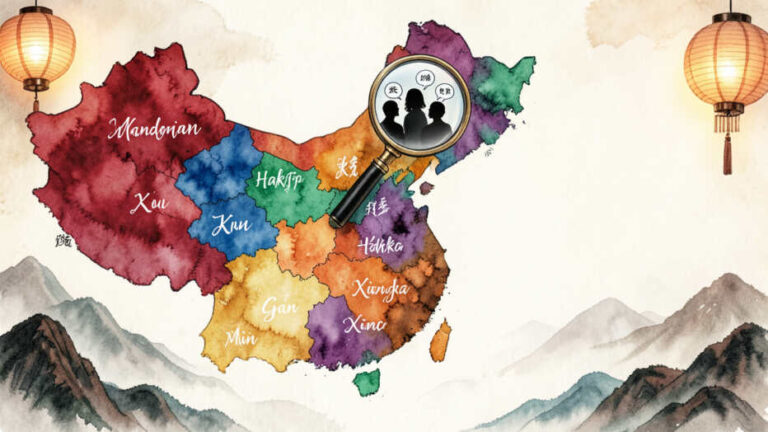
China has seven to ten major dialect groups. Besides Mandarin and Wu (Shanghainese), the largest are Cantonese (Yue) spoken in Guangdong and Hong Kong, Min (which includes Hokkien and Teochew), Hakka, Gan, and Xiang. These groups often have their own internal variations.
Final Thoughts
The distinction between Shanghainese and Standard Mandarin underscores the incredible linguistic diversity within the Chinese language family. From their divergent phonetic roots to their unique tonal melodies and vocabulary, they represent two distinct paths of linguistic evolution. Recognizing these differences enriches our understanding of Chinese culture and history.
As China continues to modernize, the relationship between these languages will keep evolving. Whether as a subject of academic study, a tool for local connection, or a marker of identity, Shanghainese remains a vital part of the nation’s cultural mosaic. Appreciating its unique features alongside Standard Mandarin gives a fuller picture of the living, breathing world of Chinese languages.