The Meaning of the Phoenix in Chinese Culture: Fenghuang Symbolism
The meaning of the phoenix in Chinese culture is deeply woven into mythology, art, and philosophy. Known as the Fenghuang, this majestic bird is not a simple symbol of rebirth like its Western counterpart. It represents a complex ideal of virtue, grace, and celestial harmony, serving as a powerful emblem for centuries.
Understanding the Fenghuang provides a direct window into traditional Chinese values and aesthetics.
Simply put, the Fenghuang is a mythical bird in Chinese culture that symbolizes high virtue, grace, and the union of yin and yang. It is often depicted as a composite of several birds and represents peace, prosperity, and the celestial order.
Key Takeaways
- The Chinese phoenix, called Fenghuang, symbolizes virtue, grace, and cosmic balance, not just rebirth.
- It is traditionally a composite creature, combining features of many birds to represent universal harmony.
- The Fenghuang often pairs with the dragon, where the dragon symbolizes the emperor and the Fenghuang the empress.
- Its image is prevalent in traditional art, bridal dowries, and royal insignia as a harbinger of peace and prosperity.
- The symbolism of the Fenghuang is foundational in understanding traditional Chinese art, architecture, and imperial imagery.
What is the Fenghuang?
The Fenghuang is the avian symbol of Chinese mythology, often translated as the “Chinese phoenix.” However, this translation can be misleading. Unlike the Western phoenix, which dies in flames and is reborn from its ashes, the Fenghuang is a symbol of the sun, the south, and the element of fire in a cyclical, harmonious sense. It represents grace, dignity, and the prosperous reign of an emperor.
Historically, the creature’s description evolved. Early texts depicted it with a bird’s head, the neck of a snake, the back of a tortoise, the tail of a fish, and the claws of an eagle. Over time, its image became more avian and majestic.
The “five-colored” plumage of the Fenghuang is significant, each color corresponding to the five cardinal virtues: benevolence (ren), righteousness (yi), propriety (li), wisdom (zhi), and fidelity (xin).
- Primary Association: The south and the sun, embodying the yang principle.
- Virtue Embodiment: Its appearance was said to signal the arrival of a virtuous ruler and an era of peace.
- Composite Design: The blending of features symbolizes the unification of different elements and virtues into a perfect whole.
- Five Colors: Red, yellow, blue, white, and black, representing the five Confucian virtues.
- Celestial Bird: Believed to dwell in the sun and fly to the heavens to announce the dawn.
How is the Fenghuang Depicted in Chinese Art?
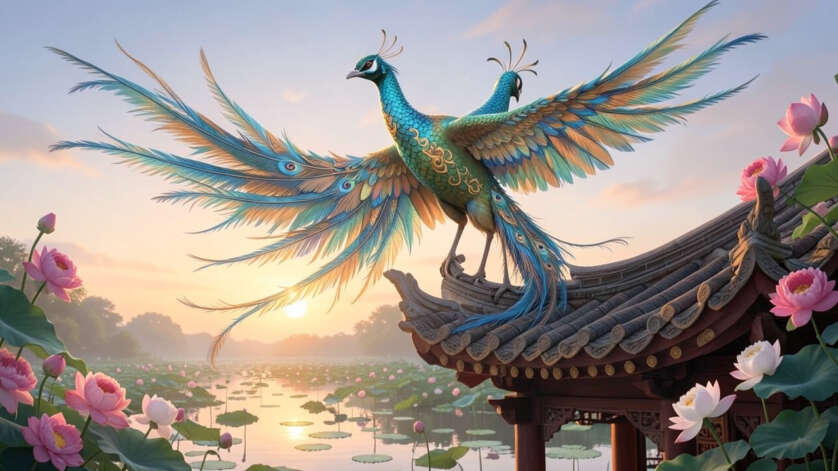
The depiction of the Fenghuang in art is rich with symbolism and follows specific conventions. Artists emphasize its elegant, flowing form, particularly its long, elaborate tail feathers. It is frequently shown in flight or perched among flowering trees, especially the peony, which itself represents wealth and honor.
The pairing of Fenghuang and peonies creates a powerful motif symbolizing “wealth and honor” (fugui).
Common artistic settings include palace walls, temple ceilings, fine porcelain, silk embroidery, and jade carvings. In imperial art, the Fenghuang would often appear alongside the dragon. The dragon, representing the emperor (yang), and the Fenghuang, representing the empress (yin), together symbolize perfect marital harmony and the balance of cosmic forces.
This pairing became a standard decorative theme for wedding attire and furniture.
| Artistic Medium | Typical Fenghuang Imagery | Symbolic Meaning |
|---|---|---|
| Royal Robes | Stylized Fenghuang on Empress’s robes | Feminine virtue, imperial authority |
| Porcelain (Blue & White) | Fenghuang chasing a pearl amidst clouds | Wisdom, spiritual energy, the pursuit of truth |
| Bridal Embroidery | Fenghuang paired with a dragon | Marital harmony, yin-yang balance |
| Jade Carvings | Pendant or sculpture of a Fenghuang | Protection, noble character, auspiciousness |
Tip: When you see a bird with a long, multi-colored tail alongside a dragon in traditional Chinese art, you are almost always looking at the Fenghuang and its symbolic partner.
Why is the Fenghuang Associated with the Empress?
The association of the Fenghuang with the empress is a direct result of its yin symbolism. In traditional Chinese cosmology, the universe is governed by the interplay of yin (feminine, receptive, earthly) and yang (masculine, creative, heavenly). The dragon is the ultimate symbol of yang energy and was exclusively linked to the emperor.
Naturally, the Fenghuang became the emblem of the empress, representing her grace, virtue, and her role as the “mother of the nation.”
This pairing was crucial for expressing the ideal of a balanced court and a harmonious empire. During the Ming and Qing dynasties, this iconography was strictly codified. The empress’s headdress, robes, and palace quarters were adorned with five-clawed Fenghuang motifs.
The number of birds depicted also held meaning; three phoenixes could represent the three sovereigns, while five represented the five elements. Using this symbol without imperial authorization was a serious offense.
- Yin-Yang Complementarity: The Fenghuang (yin) completes the dragon (yang), forming a perfect cosmic pair.
- Source of Virtue: The empress, as the Fenghuang, was the moral and domestic center of the imperial family.
- Symbol of Peace: Just as the Fenghuang appears in times of peace, the empress maintained harmony within the palace.
- Herald of Prosperity: A sighting of the Fenghuang was a good omen for the state, mirroring the empress’s auspicious role.
- Artistic Protocol: Strict rules governed the depiction of Fenghuang on imperial garments and objects.
What Does the Pairing of Dragon and Fenghuang Symbolize?
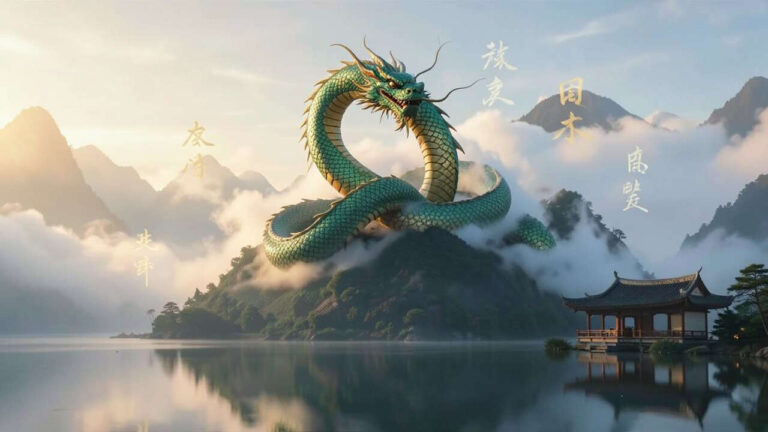
The combined imagery of the dragon (long) and the Fenghuang is one of the most potent symbols in Chinese culture. Together, they represent the ideal state of balance and perfection. The dragon dominates the skies, oceans, and rivers—realm of the heavens and deep power.
The Fenghuang rules the sun, the south, and the terrestrial world of virtue and grace. Their union is the union of heaven and earth, of male and female, of power and beauty.
This symbolism extends far beyond the imperial court. It is a central motif for marriage, signifying a blissful and complementary partnership. Wedding invitations, bed linens, and ceremonial gifts often feature this pairing.
It communicates a wish for the couple to emulate the cosmic balance of the dragon and Fenghuang, achieving mutual respect, prosperity, and a long life together. In modern times, this pairing remains a popular and meaningful decorative theme.
The Dynamic Balance of Yin and Yang
The dragon-Fenghuang pair is a visual textbook for the yin-yang theory. The dragon is active, fierce, and represents the emperor’s earthly mandate. The Fenghuang is serene, elegant, and represents the empress’s nurturing virtue.
One does not exist without the other. This dynamic tension and harmony are believed to be the source of all creation and the foundation of a well-ordered society and family.
Auspicious Meanings for Modern Life
Today, the symbol is invoked for blessings beyond royalty. You will find it on jewelry for newlyweds, in the decor of new homes, and in corporate logos that wish to project an image of prestigious harmony. It carries wishes for a successful marriage, family harmony, and balanced achievement in all endeavors.
Warning: In historical contexts, misusing the imperial dragon and Fenghuang symbols could be interpreted as rebellion or a challenge to the throne. Always consider the historical weight of these images.
How Does the Fenghuang Differ from the Western Phoenix?
While often translated as “phoenix,” the Fenghuang is a fundamentally different creature with distinct cultural roots. The Western phoenix, originating from Egyptian and Greek mythology, is a solitary bird known for its cyclical death and rebirth from fire. Its core theme is immortality, resurrection, and transformation through destruction.
The Fenghuang, however, is a social creature that represents virtue, peace, and earthly harmony.
The Fenghuang is not born from fire but is a celestial being that embodies existing virtues. Its appearance signals a positive state of affairs rather than a renewal from ashes. Furthermore, the Fenghuang is almost always depicted in relation to other entities—the dragon, the peony, the sun—emphasizing its role within a larger system.
The Western phoenix often stands alone as a symbol of individual resilience. Understanding this difference is key to grasping Chinese philosophical concepts.
| Feature | Fenghuang (Chinese) | Phoenix (Western) |
|---|---|---|
| Core Myth | Celestial bird of virtue and peace | Bird reborn from its own ashes |
| Primary Symbol | Grace, virtue, yin, the empress | Resurrection, immortality, the sun |
| Appearance | Composite of many birds, five colors | Eagle-sized, brilliant plumage |
| Context | Paired with dragon, in harmony with nature | Often solitary, a cycle of death/rebirth |
| Message | The world is in balance and at peace | Something can arise from destruction |
What Are Common Variations and Regional Depictions?
While the core symbolism remains consistent, artistic depictions of the Fenghuang vary across China’s vast history and regions. Southern styles might feature more floral elements, integrating the bird with local flora like lotus or plum blossoms. Court art from the Qing dynasty presents a highly formalized and intricate Fenghuang, often with a less naturalistic and more heraldic appearance.
Folk art, used in festivals or home decor, often shows a more vibrant and less rigid bird, emphasizing joy and celebration.
In Chinese minority cultures, similar bird symbols exist but may carry local mythological meanings. For example, the Miao people have rich bird symbolism in their embroidery, which may share aesthetic similarities with Fenghuang motifs. These variations highlight how a central symbol can be adapted while retaining its core auspicious nature.
The common thread is always beauty, grace, and positive energy.
Important: The “feng” in Fenghuang translates to “male phoenix,” but the creature itself is considered the yin counterpart to the dragon’s yang. The naming can be confusing in direct translation.
How is the Fenghuang Used in Modern Contexts?
The legacy of the Fenghuang thrives in modern Chinese culture. It remains a premier symbol for weddings and engagements, appearing on invitations, decorations, and gifts to bless the couple with harmony. In business, it signifies an enterprise that is both prosperous and operated with integrity.
You might see it in the names of hotels, restaurants, or brands wishing to convey a sense of prestigious heritage and grace.
The symbol has also permeated global popular culture, appearing in fantasy games, movies, and literature that draw from East Asian mythology. For the global audience, it offers a visually stunning alternative to Western mythical creatures. Within China, it is a source of national cultural pride, appearing in ceremonies for the Olympics or World Expo pavilions as an emblem of a rich, enduring civilization.
Its use ensures that ancient philosophy remains a visible part of contemporary life.
The Fenghuang in Contemporary Design and Branding
- Corporate Identity: Companies use it to suggest balance, ethical practice, and long-term vision.
- Fashion and Jewelry: Designs incorporate the motif for elegance and cultural significance.
- Tattoos and Body Art: It is a popular choice for those wishing to express virtue, rebirth (in a cultural sense), or yin-yang balance.
- Home Decor: Paintings, vases, and carvings of Fenghuang are used to invite good fortune and marital bliss.
- Cultural Events: It features prominently in parades, dance performances, and New Year celebrations.
Frequently Asked Questions
Is the Fenghuang male or female?
The name “Fenghuang” is composed of “feng” (male phoenix) and “huang” (female phoenix). Originally, the Fenghuang was a single creature, but over time the name came to denote the pair. In symbolic use, the Fenghuang as a whole represents the yin principle and is the empress’s symbol.
When paired with the dragon, it specifically embodies the feminine half.
Can you find real Fenghuang in Chinese folklore?
No, the Fenghuang is a mythical creature, not based on any real animal. Its composite nature is a deliberate artistic and philosophical choice. Historical texts claim sightings as auspicious omens for a wise ruler, but these are legend, not natural history.
The bird is a cultural and spiritual symbol, not a zoological one.
What is the difference between the Fenghuang and a regular bird in Chinese art?
A regular bird, like a crane or magpie, has specific symbolism (longevity, happiness). The Fenghuang is distinguished by its composite features, five-colored plumage, and elaborate tail feathers. Its scale and prominence in a composition, often paired with a dragon or imperial motifs, immediately signal its status as a sacred, imperial symbol, not a common bird.
Why is the Fenghuang associated with the sun and fire?
This association comes from ancient Chinese cosmology. The Fenghuang is linked to the south, summer, and the yang element, all of which are associated with fire and the sun. It is said to live in the sun and fly to the heavens at dawn.
This connection reinforces its role as a bringer of light, virtue, and positive yang energy.
Is the Fenghuang used only for imperial or wedding symbolism?
No, while those are primary uses, the Fenghuang has broader meanings. It symbolizes peace, prosperity, and virtue in general. It can appear in art depicting a golden age, in temples to represent celestial grace, and in modern branding to convey ethical excellence.
Its versatility comes from its core association with balance and high moral character.
Final Thoughts
The Fenghuang is a profound emblem of grace, virtue, and cosmic harmony in Chinese culture. Far more than a simple bird, it represents the ideal of a balanced world, most powerfully through its partnership with the dragon. From imperial robes to modern wedding gifts, its image carries centuries of meaning.
The next time you see this majestic, multi-colored bird in art, you’ll recognize it as a timeless symbol of peace, prosperity, and the elegant balance of all things.